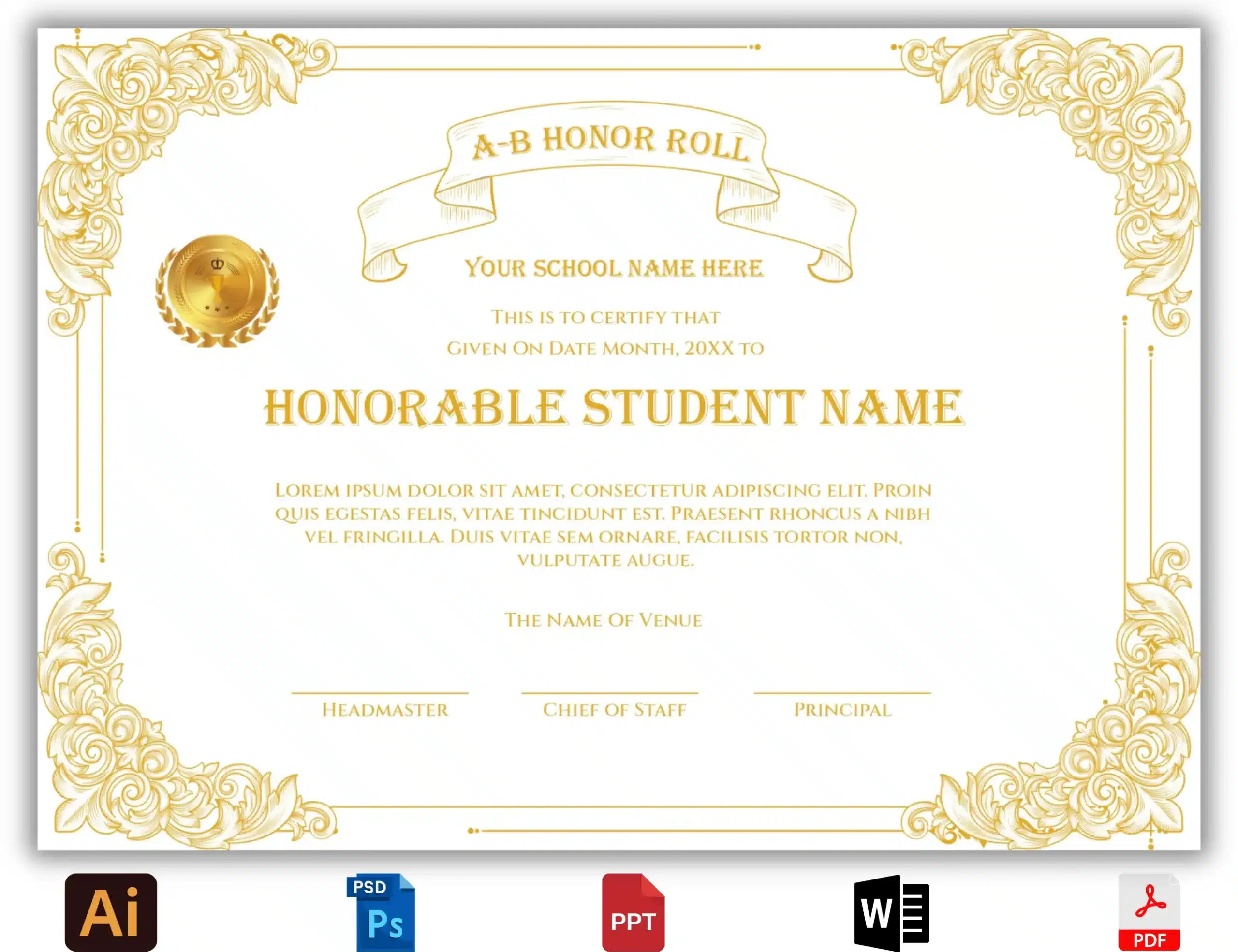
It's school award season. You’re sitting in a crowded gymnasium, the air smells like floor wax and nervous energy, and the principal starts calling names. For many kids, the goal isn’t necessarily the "Straight A" plaque. It’s that crisp, cardstock AB honor roll certificate that signifies they’ve put in the work. It’s a middle ground. It’s a badge of consistency. Honestly, it’s probably the most relatable academic achievement because it acknowledges that life happens—sometimes you ace the test, and sometimes you barely scrape by with a B because algebra is hard.
But what actually goes into this? It’s more than just a piece of paper with a gold seal.
What an AB Honor Roll Certificate Represents
Most schools define the "AB Honor Roll" as a specific GPA bracket. Usually, we are talking about a $3.5$ to $3.9$ range. If a student gets all As and one B, they’re on it. If they get half As and half Bs, they’re on it. The moment a C+ enters the chat? Everything changes. That’s why this specific certificate is such a motivator for the "average" student who is working their tail off.
It represents a high level of academic rigor without the crushing pressure of perfectionism. Perfection is a heavy weight for a ten-year-old to carry. Or a sixteen-year-old, for that matter.
Research from the American Psychological Association often points toward the "Goldilocks" zone of motivation. If a goal is too easy, kids get bored. If it’s impossible (like maintaining a 100% average in every subject), they give up. The AB honor roll certificate sits right in that sweet spot. It tells a student, "Hey, you're doing great. You're above average. Keep going."
The Criteria for Earning the Award
Usually, the rules are pretty rigid. Most school districts in the U.S., like those in Fairfax County or Miami-Dade, use a weighted or unweighted scale to determine eligibility.
- Grade Requirements: Only grades of A or B are allowed. Even one C usually disqualifies the student.
- Weighted vs. Unweighted: In high school, an A in an AP class might count as a 5.0, making the AB honor roll easier to hit even with a B in another class.
- Subject Consistency: Some schools require these grades in core subjects (Math, Science, English, Social Studies), while others include "specials" like PE or Art.
You've probably noticed that some parents get more excited about this than the kids do. There's a reason for that. It’s a tangible metric of effort. It’s something to stick on the fridge. It’s a physical artifact of a semester where the kid actually turned in their homework on time.
Why Some Educators Critique the System
Not everyone loves these certificates. Alfie Kohn, a well-known critic of "carrots and sticks" in education, has argued for decades that extrinsic rewards—like a printed certificate—can actually kill a student's intrinsic desire to learn. The argument is basically that if you’re only studying to get the paper, you aren’t studying because you care about the history of the Industrial Revolution.
There's also the "C-student" problem. If a kid works twice as hard as an "A-student" but ends up with a C, they get nothing. No ceremony. No certificate. That can be crushing.
The Psychological Boost
On the flip side, for many students, especially those from underserved communities or those struggling with learning disabilities, an AB honor roll certificate is a massive win. It’s validation. According to the National Association of School Psychologists, positive reinforcement plays a massive role in building self-efficacy.
Self-efficacy is basically a kid’s belief that they can do the thing. When they hold that certificate, they think, "Okay, I'm a person who succeeds at school." That identity shift is worth way more than the paper itself.
The "Design" of a Good Certificate
If you're a teacher or a PTA member reading this, please, don't just use a generic Word doc with Comic Sans. The aesthetics matter. If it looks like a receipt from a grocery store, the kid won't care.
High-quality certificates usually feature:
- A Formal Border: Think classic scrolls or geometric patterns.
- Heavyweight Paper: 65lb to 80lb cardstock is the gold standard.
- The Gold Foil Seal: It’s a cliché because it works. It feels "official."
- Specific Signatures: Having the principal and the teacher actually sign it (not a digital stamp) makes a huge difference in how the student perceives the value.
How to Support a Student Who Missed the Cut
It happens. A kid works hard, gets a 79% in Chemistry, and suddenly they are off the list. It’s a "B-minus" world for them.
First, validate the effort. Grades are a snapshot of performance, not a measurement of worth. You've gotta make sure they know that. Second, look at the "why." Was it a lack of study time? Or was the material just legitimately over their head?
Sometimes, missing out on the AB honor roll certificate is the wake-up call a student needs to ask for a tutor or to start using a planner. It’s a pivot point.
Actionable Steps for Parents and Teachers
If you want to use honor roll certificates effectively, you can't just hand them out and walk away. You need a strategy to make them meaningful.
For Teachers:
- Personalize the Handout: When you give the AB honor roll certificate to the student, mention one specific thing they did well. "Your essay on the Great Gatsby was what pushed you over the edge into that A range."
- Host a "Growth" Award Too: Create a separate certificate for students who improved their GPA by 0.5 points, even if they didn't hit the AB mark. This catches the kids who are working the hardest.
- Digital Copies for Parents: Send a high-res PDF. Parents love to post these on social media, and that public "good job" reinforces the behavior for the student.
For Parents:
- The Fridge Rule: Display the certificate. It sounds old-school, but it shows that you value their academic progress as much as their sports trophies.
- Avoid Monetary Rewards: Instead of "Here is $20 for your certificate," try "Let's go get your favorite dinner to celebrate your hard work." Focus on the celebration of the effort, not the "buying" of the grade.
- Discuss the "B": If they got a B, talk about it. Is it a B they are proud of because the class was grueling? Or a B they got because they coasted? Understanding the nuance helps them set better goals for the next term.
For Students:
- Keep a Portfolio: Save these. When you apply for your first job or a scholarship in a few years, having a folder full of academic recognitions helps you write your resume.
- Identify Your "B" Subjects: Look at where you fell short of an A. If it’s a subject you actually like, maybe it’s time to change your study habits for that specific class.
The AB honor roll certificate is a milestone. It’s a middle-of-the-road victory that proves a student is capable, consistent, and competitive. Whether it’s printed on fancy vellum or standard printer paper, the message is the same: the work was seen, and the work mattered.
Don't let the quest for the "Perfect A" overshadow the "Solid B." In the real world, being a "B" student who shows up, works hard, and stays consistent is often the secret to long-term success.
How to Create Your Own Certificate (Real-World Specs)
If you are tasked with making these for a school or homeschool co-op, follow these technical specs to make them look professional. Use a layout program like Canva or Adobe Express, but stick to these rules:
- Dimensions: Standard 8.5" x 11" (Letter).
- Margins: At least 1-inch margins on all sides to allow for framing.
- Typography: Use a "Serif" font for the student's name (like Times New Roman or Garamond) and a "Sans-Serif" font for the body text (like Arial or Helvetica). This contrast looks modern yet traditional.
- Color Palette: Stick to Navy Blue, Burgundy, or Forest Green. These colors are psychologically associated with authority and tradition.
By focusing on the quality of the recognition, you ensure the AB honor roll certificate remains a coveted prize rather than just another piece of paper that ends up in the recycling bin.