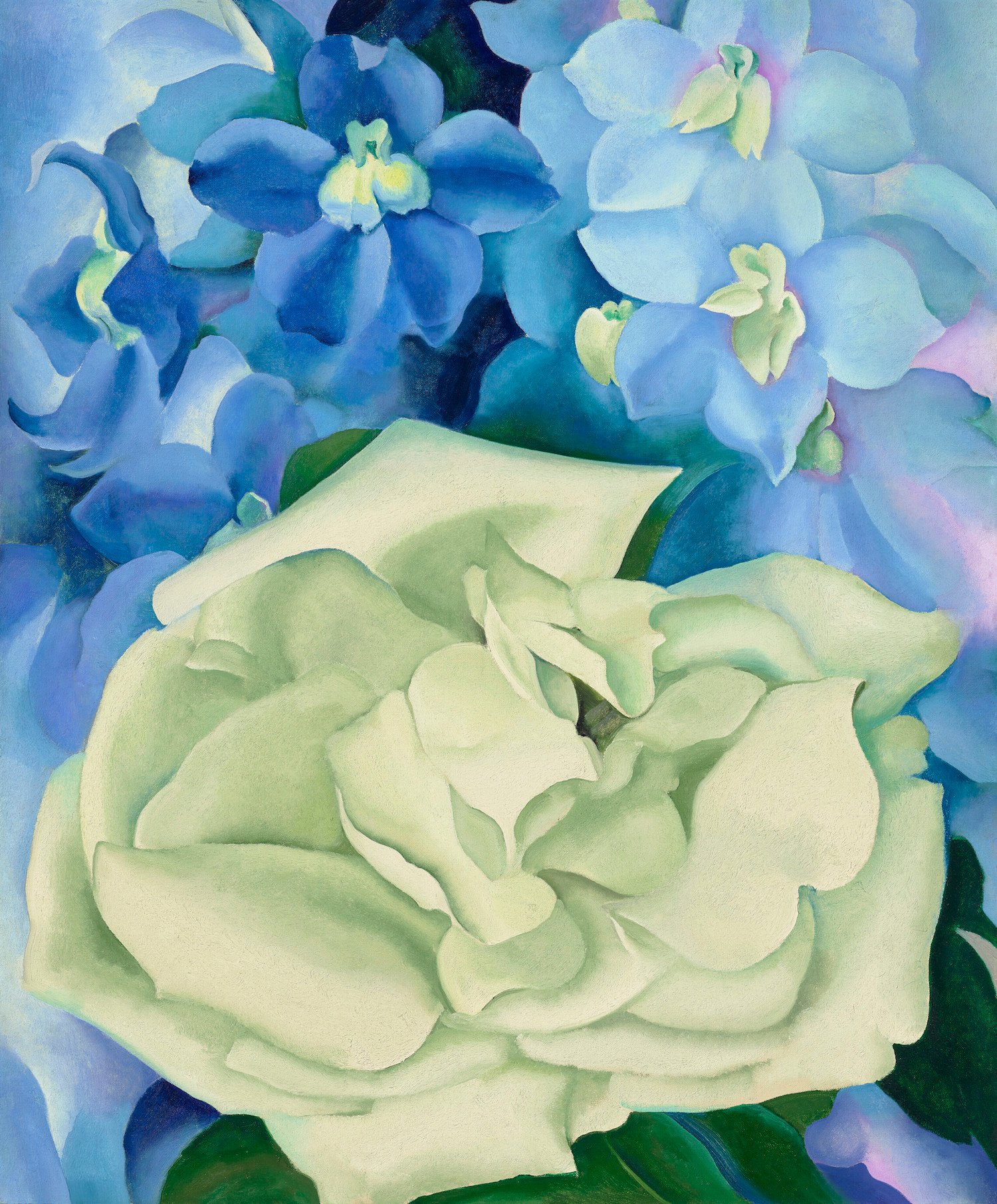
You’ve seen the flowers. Everyone has. Those massive, pulsating blooms that feel like they’re breathing right off the museum wall. But honestly, if you think that’s all she did, you’re missing the actual soul of her work. Georgia O'Keeffe wasn't just "the flower lady." She was a pioneer of American Modernism who spent seven decades redefining how we look at the world, from the vertical steel of Manhattan to the sun-bleached pelvis bones of New Mexico.
The truth is, a georgia o'keeffe paintings list is a massive undertaking because she produced over 2,000 works. It’s not just about the "hits." It’s about the evolution of a woman who decided that if she couldn't paint like the men, she’d paint like no one else had ever dared to.
The Early Years: Charcoals and "Specials"
Before the oil paint, there was the charcoal. In 1915, O'Keeffe had a bit of a crisis. She felt her work looked too much like her teachers', so she basically threw it all away and started over with nothing but black and white.
- No. 12 Special (1916): This is where it started. Swirls, lines, and total abstraction. It’s raw.
- Blue #2 (1916): A watercolor that feels like a song.
- Evening Star No. III (1917): One of her most famous early watercolors. The colors bleed into each other in a way that feels incredibly modern even today.
She sent these to a friend in New York, who showed them to the legendary photographer Alfred Stieglitz. He reportedly said, "Finally, a woman on paper." Kinda dramatic, but he wasn't wrong.
The Skyscrapers: Manhattan in the 1920s
A lot of people forget she lived in New York for years. She lived on the 30th floor of the Shelton Hotel, looking down at the city. While her contemporaries were painting the grit and the noise, she was painting the geometry and the light.
- City Night (1926): Look at the scale. The buildings loom over you like giants. It’s claustrophobic but beautiful.
- Radiator Building – Night, New York (1927): This is basically a portrait of the city’s energy. The red glow and the pinpricks of light—it’s iconic.
- The Shelton with Sunspots (1926): She captures the way the sun hits the steel and creates those weird lens flares we usually associate with cameras, not paintbrushes.
The Big Flowers: Why She Scaled Up
"Nobody really sees a flower—really—it is so small—we haven't time," she once said. So she painted them big. She wanted to surprise people into actually looking.
Jimson Weed (1932) is probably the one you know. It sold for $44.4 million in 2014, which is still a record for a female artist. But look closer at Black Iris III (1926) or Oriental Poppies (1928). These aren't just botanical studies. They are deep, architectural explorations of color. People love to project "hidden meanings" onto these (usually sexual), but O'Keeffe always rolled her eyes at that. She just liked the shapes. Honestly.
The New Mexico Shift: Bones and Badlands
In 1929, she went to New Mexico and basically never looked back. The desert changed her palette. The lush greens of Lake George were replaced by "the far away," a landscape of ochre, red, and dust.
The Bone Series
She started picking up bones because there were no flowers in the desert.
- Cow's Skull: Red, White, and Blue (1931): Her way of making a "Great American Painting."
- Ram's Head White Hollyhock and Little Hills (1935): A surreal mashup of life and death.
- Pelvis with the Distance (1943): She would hold the bones up to the sky and paint the blue through the holes.
The Landscapes
- Black Mesa Landscape, New Mexico (1930): The hills look like they’re made of velvet.
- Red Hills with the Pedernal (1936): She painted that mountain (the Pedernal) so many times she joked that God told her if she painted it enough, He’d give it to her.
The Late Career: Above the Clouds
Even when her eyesight started failing in her 70s and 80s, she didn't stop. She took her first airplane trips and was obsessed with the view from the window.
She produced the Sky Above Clouds IV (1965), a massive 24-foot-long canvas. It’s a field of white clouds stretching to the horizon. It’s peaceful. It’s the work of someone who had seen everything and was still looking for more.
What a Georgia O'Keeffe Paintings List Teaches Us
If you’re looking to truly understand her, you can’t just stick to the postcards. You have to see the transition from the charcoal "Specials" to the hard-edged "Patio Door" series of the 1950s. She was always stripping things down to their simplest form.
Where to see them in 2026:
- The Georgia O'Keeffe Museum (Santa Fe, NM): The motherlode. They have a new interactive timeline that’s pretty incredible for researchers.
- MoMA (New York): Home to some of the best early abstractions.
- The Art Institute of Chicago: They have Sky Above Clouds IV. Seeing it in person is a religious experience, basically.
Actionable Next Steps:
- Visit the Georgia O'Keeffe Museum’s digital "Collections Online." They recently updated their database to include over 2,000 items, including sketches and personal photographs. It’s the most complete georgia o'keeffe paintings list available.
- Compare her "Lake George" work with her "New Mexico" work side-by-side. Notice the shift in how she handles light; the New York light is diffused and soft, while the New Mexico light is sharp and unforgiving.
- Look for a local exhibit. In 2026, several traveling retrospectives are focusing on her "lesser-known" works, specifically her Hawaiian pineapple paintings from 1939. These are often left off the standard lists but show a totally different side of her talent.