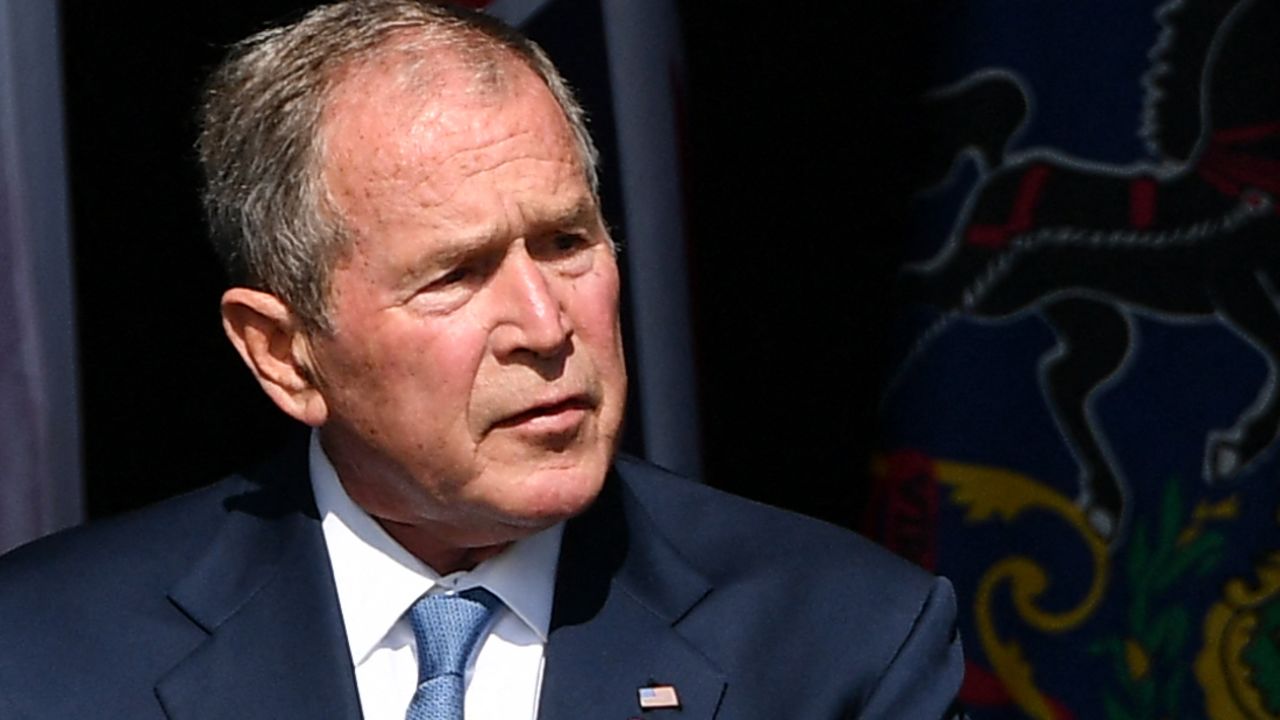
He was holding a children’s book called The Turtle. That’s the image most people have burned into their brains when they think about George W. Bush and 9/11. He’s sitting in a classroom in Sarasota, Florida, looking totally stunned after Andy Card whispered in his ear that a second plane hit the Twin Towers. Honestly, that moment defined his entire presidency. It wasn't just a bad day at the office; it was the second that the 21st century actually started.
Most folks remember the bullhorn at Ground Zero or the "Mission Accomplished" banner later on, but the reality of how the Bush administration handled those first 24 hours is way more chaotic than the polished history books let on. It was a mess of scrambled fighter jets, failed communications, and a president who was basically a nomad in the sky because the Secret Service was convinced Air Force One was a target.
The Morning Everything Broke
When the first plane hit, the initial thought wasn’t "terrorism." Even the President's staff thought it was a horrible accident involving a small prop plane. Then the second one hit. That’s when the world shifted. You’ve probably seen the footage of Bush staying in that classroom for about seven minutes after being told "America is under attack." People criticize him for that, saying he looked like a deer in headlights. But if you look at the Secret Service logs and internal memos from the 9/11 Commission, his lead agent, Dave Wilkinson, actually told him to stay put until they could secure a perimeter.
Bush later told the commission he didn't want to spook the kids. He wanted to project a sense of "calm." Whether you buy that or not, the machinery of the federal government was already grinding into gear behind him.
The communication that day was garbage. Seriously.
Air Force One had terrible satellite links. The President couldn't get a clear line to the Pentagon for a good chunk of the morning. While the world was watching the towers fall, the Commander in Chief was flying over the Gulf of Mexico, arguing with his security detail. They wanted him to go to an underground bunker in Nebraska. He wanted to go back to D.C. Security won.
The Scramble Over Washington
While Bush was in the air, Dick Cheney was in the Presidential Emergency Operations Center (PEOC). This is where things get legally murky. Cheney authorized the military to shoot down any civilian aircraft that didn't respond to radio calls. That is a massive, heavy decision. Usually, only the President makes that call.
Bush eventually gave the "okay" over a crackly phone line, but there was a period of about 20 minutes where the Vice President was essentially running the show. There’s a lot of debate among historians like Philip Zelikow—who led the 9/11 Commission—about exactly when that authorization happened. It highlights just how frayed the chain of command was in those first two hours.
Why 9/11 George W. Bush Decisions Still Matter Today
The immediate aftermath wasn't just about grief. It was about a total pivot in American foreign policy. Before the attacks, Bush was focused on domestic issues like education (hence the Florida school visit) and a sort of "humble" foreign policy. 9/11 killed that.
The "Bush Doctrine" was born in the smoke of the World Trade Center. Basically, it meant the U.S. would treat those who harbor terrorists the same as the terrorists themselves. This led directly to Afghanistan and, eventually, the much more controversial invasion of Iraq.
- The Patriot Act: This moved through Congress at lighting speed. It changed how the NSA and FBI look at your data.
- The Department of Homeland Security: A massive bureaucratic overhaul that we just take for granted now.
- The Authorization for Use of Military Force (AUMF): This legal document is still used today to justify drone strikes and special ops missions in countries we aren't even technically at war with.
It’s easy to forget how much the atmosphere changed. Bush’s approval rating hit 90%. People were flying flags on their cars. He had the kind of political capital no president has seen since, and he used every bit of it to reshuffle the global deck.
The Bullhorn Moment and the Shift in Tone
Three days after the attacks, Bush stood on a pile of rubble at Ground Zero. A worker shouted that they couldn't hear him. Bush grabbed a bullhorn and said, "I can hear you! The rest of the world hears you! And the people who knocked these buildings down will hear all of us soon!"
That was the peak. Honestly, if you look at the polling, that was the moment he transitioned from a "disputed" president (remember the 2000 election mess?) to a wartime leader. But it also set a tone of "us versus them" that some critics argue fueled the Islamophobia that spiked in the early 2000s. To his credit, Bush went to a mosque shortly after 9/11 to say "Islam is peace," but the gears of war were already turning too fast to stop.
The Intelligence Failures
We have to talk about the PDB—the President’s Daily Brief. On August 6, 2001, Bush received a memo titled "Bin Ladin Determined to Strike in US."
Critics say this was a "smoking gun" that he ignored. The administration’s defense was that the report was "historical" and didn't have specific dates or locations. Condoleezza Rice, the National Security Advisor at the time, argued that they were looking for overseas threats, not someone flying a plane into a skyscraper in Manhattan.
The reality is likely somewhere in the middle. The FBI and CIA weren't talking to each other. Information was siloed. Bush was the guy at the top of a broken system, and while he didn't "cause" the failure, he was the one who had to answer for why the dots weren't connected. The 9/11 Commission Report eventually laid this out in grueling detail—500+ pages of "oops" and "we should have known."
Misconceptions About the Day
There are so many weird myths about George W. Bush and 9/11. No, he wasn't in on it. No, the Secret Service didn't whisk him away to hide because they were cowards; they did it because the continuity of government protocols are incredibly rigid.
One thing people get wrong is the "flight of the Saudis." There’s a popular theory that Bush personally authorized a private jet to fly members of the Bin Laden family out of the country while all other planes were grounded. The 9/11 Commission actually looked into this. They found that while Saudi nationals did leave the U.S., it happened after the airspace was reopened, and they were screened by the FBI. It wasn't some secret midnight escape, though the optics were definitely terrible.
What This Means for Us Now
Looking back from 2026, the era of 9/11 feels like a different world, but we are still living in the house that George W. Bush built. The TSA lines at the airport? That's 9/11. The way the President can order a strike without a formal declaration of war? That's 9/11.
The most important takeaway isn't just about one man. It’s about how a single event can cause a democracy to trade a whole lot of liberty for the promise of security. Bush believed he was doing the right thing to prevent another attack. Whether the trade-off was worth it is something historians are still fighting over.
Actionable Insights for Researching This Era
If you're trying to get the full picture of this period, don't just rely on Wikipedia. There are better ways to see the raw data.
- Read the 9/11 Commission Report Executive Summary: It’s surprisingly readable. It explains the "lack of imagination" that led to the attacks.
- Watch the "National Archives" Oral Histories: They have interviews with the people who were actually on Air Force One that day. The fear in their voices is palpable.
- Check the FOIA Electronic Reading Room: The CIA and FBI have declassified thousands of documents related to the 2001 intelligence briefings.
- Compare the rhetoric: Look at Bush's speech on the night of 9/11 versus his State of the Union in 2002. You can see the shift from "national mourning" to "global crusade" happening in real-time.
The legacy of George W. Bush is inseparable from those four planes. He went from being a Texas governor who wanted to fix schools to a president who redefined the American empire. Whether you view him as a hero who stepped up or a leader who overreached, you can't understand modern America without understanding those 24 hours in September.
To really grasp the weight of these events, start by looking into the "Continuity of Government" protocols. It explains why the federal government reacted the way it did during the vacuum of the first few hours. Understanding those systems helps separate the conspiracy theories from the actual procedural failures that happened that Tuesday morning.