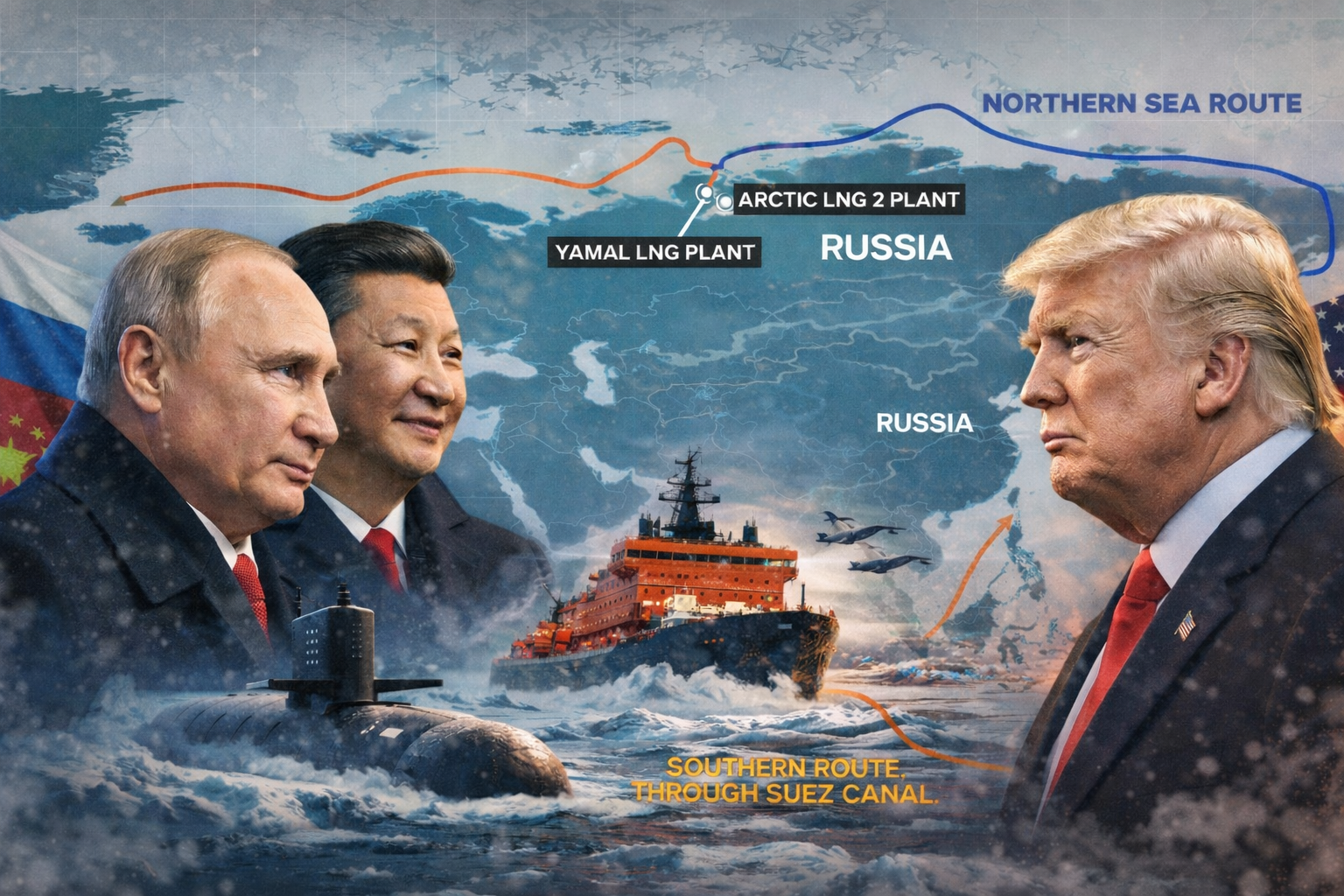
The traditional dominance of the United States over global trade depends on the control of "choke points"—specifically the Suez Canal, the Panama Canal, and the Malacca Strait—and the naval capacity to enforce freedom of navigation within these corridors. This maritime architecture is currently facing a structural challenge through the development of the Northern Sea Route (NSR). By integrating nuclear-powered icebreaking technology with strategic undersea asset deployment, a Russo-Chinese partnership is attempting to bypass the US-controlled blue-water geography, effectively creating a "closed-loop" logistics system that operates outside the reach of Western sanctions and naval interdiction.
The Physical Constraints of Arctic Logistics
The NSR reduces the shipping distance between East Asia and Northern Europe by approximately 40% compared to the Suez Canal route. However, distance is a deceptive metric. The actual viability of the NSR is dictated by three technical variables: ice thickness, navigational seasonality, and the requirement for nuclear propulsion.
Conventional diesel-electric icebreakers face a fuel-density bottleneck. To break through multi-year ice that exceeds three meters in thickness, an engine requires immense, sustained power. Diesel ships must devote a significant portion of their hull volume to fuel storage, which reduces cargo capacity and requires frequent refueling stops in a region with virtually zero infrastructure.
Nuclear propulsion solves this by providing near-limitless energy density. A nuclear icebreaker, such as Russia’s Project 22220 (Arktika-class), can operate for years without refueling, maintaining the steady thermal and mechanical output necessary to keep shipping lanes open even during the depths of the Arctic winter. This is not merely a transport capability; it is a territorial assertion. By maintaining a fleet of nuclear icebreakers, a state converts a seasonal waterway into a permanent, sovereign industrial corridor.
The Strategic Asymmetry of Icebreaker Tonnage
The United States currently operates a negligible fleet of heavy icebreakers, primarily under the jurisdiction of the Coast Guard rather than the Navy. This creates a "capability gap" that is difficult to close quickly due to the specialized nature of Arctic shipbuilding.
Russia’s "Icebreaker Bastion" strategy relies on:
- Project 22220 Vessels: Utilizing RITM-200 reactors to provide 60 megawatts of power to the propellers, allowing them to traverse ice up to 3 meters thick at a continuous speed.
- The Leader-class (Project 10510): Currently under construction, these vessels are designed to provide 120 megawatts of power, intended to facilitate year-round transit for the heaviest Liquefied Natural Gas (LNG) tankers.
- The Integration of Civilian and Military Utility: These ships serve as the primary escort for Yamal LNG exports, but they also ensure that the Northern Fleet’s nuclear-powered ballistic missile submarines (SSBNs) can be deployed under the ice cap, where they are shielded from US aerial and satellite surveillance.
China’s role in this framework is primarily financial and technological. Lacking Arctic territory, Beijing has designated itself a "Near-Arctic State." By investing in Russian energy projects and co-developing "Polar Silk Road" infrastructure, China secures a hedge against the "Malacca Dilemma"—the risk that the US Navy could blockade the narrow Malacca Strait during a conflict, cutting off 80% of China’s oil imports.
The Undersea Domain and Submarine Proliferation
While icebreakers clear the surface, the sub-surface layer represents the "hard power" component of this shift. The deployment of the Borei-class and Yasen-class nuclear submarines represents a qualitative leap in stealth and strike capability.
The Arctic environment provides a unique acoustic advantage. The ambient noise of shifting ice and the complex thermocline layers make passive sonar detection significantly more difficult than in the open Atlantic or Pacific. This allows for the creation of "bastions"—protected maritime zones where SSBNs can sit in high-readiness states.
The threat to US trade isn't just the bypass of the Suez Canal; it is the vulnerability of the undersea cable network. Over 95% of global data and trillions of dollars in daily financial transactions travel via fiber-optic cables on the ocean floor. The Russian GUGI (Main Directorate of Deep-Sea Research) operates specialized mother-ships and midget submarines designed for deep-sea operations. The ability to intercept, tap, or sever these cables in the Arctic or North Atlantic gives a competitor the power to induce a systemic collapse of the Western financial grid without firing a conventional shot.
The Economic Logic of Sovereign Shipping
To understand why this shatters the "US hold on global trade," one must look at the insurance and legal frameworks of international shipping. Most global shipping is governed by the UN Convention on the Law of the Sea (UNCLOS) and insured through London-based syndicates.
Russia claims the NSR as "internal waters," a legal designation that allows them to mandate the use of Russian pilots, Russian icebreaker escorts, and Russian-regulated insurance. By forcing international transit through a domestic regulatory framework:
- Sanction Immunity: Transactions for transit fees and fuel can be conducted in non-dollar currencies (Yen, Ruble, or digital assets), bypassing the SWIFT system.
- Logistical Certainty: While the Suez Canal is prone to physical blockage (as seen with the Ever Given) and geopolitical instability (Houthi strikes in the Red Sea), the NSR is controlled by a single sovereign entity capable of guaranteeing security through icebreaker escorts.
- Resource Monopolization: The NSR is the primary export route for the Arctic’s massive nickel, palladium, and LNG reserves. Control of the route equals control over the price and availability of these critical industrial inputs.
The Technical Bottlenecks of the Arctic Pivot
Despite the strategic momentum, three primary bottlenecks prevent the NSR from immediately replacing traditional routes.
1. The Containerization Deficit
Most global trade relies on "Just-in-Time" (JIT) logistics. Container ships require predictable schedules. The Arctic, even with nuclear icebreakers, remains unpredictable due to extreme weather and shifting ice floes. Furthermore, the NSR lacks "transshipment hubs"—large-scale ports where containers can be sorted and moved to smaller feeder ships. Until Murmansk or Petropavlovsk are developed into world-class container ports, the NSR will remain primarily a bulk commodity route (LNG, oil, minerals) rather than a consumer goods route.
2. The Insurance Vacuum
Western insurers are hesitant to cover Arctic transits due to the lack of search-and-rescue infrastructure and the catastrophic environmental costs of a spill in icy waters. Russia and China must therefore build a parallel insurance industry, backed by sovereign wealth funds, to absorb the risk that Lloyd’s of London refuses to touch.
3. The Depth Constraints
Sections of the NSR, particularly the Sannikov Strait, have depth limitations (approx. 13-15 meters). This prevents "Ultra Large Crude Carriers" (ULCCs) from traversing the route fully loaded. This necessitates the construction of specialized, shallow-draft "Arctic-class" tankers, which are significantly more expensive to build and operate than standard hulls.
The Strategic Realignment of Global Tonnage
The US response has traditionally focused on "Freedom of Navigation Operations" (FONOPs). However, FONOPs are ineffective against a competitor that is building physical infrastructure. You cannot "patrol" a route that is frozen over unless you have the icebreaking tonnage to match the competitor.
The current trajectory suggests a bifurcation of global maritime trade:
- The Blue Water System: Managed by the US, utilizing the existing canal and strait network, governed by UNCLOS and the US Dollar.
- The White Water System: Managed by a Russo-Chinese partnership, utilizing the NSR, governed by bilateral agreements and the Chinese Yuan, and secured by nuclear-powered surface and sub-surface assets.
This "White Water" system creates a strategic sanctuary. It allows Russia to monetize its vast northern resource base and provides China with a "backdoor" to Europe that the US Navy cannot easily shut. The shift is not about "shattering" trade in a single event, but about the steady migration of volume to a geography where the US has no structural leverage.
The operational priority for Western planners must shift from traditional naval presence to the rapid development of "Arctic-hardened" logistical assets. This includes the deployment of persistent undersea sensor arrays to monitor the "bastions" and the accelerated procurement of heavy polar security cutters. Without a physical capacity to operate in the high north, the West cedes the regulatory and economic standards of the next century's most critical trade corridor. The struggle for global trade is moving from the tropical chokepoints to the polar extremes, where the primary currency of power is no longer just the carrier strike group, but the megawattage of a nuclear reactor crushing through the ice.


