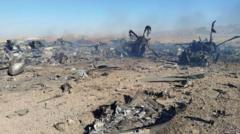
The successful recovery of a downed American airman from the rugged, hostile terrain of the Iranian interior represents more than a logistical triumph. It is a stark reminder that the United States maintains a persistent, invisible presence in some of the most defended airspace on the planet. This mission did not succeed because of luck or a sudden gap in Iranian radar coverage. It succeeded because of a multi-layered architecture of stealth assets, electronic warfare, and a cold-blooded calculation of risk that pushed the limits of what special operations forces can achieve in a non-permissive environment.
When an aircraft goes down in enemy territory, the clock is the primary adversary. In this instance, the pilot managed to eject and find a defensible position within a remote mountain range, but the geographic isolation was a double-edged sword. While it provided initial cover, it also meant any rescue force would have to penetrate deep into a sovereign nation equipped with sophisticated surface-to-air missile systems. The decision to launch the rescue was not made in a vacuum; it was the result of a high-stakes gamble that a rapid, overwhelming force could slip in and out before a centralized military response could mobilize.
The Invisible Corridor
The mechanical failure or tactical incident that forced the airman to eject was only the beginning. The real story lies in the "invisible corridor" created by U.S. Cyber Command and the Air Force’s electronic warfare wings. To get a rescue helicopter—likely an MH-60M Black Hawk or a CV-22B Osprey—into Iranian airspace, the military had to do more than just fly low. They had to blind the eyes of the Islamic Revolutionary Guard Corps (IRGC).
Sources familiar with such operations suggest that the mission utilized a combination of stand-off jamming from assets outside the borders and localized cyber-intrusions that created "ghost" tracks on Iranian radar screens. This allowed the rescue package to move through the mountains as a digital phantom. If the Iranian radar operators saw anything at all, it was a clutter of false positives or a temporary "dead zone" that looked like a routine equipment glitch rather than a precision strike force.
Stealth as a Baseline
Traditional rescue missions often rely on "brute force" speed. This mission was different. The use of low-observable technology was not an optional add-on; it was the foundation of the entire plan. By utilizing terrain masking—flying in the literal shadows of the mountain peaks—the pilots stayed below the horizon of fixed radar installations. This is a grueling way to fly. It requires night-vision goggles, terrain-following radar, and nerves that don't fray when the cockpit altimeter shows you are only fifty feet above jagged rock in total darkness.
The Human Element in a Tech Driven Rescue
Technology facilitates the entry, but human judgment secures the objective. Once the rescue bird hovered over the extraction point, the mission transitioned from a high-tech shell game to a grit-and-dirt recovery. The Pararescue Jumpers, or PJs, who descended into the site were operating under a "zero-fail" mandate. They had to verify the identity of the survivor, assess medical status, and secure the perimeter in a matter of seconds.
The pilot was not just a passenger; he was a liability until the moment he was strapped into the airframe. In these environments, the fear is never just the military. It is the local population. A shepherd or a local militia scout with a cell phone can compromise a multi-billion dollar operation faster than a radar dish. The team on the ground had to maintain absolute noise discipline while preparing for a hot extraction if things went south.
The Problem of Sovereignty
Every mile flown into Iran was a potential act of war. This is the detail that diplomatic cables will likely gloss over, but it is the central anxiety of the Pentagon. If the helicopter had crashed or been shot down, the United States would have been faced with a hostage crisis that would make the 1979 embassy takeover look like a minor skirmish. The planners knew this. They proceeded anyway, banking on the fact that the Iranian command structure is often slow to react to anomalies in remote regions.
The Geopolitical Fallout
Iran’s silence following the event is as telling as a loud protest. For Tehran to admit that a U.S. rescue team spent significant time on the ground and in their air without being intercepted is a massive embarrassment. It exposes deep cracks in their air defense network, specifically the integration of their Russian-made S-300 systems with domestic radar tech.
A Message to Adversaries
The successful extraction serves a secondary purpose beyond saving a life. It is a demonstration of capability intended for eyes in Beijing and Moscow, not just Tehran. It signals that the "tyranny of distance" is being eroded by advances in refueling and low-observability. If the U.S. can pull a pilot out of the heart of the Zagros Mountains, no "denied area" is truly off-limits.
There is a cold reality to these missions that rarely makes it into the evening news. For every successful "unfolded" rescue, there are a dozen contingency plans that involve leaving the airman behind or launching a full-scale kinetic strike to prevent capture. The airman survived because he followed his SERE (Survival, Evasion, Resistance, and Escape) training to the letter, staying mobile and signal-silent until the recovery window opened.
The Limits of the Machine
Despite the success, we shouldn't view this as a blueprint for every future conflict. The Iranian air defense grid is formidable, but it is not the unified, automated web that a Tier-1 adversary would possess. Against a more integrated defense system, the "blind and fly" strategy would require a much larger footprint, likely involving the total suppression of enemy air defenses (SEAD) and a far greater risk of escalation.
The hardware used in this rescue is aging. The MH-60 and the CV-22 are remarkable machines, but they are increasingly vulnerable to man-portable air-defense systems (MANPADS) that are becoming ubiquitous in gray-zone conflicts. The next generation of combat rescue will likely involve autonomous or semi-autonomous extraction drones—smaller, quieter, and more expendable than a manned helicopter with a crew of five.
Hard Truths of the Long Flight Home
The trip back out was just as dangerous as the trip in. The "adrenaline dump" that occurs after a successful pickup is a known killer in aviation. Pilots have to transition from the high-stakes intensity of the extraction back into the monotonous, high-concentration flight through enemy territory. One mistake, one momentary lapse in altitude control, and the success story becomes a tragedy.
The airman is now back on friendly soil, undergoing the standard post-isolation debriefing. The intelligence gathered from his time on the ground—what he saw, what he heard, and how the IRGC responded to his presence—is often as valuable as the pilot himself. He is a walking data point in a larger game of regional dominance.
The rescue was a masterpiece of coordination, but it also highlights a growing vulnerability. As sensor technology improves, the shadows that the U.S. military hides in are shrinking. The window for these kinds of "invisible" operations is closing, forcing a shift toward even more radical technologies to maintain the same level of reach. For now, the United States has proven it can still reach into the dark and pull its people back, but the cost of that reach is rising every year.
Every successful mission of this scale creates a false sense of security in the public consciousness. We see the happy ending and assume the process is foolproof. It isn't. It is a fragile sequence of events where a single mechanical failure or a lucky shot from a bored insurgent could have changed the course of Middle Eastern history. The real story isn't that they got him out; it's that they were willing to risk everything to prove that they could.