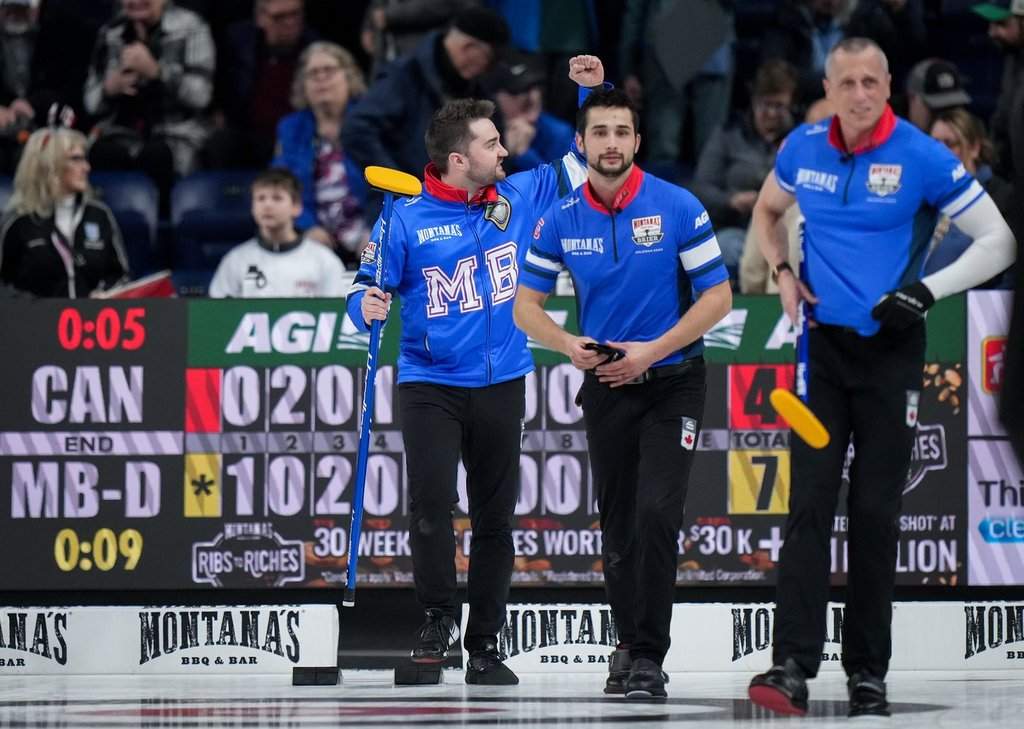
Matt Dunstone and his crew didn’t just leave the Rock League. They exposed the cracks in a system that tries to treat world-class athletes like replaceable cogs in an unproven startup machine.
The mainstream sports desk is currently mourning this as a "loss for the league" or a "scheduling conflict." That is a surface-level reading of a deep structural shift. What we are actually seeing is the birth of the Athlete-Centric Power Play. For decades, curling has been governed by a "just be happy to be here" mentality. Organizations expect top-tier skips to sacrifice their physical longevity and team chemistry for the sake of "growing the game."
Dunstone, B.J. Neufeld, Colton Lott, and Ryan Harnden—along with Olympic vet Matt Tardi—just proved that the game is already grown. It belongs to the players, not the administrators.
The Myth of the Mandatory Startup League
New professional leagues always sell the same dream: "We are changing the sport." In reality, they are often trying to capture the value generated by athletes without offering the stability required to maintain elite performance.
The Rock League is a bold experiment, but the narrative that players are "pulling out" implies a lack of commitment. Let’s correct that immediately. In any other professional sport, if a player identifies a risk to their primary career goals—in this case, the Brier and the Olympic cycle—and pivots, we call it load management. We call it strategic prioritization.
Curling is a game of friction, and I’m not talking about the ice. The friction between a player's limited peak years and a crowded competitive calendar is a zero-sum game. You cannot give 100% to a new, high-intensity league and expect your sliding leg and mental focus to remain pristine for the Grand Slams and national championships. Dunstone’s team looked at the ROI and realized that the "exposure" offered by a fledgling league doesn't pay out in the same currency as a Purple Heart or an Olympic podium.
Why Team Chemistry Beats "All-Star" Drafts
The Rock League operates on a format that often breaks up established teams. This is where the league's logic fails and where Dunstone’s logic shines.
In curling, $\vec{V}$ (velocity) and $\theta$ (line of delivery) are only half the battle. The other half is the unspoken communication between a skip and his sweepers—a language built over thousands of hours. The "lazy consensus" says that fans want to see "super-teams" mashed together in a draft.
I’ve spent years watching teams try to buy chemistry. It doesn't work.
- The Communication Gap: You can’t learn a new sweeper’s weight-call nuances in a weekend.
- The Risk of Injury: Different delivery styles and sweeping positions put different strains on the body. Forcing a pro into a new system for a short-term league is a recipe for a torn labrum.
- The Brand Dilution: Team Dunstone is a brand. Team Gushue is a brand. When you dilute those brands into "Team Blue" or "Team Red" for a televised gimmick, you strip the players of their most valuable asset: their identity.
Dunstone and his teammates are protecting the Team Dunstone equity. They aren't just curlers; they are a small business. Pulling out isn't a retreat; it's a corporate defense maneuver.
Dismantling the "Growth" Fallacy
People ask: "How will curling grow if the stars don't play in new leagues?"
This is the wrong question. The right question is: "Why is the league’s survival dependent on the unpaid or under-compensated risk of the sport's top 1%?"
The Rock League—and any venture like it—must provide a value proposition that outweighs the risk of missing a major. If the stars are leaving, the problem isn't the stars' "commitment." The problem is the league's incentive structure.
When a player like Matt Tardi, who has seen the absolute pinnacle of the sport at the Olympics, decides the juice isn't worth the squeeze, you listen. These aren't rookies looking for a break. These are veterans who know exactly what their time is worth. In my experience, when the highest-performing assets in an industry begin to decline participation in a specific sector, that sector is headed for a correction.
The Calculated Risk of Saying No
There is a massive amount of pressure on curlers to be "ambassadors." They are expected to do every interview, play in every exhibition, and support every new initiative.
But high-performance sport is not a charity.
By withdrawing, this group has set a precedent that will actually help the sport in the long run. They are forcing organizers to realize that:
- Player Health is Non-Negotiable: The schedule is currently a nightmare.
- Contractual Clarity is King: Players need to know that their primary team obligations won't be compromised.
- Financial Upside Must Match Risk: If you want the best, you pay the market rate for the risk of injury.
Imagine a scenario where a top skip plays in an unsanctioned or secondary league, blows out a knee, and misses the Olympic trials. Who pays his salary? Who supports his team? The league? No. He’s on his own. Dunstone is simply refusing to bet his career on someone else’s startup.
The Professionalization Paradox
We want curling to be "professional," yet we get angry when curlers make professional business decisions.
The competitor's article treats this as a roster shuffle. It’s not. It’s a statement of autonomy. The status quo in curling is a paternalistic model where the associations and leagues hold the cards. Dunstone just flipped the table.
This isn't about one league or one weekend in March. This is about the realization that the elite curler is a finite resource. You can’t keep mining that resource without reinvesting in the athlete’s long-term viability.
The Rock League might be a great product, but it isn't the only product. For Matt Dunstone and his teammates, the product is their performance at the highest level of the world stage. Anything that threatens that—be it fatigue, travel, or the mechanical disruption of playing with different teammates—is an obstacle.
They didn't "pull out." They prioritized. And in a sport that is desperate to be taken seriously as a professional endeavor, that is the most professional move they could have made.
Stop asking why they left. Start asking what the league needs to do to be worth their time.
Would you like me to analyze the current WCF schedule to identify where the next major player "pull out" will occur?