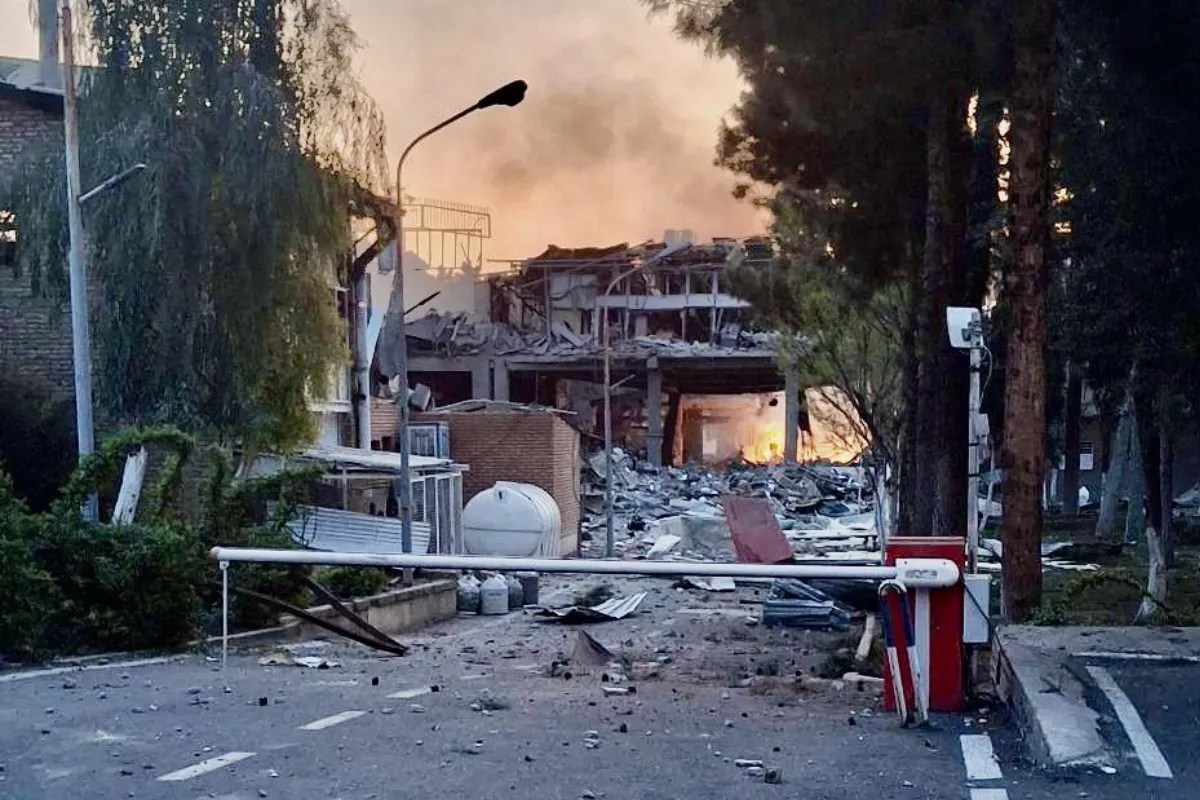
Donald Trump’s recurring threat to bomb Iran into the "stone age" ignores a brutal reality that military planners know all too well. You cannot bomb a highly educated, technologically advanced nation of 90 million people into the primitive past without triggering a global economic collapse. While the rhetoric makes for powerful political theater, the actual execution of such a campaign would require a level of sustained violence that the modern world is entirely unprepared to absorb. China's sharp diplomatic rebuke of this stance is not merely posturing; it is a calculated defense of Beijing's massive energy and infrastructure investments across the Middle East.
The premise that air power alone can dismantle a nation's core identity is a flawed holdover from twentieth-century strategic bombing theories. It did not work in Vietnam. It did not work in Afghanistan. In Iran, a country with vast mountainous terrain and deeply buried nuclear and military facilities, the task is infinitely more complex.
The Illusion of the Clean Strike
Politicians love to talk about surgical strikes. They paint a picture of precision weapons drifting down chimneys to take out bad actors while leaving the surrounding society intact. This is a fantasy.
Iran is not a collection of isolated military camps. Its defense industry, nuclear program, and civil infrastructure are deeply woven into the fabric of its urban centers. To actually degrade Iran to the point of functional paralysis, an attacker would have to destroy the electrical grid, water treatment plants, telecommunications hubs, and transportation networks.
This is where the "stone age" rhetoric meets cold math.
Consider the electrical grid. Iran generates over 85,000 megawatts of power. Disabling that capacity would require targeting hundreds of power stations and substations. Many of these are located near civilian populations. The immediate aftermath would not just be dark homes. It would mean failing hospitals, spoiled food supplies, and the immediate halt of water pumping stations. You do not destroy a government this way; you create a humanitarian catastrophe that breeds generational hostility.
Furthermore, Iran has spent the last two decades preparing for exactly this scenario. They have mastered the art of passive defense.
Key facilities, like the Fordow uranium enrichment plant, are buried deep inside mountains under layers of reinforced concrete and rock. Standard bunker busters struggle to reach these depths. To actually destroy them would require repeated, heavy strikes over days or weeks, effectively turning a "quick strike" into a full-scale war of attrition.
Beijing's Calculated Anger
When China pushes back against Washington's threats toward Tehran, it is not acting out of a sudden burst of altruism. Beijing is protecting its lifeline.
China is the world's largest importer of crude oil, and a massive chunk of that oil flows through the Strait of Hormuz. Iran sits directly on the northern coast of that narrow chokepoint. If a conflict breaks out, the Strait will close. It is not a question of if, but how fast. Iran possesses one of the largest arsenals of anti-ship missiles and fast-attack boats in the world. They do not need to defeat the U.S. Navy to win; they only need to make the passage too dangerous for commercial insurance companies to touch.
Let us look at the economic reality. Roughly 20 percent of the world's petroleum passes through the Strait of Hormuz daily.
If that supply is cut off, oil prices will not just rise. They will explode. Analysts have repeatedly warned that a complete blockage could send oil north of $200 a barrel. For a Chinese economy that is already wrestling with internal property debt and slowing growth, that kind of energy shock is an existential threat.
Beyond oil, China has signed a 25-year strategic cooperation agreement with Iran. This pact involves hundreds of billions of dollars in Chinese investments in Iranian telecommunications, ports, railroads, and healthcare. When American leaders threaten to vaporize Iranian infrastructure, they are threatening to vaporize Chinese capital. Beijing’s furious response is the natural reaction of an investor watching a business partner face arson.
The Retaliation Network
Any strategist who believes Iran will simply sit back and take a beating has ignored the last forty years of Middle Eastern history. Iran's primary defense mechanism is its network of regional proxies. It is an asymmetric warfare masterpiece.
If bombs begin falling on Tehran, the reaction will be instantaneous across multiple borders.
- Lebanon: Hezbollah possesses an estimated 150,000 rockets and missiles aimed at Israeli cities and infrastructure. They can overwhelm the Iron Dome through sheer volume.
- Yemen: The Houthis have already demonstrated their ability to disrupt Red Sea shipping and strike targets deep inside Saudi Arabia with drones and ballistic missiles.
- Iraq and Syria: Dozens of Shiite militia groups stand ready to target American bases and personnel scattered across the region.
This is the fatal flaw in the "stone age" theory. To hit Iran hard enough to neutralize its government, you trigger a regional firestorm that engulfs American allies like Israel, Saudi Arabia, and the United Arab Emirates. The economic damage to the global energy market would be severe, and the military cost would be measured in thousands of lives.
The Technological Resilience Factor
There is another aspect that aggressive rhetoric ignores. Iran is not a pre-industrial society waiting to be dismantled. It is a nation with a highly developed domestic engineering capability.
When the West imposed severe sanctions on Iran's aviation and oil industries, the prediction was that their fleets would fall out of the sky and their refineries would grind to a halt. That did not happen. Instead, Iranian engineers learned to reverse-engineer parts. They developed indigenous drone technologies that are now being used in global conflicts. They built a domestic internet infrastructure designed to withstand external attacks.
You cannot bomb knowledge out of people's heads.
Even if you destroy the physical buildings of the Sharif University of Technology in Tehran, the scientists, engineers, and coders remain. They know how to rebuild. They know how to innovate under duress. Attempting to bomb a country back to a primitive state only works if that country lacks the intellectual capital to reconstruct itself. Iran possesses that capital in spades.
To pretend that a few weeks of heavy bombing would solve the "Iran problem" is the height of strategic naivety. It assumes the enemy will refuse to fight back, that allies will blindly absorb the collateral damage, and that rivals like China will stand by and watch their economic interests turn to ash.
True defense expertise requires looking past the bluster of political campaigns and examining the hard, unforgiving logistics of modern warfare. The cost of trying to break Iran is a price the global economy simply cannot afford to pay.
The next time a politician promises a quick, decisive victory through overwhelming air power, look at a map of the Strait of Hormuz and check the current price of crude oil. The answers to why these threats are empty are written right there.