The steel hull of the tanker groans against the black water of the Mediterranean, a low-frequency vibration that most people on the shore never hear. Deep in its belly, the ship carries a liquid chilled to -162°C. It is a cargo of contradictions. On paper, Europe is severing its ties with the Kremlin, turning its back on the pipelines that once bound the continent to Russian gas. But look closer at the docking manifests in Spain, Belgium, and France. The gas is still flowing. It just changed its state of matter.
Consider a glass-walled office in Brussels where a policy aide watches a flickering screen. On one tab, there are press releases about the "Green Deal" and the phased exit from Russian energy. On the second tab, the raw data shows a different reality: European imports of Russian Liquefied Natural Gas (LNG) have quietly climbed to record highs. This is the friction between political will and the physical need to keep the lights on.
It is a silent surge.
While the Nord Stream pipelines sit silent and rusted at the bottom of the Baltic Sea, the maritime route has become a busy highway. In the first half of 2024, the EU's appetite for Russian LNG didn't just persist—it intensified. We are talking about a 7% increase in volume compared to the previous year. This isn't a rounding error. It is a multi-billion dollar lifeline moving through the ports of Zeebrugge and Bilbao.
The Art of the Blind Eye
The irony is thick enough to choke on. European leaders speak of "de-risking" and "strategic autonomy," yet the logistical reality is a tangled web of long-term contracts signed years before the first tank crossed the Ukrainian border. Breaking these contracts is a legal minefield. If a Spanish utility company simply stops taking the gas, they don't just lose the fuel; they face catastrophic lawsuits and "take-or-pay" penalties that could bankrupt them.
So, the ships keep coming.
Imagine a dockworker in Zeebrugge named Marc. He doesn't see "geopolitics" when the massive carrier slides into the berth. He sees a high-pressure unloading arm connecting to a manifold. He sees the frost forming on the pipes as the super-chilled liquid begins its transfer. To Marc, it is just work. To the European economy, it is the difference between a functional industrial sector and a winter of shuttered factories.
The liquid gas is a ghost in the machine. Once it hits the regasification terminal and turns back into a vapor, it mixes with gas from Norway, Qatar, and the United States. It becomes anonymous. Molecules don't carry flags. By the time that gas reaches a stovetop in a Parisian apartment or a furnace in a German steel mill, its origin has been laundered by the sheer complexity of the grid.
The Yamal Connection
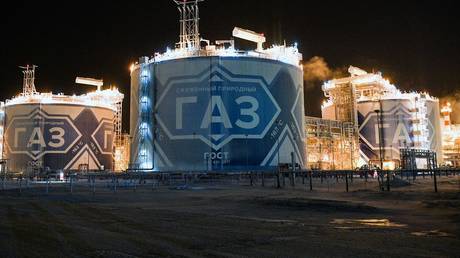
Most of this gas originates from the Yamal LNG project, a massive, frozen industrial fortress in the Russian Arctic. It is a place where the wind screams and the sun vanishes for months at a time. The project was built with French technology, financed with international capital, and is now being used to bypass the very sanctions the West designed to cripple the Russian war machine.
Russia has played this hand with cynical brilliance. By shifting from fixed pipelines to flexible ships, they have made their energy exports harder to pin down. A pipeline is a marriage; a tanker is a one-night stand. If Europe won't buy it, the ship can turn toward Asia. But Europe is buying it. In fact, European nations accounted for nearly half of Russia's sea-borne LNG exports recently.
We are paying for the defense of Ukraine with one hand and funding the opposition with the other. This isn't a conspiracy. It is a systemic failure of timing.
The Cost of the Moral High Ground
Why not just ban it? The question seems simple until you look at the price charts. The European energy market is a fragile ecosystem. When pipeline gas from Russia was cut off, prices spiked to levels that threatened to de-industrialize Germany. LNG from the U.S. and Qatar helped fill the void, but it is expensive. Russian LNG remains a "budget" option that helps suppress the volatility of the spot market.
If the EU were to implement a total, immediate ban on Russian LNG tomorrow, the shockwave would be felt in every household. It would be a choice between moral purity and economic stability. For most politicians, that is no choice at all. They prefer the "quiet ramp-up," a strategy of public condemnation paired with private consumption.
There is a psychological toll to this duplicity. It creates a sense of helplessness in the electorate. We are told the transition is happening, that we are winning the energy war, yet the data tells a story of dependency that refuses to die. It is like trying to quit a habit while the dealer is still delivering to your back door under the cover of night.
The Invisible Infrastructure
The sheer scale of the infrastructure required to move this gas is staggering.
These terminals are the cathedrals of the modern age—complex, expensive, and permanent. Once a country invests billions into the pipes and tanks needed to process LNG, they are locked into that supply chain for decades. Spain, for instance, has more regasification capacity than almost anyone else in Europe. This has turned the Iberian Peninsula into a revolving door for Russian gas, which is then piped northward to countries that claim to be "Russian-gas free."
It is a shell game played with tankers. A ship arrives from Yamal, unloads in Bilbao, and the Spanish grid sends an equivalent amount of "Spanish" gas to France. The accounting is clean. The reality is messy.
The Broken Promise of 2027
The EU has set a target to end all Russian fossil fuel imports by 2027. It is a bold date, a line in the sand. But as the clock ticks, the imports are going up, not down. This is the "Sunk Cost" trap of energy policy. We are building more LNG infrastructure to replace pipelines, but that infrastructure is being fed by the very source we are trying to escape.
Think of the "Energy Trilemma": security, equity, and sustainability. You want your energy to be secure (not from a hostile neighbor), equitable (affordable), and sustainable (green). Right now, Europe is failing on all three fronts when it comes to LNG. It isn't secure because the money still flows to Moscow. It isn't equitable because the prices remain high. And it isn't sustainable because, despite the "natural" label, gas is still a fossil fuel that leaks methane into the atmosphere.
The tension is most visible in the ports. In some Belgian docks, activists have tried to block the arrival of Russian tankers. They hold signs and shout at the steel walls of the ships. But the ships are indifferent. They are guided by contracts that were written in the ink of a different era, enforced by international maritime law that doesn't care about the morality of a border conflict.
A Cold Reality
There is no easy villain in this story. The utility companies are bound by law. The politicians are bound by the fear of a freezing electorate. The consumers are bound by their bank accounts.
We are living in an era of the "Great Disconnect." We want the world to change, but we are unwilling or unable to pay the price of that change in real-time. So, we accept the quiet ramp-up. We look away from the manifest. We pretend that the heat in our radiators comes from a place of virtue, rather than a frozen terminal in the Arctic.
As the sun sets over the Mediterranean, another tanker clears the horizon. It carries enough energy to power a city for a month. It also carries the weight of a continent's unresolved hypocrisy. The frost on the pipes is thick, white, and biting. It is a cold reminder that even when you close the front door, the ghost finds a way through the cracks.
The lights stay on in Brussels. The factories in the Ruhr valley keep humming. The checks keep clearing in Moscow. The ships keep moving, silent and heavy, across a sea that remembers every secret we try to bury in the data.