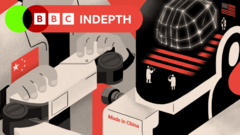
You've likely heard the narrative that the US has already won the AI war. It’s a comfortable story for Silicon Valley. We have the fastest chips, the most capital, and the flashy Silicon Valley CEOs. But if you look at the actual data from early 2026, the "race" isn't a single track. It's more like a decathlon where the US is dominating the 100-meter sprint while China is quietly lapping everyone in the long-distance events.
The US still holds the lead in "frontier" models—the massive, trillion-parameter brains like GPT-5 or the latest Gemini iterations. However, China has pivoted. Instead of trying to out-brute-force Nvidia’s H100 clusters, Chinese firms like DeepSeek and Alibaba are winning on efficiency, deployment, and sheer human talent.
The Efficiency Trap
For a long time, the American strategy was simple: more compute equals more intelligence. We threw thousands of chips and megawatts of power at the problem. China couldn't do that because of export controls. They had to get smart.
DeepSeek’s R1 model, which shook the industry last year, proved you could match elite performance with a fraction of the training cost. By early 2026, the "quality gap" has practically evaporated. In 2023, US models beat Chinese ones on major benchmarks by nearly 20 points. Today, that gap is often less than 2 points. When a "good enough" model costs 90% less to run, the "best" model starts to look like a luxury most businesses don't need.
Why the US Compute Lead Is Shaky
The US currently controls about 74% of high-end AI compute capacity. That's a massive advantage. But chips need power, and that’s where the American engine is sputtering.
Our power grids are hitting a wall. Data center projects in Virginia and Texas are facing multi-year delays because the literal wires in the ground can't handle the load. China, meanwhile, is building power generation at a pace we can't touch. They already produce more electricity than the US, EU, and India combined. If you have the fastest car but no gas, you aren't winning the race. China is building the gas stations.
The Talent Flip
This is the statistic that should actually keep people up at night: 51% of the world’s top AI researchers now come from China. Historically, those researchers did their undergrad in China and then moved to the US to work for Google or Meta. That’s changing. In 2019, only about 30% of those top-tier researchers stayed in China. By late 2025, that number jumped to 68%.
We’re seeing a "reverse brain drain" fueled by massive domestic investment and a growing sense that the most interesting "embodied AI" work—think robots and self-driving tech—is happening in Shenzhen, not San Francisco. When 9 out of the top 10 universities producing AI talent are in China, the long-term trend line isn't hard to plot.
Real World Integration vs. Chatbots
The US is great at building AI that talks to you. China is winning at AI that actually does things in the physical world.
- Robotics: In 2023, China installed over 276,000 industrial robots. That’s seven times more than the US.
- Autonomous Systems: While we argue about Waymo's geofencing, Baidu’s Apollo Go and WeRide are scaling across dozens of Chinese cities with fewer regulatory hurdles.
- Agentic Devices: Chinese consumers are already using "AI smartphones" that don't just answer questions but actively manage their lives—booking tickets, ordering food, and navigating apps autonomously.
The Bottom Line
The US leads in innovation; China leads in implementation. We build the "God Models," but they build the infrastructure that puts AI into every factory, phone, and car.
If you're an investor or a developer, the move isn't to ignore one side. It's to realize that the US advantage in raw compute is a temporary moat that software efficiency is quickly drying up. The real winner won't be the one with the smartest chatbot, but the one who can power and deploy millions of "good enough" models into the physical economy.
Next Steps for Leaders
- Focus on Inference, Not Just Training: The battle is shifting from how you train a model to how cheaply and efficiently you can run it.
- Watch the Grid: Energy availability is the new silicon. If your AI strategy doesn't include a plan for power, it isn't a strategy.
- Diversify Your Talent Pipeline: Relying on a shrinking pool of US-based researchers is a losing game. Look toward the open-source ecosystems coming out of Asia.
The era of American AI exceptionalism is over. We’re in a competitive parity phase now, and the winner will be whoever scales the fastest, not whoever speaks the loudest at a tech conference.