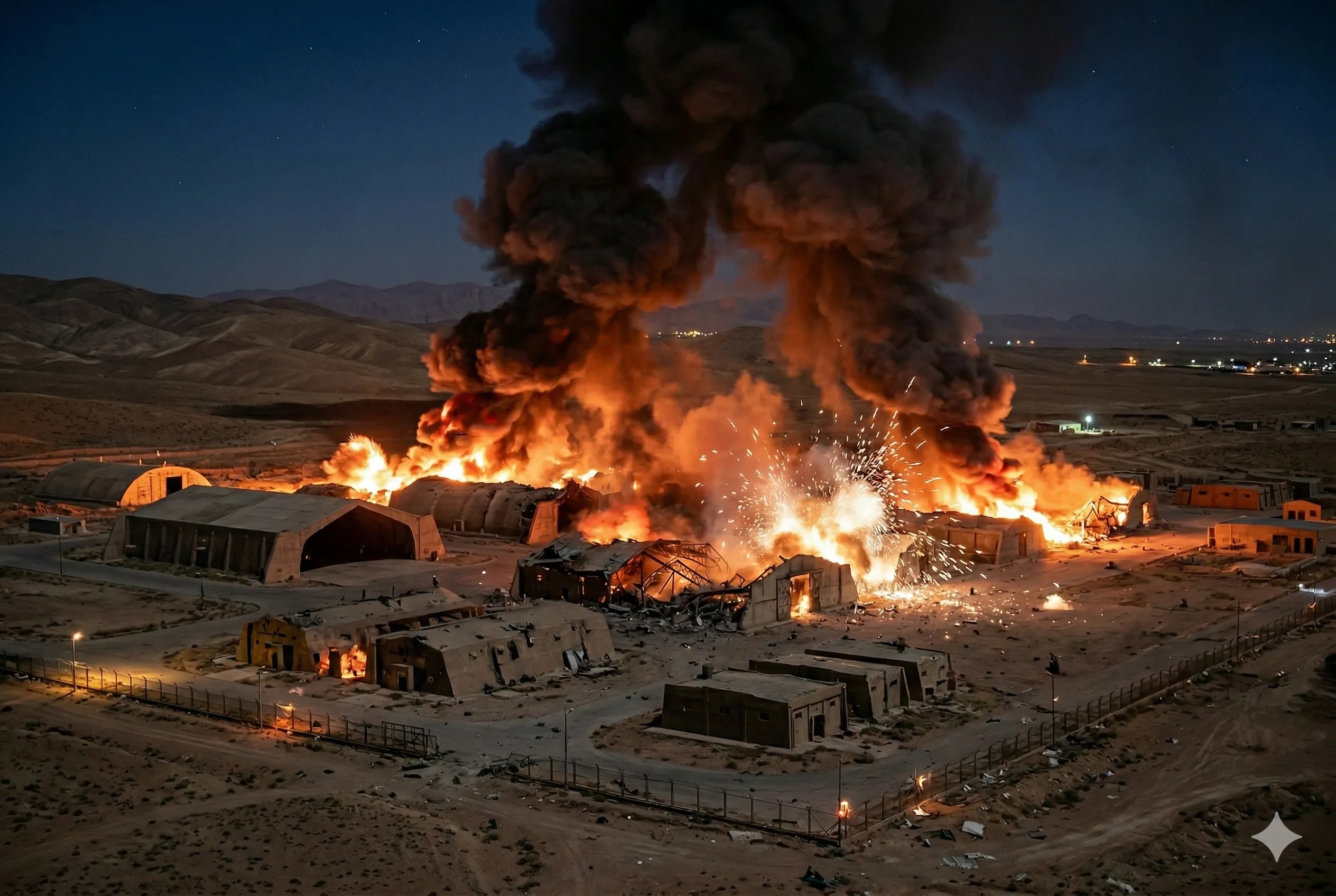
The smoke rising from Iranian weapons depots in the wake of joint U.S.-Israeli strikes marks a definitive shift from shadow boxing to open, kinetic confrontation. These operations targeted specific logistics nodes and storage facilities used by the Islamic Revolutionary Guard Corps (IRGC) to funnel precision-guided munitions and drone components across the region. While initial reports focused on the sheer volume of the explosions, the tactical reality reveals a sophisticated effort to degrade Iran’s "forward defense" strategy by systematically dismantling its supply chain.
The Architecture of the Strike
Military operations of this scale do not happen in a vacuum. They are the result of months of signals intelligence (SIGINT) and human intelligence (HUMINT) coalescing into a target list that prioritizes high-value hardware over personnel. By hitting weapon depots, the coalition isn't just destroying physical assets; it is creating a massive vacuum in the logistical flow that supports proxy networks in Lebanon, Syria, and Yemen.
The precision required to hit these underground or reinforced bunkers suggests the use of specialized bunker-buster munitions and advanced electronic warfare suites designed to blind local air defenses. We are seeing a move away from the "tit-for-tat" exchanges of the past decade. This is a deliberate attempt to reset the balance of power by neutralizing the very tools Iran uses to project influence beyond its borders.
Tracking the Logistics of the IRGC
To understand why these specific depots were chosen, one must look at the IRGC’s internal distribution network. Iran does not simply move completed missiles from point A to point B. Instead, it moves sub-components—engines, guidance kits, and carbon-fiber casings—to be assembled closer to the front lines.
The targeted sites were likely hubs for these "flat-pack" weapons systems. When a depot containing solid-fuel rocket motors or volatile drone propellants is hit, the secondary explosions provide a clear indicator of the facility's importance. These secondaries often cause more damage than the initial kinetic impact, turning the IRGC’s own stockpiles against their infrastructure.
The Drone Factor
A significant portion of the recent focus has landed on Shahed-series loitering munitions. These drones have become the centerpiece of Iranian asymmetric warfare because they are cheap, expendable, and difficult to track. By striking the assembly and storage points for these units, the U.S. and Israel are targeting the primary mechanism Iran uses to bypass traditional air defense umbrellas.
The intelligence suggests that many of these depots were recently stocked with newer iterations of these drones, featuring improved anti-jamming capabilities. Destroying them on the ground is significantly more cost-effective than trying to intercept hundreds of them in flight. It is a matter of basic military arithmetic.
Beyond the Battlefield
The geopolitical ripples of these strikes extend far beyond the scorched earth of the impact zones. For the U.S., these actions signal a hardening of policy that contradicts the narrative of a total pivot away from the Middle East. It proves that despite distractions in other global theaters, the capability to execute complex, multi-domain strikes remains intact and ready.
For Israel, these strikes are an existential necessity. The "War Between Wars" has entered a more aggressive phase where the goal is no longer just to delay Iranian capabilities but to actively roll them back. The coordination between Washington and Jerusalem on these missions reflects a level of intelligence sharing that is unprecedented in the modern era.
Counter-Arguments and Risks
Critics of this aggressive posture argue that striking sovereign territory or IRGC-controlled assets only fuels the cycle of escalation. There is a legitimate concern that backed into a corner, Tehran may feel compelled to authorize a direct response against Western shipping in the Strait of Hormuz or launch massive cyberattacks against critical infrastructure.
However, the "wait and see" approach of previous years allowed Iran to build a "Ring of Fire" around its rivals. The current strategy operates on the belief that the cost of inaction has finally surpassed the risk of escalation. If the depots are left untouched, the weapons within them will inevitably be used. The choice, from a strategic perspective, is not between peace and war, but between a controlled strike now or a much larger, uncontrolled conflict later.
Technical Superiority and Electronic Dominance
The success of these raids depended heavily on the total suppression of enemy air defenses (SEAD). Reports indicate that Iranian radar systems in the vicinity of the strikes were either jammed or spoofed, leaving the depots vulnerable to low-profile cruise missiles and stealth platforms.
This is where the technological gap becomes most apparent. Iran has invested heavily in Russian-made S-300 systems and their own domestic variants like the Bavar-373. Yet, in the face of coordinated U.S. and Israeli electronic warfare, these systems often fail to provide a clear picture of the airspace. The ability to "ghost" past these defenses allows the coalition to pick their targets with surgical precision, minimizing collateral damage while maximizing the destruction of military hardware.
The Economic Strain on Tehran
Every destroyed depot represents millions of dollars in lost investment. In a country struggling under the weight of international sanctions and internal economic mismanagement, the loss of advanced weaponry is not easily mitigated. These are not items that can be replaced by simply increasing a factory's shifts. Many of the components required for precision guidance systems rely on smuggled Western technology or specialized Chinese parts that are increasingly difficult to procure.
By forcing Iran to constantly rebuild its domestic stockpiles, the coalition is effectively bleeding the IRGC’s budget dry. It is a war of attrition played out in the dark, where the metric of success is not territory gained, but the depletion of the enemy's treasury and technical reserves.
Internal Iranian Response
Behind the scenes, these strikes create significant friction within the Iranian military hierarchy. Finger-pointing regarding intelligence leaks and security failures is inevitable. When a "secure" depot is leveled, it suggests that the IRGC’s internal security has been compromised. This creates a climate of paranoia that can be as damaging as the bombs themselves.
Security protocols are tightened, movement is restricted, and the speed of logistics slows to a crawl as commanders worry about who might be watching. This psychological impact is a core component of the broader strategy to paralyze Iranian decision-making.
Regional Realignment
The silence from many Arab capitals in the wake of these strikes is deafening. While officially they may call for "restraint," many regional players view the degradation of Iranian military power as a net positive for their own security. We are seeing a quiet but firm alignment of interests between the West and several Gulf states that were once hesitant to support direct action against Tehran.
This coalition of convenience is built on a shared understanding that an unchecked IRGC is the primary threat to regional stability. The strikes serve as a demonstration of resolve that reassures allies and warns adversaries that the red lines drawn in the sand are backed by kinetic force.
The Mechanics of Proxy Attrition
When the central hub is hit, the spokes of the wheel begin to fail. Groups like Hezbollah and various militias in Iraq rely on a steady heartbeat of supplies from these depots. Without the constant flow of parts and ammunition, their operational readiness drops significantly.
This forces these groups to become more conservative with their existing resources. They can no longer afford to fire off rockets with abandon if they don't know when the next shipment is coming. The strikes essentially put the proxies on a "starvation diet" of munitions, reducing their ability to harass regional targets and forcing them to focus on their own survival rather than offensive operations.
The Role of Satellite Surveillance
Commercial and military satellite imagery has played a pivotal role in the aftermath. Analysts can now see the exact extent of the damage within hours. The "before and after" shots of these facilities show a level of destruction that state-run media outlets often try to downplay. The charred remains of specialized transport vehicles and the collapsed roofs of hardened hangars tell a story that Tehran's propaganda machine cannot erase.
A New Ruleset for Engagement
The old rules of engagement have been shredded. We have moved into an era where "deniable" operations are becoming less common, replaced by overt actions that carry a clear signature. The message being sent is that there is no longer a sanctuary for weapons of destabilization.
Whether these depots are located in the heart of the desert or buried under mountains, the reach of modern strike packages is absolute. The technical proficiency displayed in these missions sets a new standard for localized military intervention, prioritizing the destruction of capacity over the occupation of land.
The focus now turns to the IRGC's ability to adapt. History suggests they will attempt to disperse their holdings even further, perhaps moving smaller caches into civilian areas or deeper underground. But every move they make to hide their assets also makes those assets harder to use. Logistics thrives on efficiency; secrecy thrives on friction. By forcing Iran to choose between the two, the U.S. and Israel have already won a significant tactical victory.
The fires at these depots will eventually burn out, but the strategic landscape has been permanently altered. The "shadow war" is no longer in the shadows. It is a visible, violent, and highly technical struggle to determine who dictates the terms of security in the Middle East. The destruction of these weapons caches is a physical manifestation of a policy that no longer tolerates the export of instability.
The next phase will not be defined by a single treaty or a grand bargain, but by the ongoing, methodical erasure of the tools of war before they ever have the chance to be deployed. Control of the region now belongs to those who can see the threat, reach out, and eliminate it with total impunity.