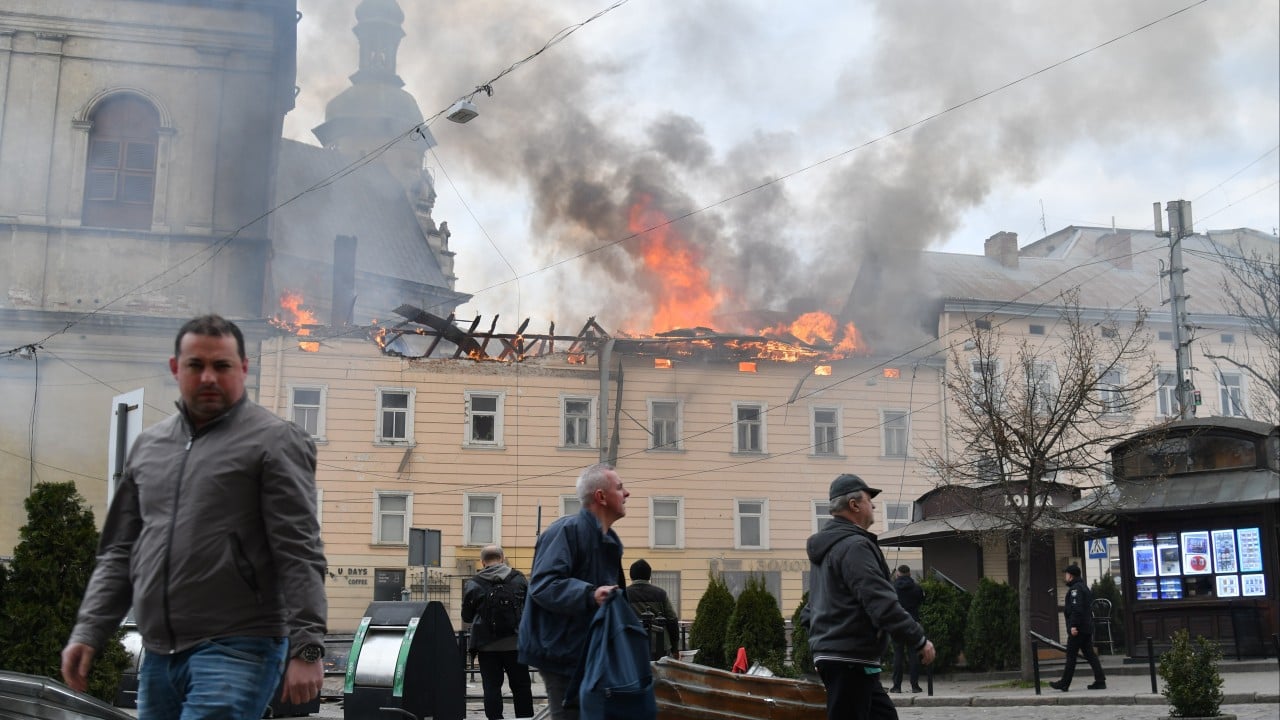
The arrival of spring in Ukraine is no longer marked merely by the thawing of the soil, but by the darkening of the skies. Russia has escalated its aerial campaign to an unprecedented scale, launching nearly 400 drones in a single coordinated wave that left four civilians dead and the nation's power grid shuddering. This is not just another spike in a long-running conflict. It is the definitive opening salvo of a long-anticipated spring offensive, one that relies on cheap, mass-produced technology to overwhelm sophisticated Western defense systems. The sheer volume of this attack suggests that Moscow has finally solved its supply chain bottlenecks, transitioning from sporadic strikes to a sustained war of industrial attrition.
For months, military analysts tracked the buildup of "Shahed" style loitering munitions, but the scale of this 400-unit barrage reveals a terrifying new math. When Russia fires ten drones, Ukraine’s Gepard systems and MANPADS can usually intercept them all. When Russia fires 400, the objective shifts. They are no longer just looking for a direct hit on a power plant; they are looking to bleed the Ukrainian stockpile of expensive interceptor missiles dry. It is a cold, calculated trade. A drone that costs $20,000 is being used to bait a defensive missile that costs $2 million. Don't miss our recent coverage on this related article.
The Mechanics of the Swarm
To understand why this specific attack is a tipping point, you have to look at the flight patterns. These weren't 400 drones flying in a straight line. They were launched from multiple vectors—Primorsko-Akhtarsk, Kursk, and occupied Crimea—to converge on targets from different angles simultaneously.
By saturating the radar screens, Russia creates "noise" that masks the movement of more lethal cruise missiles. While Ukrainian mobile fire groups are busy chasing low-flying, noisy Iranian-designed drones with heavy machine guns, the Russian military is mapping out the exact location of every active Ukrainian radar unit. This is electronic reconnaissance disguised as a suicide mission. To read more about the context of this, BBC News offers an in-depth breakdown.
The strategy has shifted from "precision" to "saturation." In the early days of the invasion, Russia burned through its limited supply of high-end Iskander and Kalibr missiles. Now, they use the drones as a crude but effective substitute. If 390 are shot down but 10 get through to a primary substation, the mission is a success in the eyes of the Kremlin. The four lives lost in this latest wave are a tragic testament to the fact that even a "low-tech" swarm can be lethal when it targets residential hubs to spread terror and distract from the front lines.
Domestic Production and the Alabuga Pipeline
The most troubling aspect of this surge is the evidence of domestic Russian manufacturing. For the past year, intelligence reports have focused on a factory in the Alabuga Special Economic Zone in Tatarstan. The goal was simple: stop relying on direct shipments from Tehran and start building "Geran-2" drones on Russian soil.
The 400-drone wave suggests that this factory is now operating at a high capacity. It means Russia is no longer dependent on the Caspian Sea shipping lanes for its primary long-range strike capability. They have moved the assembly lines closer to the front, integrated Russian-made navigation modules, and even begun experimenting with black carbon-fiber coatings to make the drones harder to spot at night.
- Cost-Efficiency: Russia is spending pennies to force Ukraine to spend dollars.
- Acoustic Overload: The "moped" sound of these engines is designed to be psychological warfare as much as a mechanical necessity.
- Frequency: Expect these 400-unit waves to become the new baseline for the spring offensive.
The Spring Offensive Ground Reality
Drones are the vanguard, but the ground is where the territorial shifts will happen. As the mud dries, the Russian military is repositioning its heavy armor. The aerial swarm serves as a massive smoke screen. While the world watches the explosions in Kyiv and Kharkiv, Russian engineers are clearing minefields and moving brigades in the Donbas.
The spring offensive is not a single "Big Bang" event like the movies. It is a series of grinding, overlapping operations. By forcing Ukraine to move its air defense assets away from the front lines to protect civilians in the cities, Russia creates a "bubble" over the battlefield. Inside that bubble, Russian Su-34 jets can drop devastating glide bombs on Ukrainian trenches with relative impunity. This is the real danger of the drone swarm: it creates gaps in the shield that were once airtight.
The Interceptor Crisis
Ukraine is facing a math problem that no amount of bravery can solve. The Patriot, IRIS-T, and NASAMS systems provided by the West are world-class. They rarely miss. But they are finite. Every time a $4 million Patriot missile is used to down a drone that looks like a lawnmower with wings, the long-term defense of the country becomes more fragile.
Western allies are currently scrambling to find a "low-cost" solution to a "low-cost" problem. This includes the deployment of more electronic warfare (EW) "jammers" and the revitalization of old-school anti-aircraft guns. However, jamming 400 drones at once requires a density of EW equipment that currently does not exist on the modern battlefield. The Russian drones are now being equipped with simplified "inertial navigation" systems that don't even need a GPS signal to find their target, making traditional jamming useless.
Why the Logistics Are Shifting
Russia has transitioned to a total war economy. Their factories are running three shifts, 24 hours a day. Meanwhile, Western aid packages are often tied up in legislative gridlock. This disparity is what emboldened the Kremlin to launch a 400-drone wave. They aren't afraid of running out.
Ukraine, conversely, must play a perfect game of chess with limited pieces. They have to decide if a battery of S-300 missiles is better spent protecting a grain silo or a frontline battalion. Russia’s strategy is to force so many of these impossible choices that eventually, the Ukrainian defense cracks.
The spring offensive is also a test of European resolve. By targeting energy infrastructure again as the weather warms, Russia is signaling that it is prepared for a multi-year conflict. They are betting that the West will grow tired of the "drone-of-the-day" headlines and push for a frozen conflict that leaves Russia in control of occupied territories.
The Evolution of Defensive Strategy
Ukraine is not sitting still. They have pioneered the use of "Mobile Fire Groups"—pickup trucks equipped with searchlights and heavy machine guns. These teams are the unsung heroes of the current air defense strategy. They provide a cost-effective way to kill drones without using missiles. But a pickup truck cannot be everywhere at once. When 400 drones enter the airspace, the sheer geometry of the problem means some will always find a gap.
Future defense will likely rely on "directed energy" or lasers, which have a near-zero cost per shot. But that technology is still in testing and won't arrive in time for this spring's fighting. For now, the defense of Ukraine rests on a patchwork of Cold War-era guns, modern Western missiles, and the sheer grit of the operators.
A New Era of Attrition
The 400-drone barrage marks the end of the "limited" phase of aerial warfare. We have entered the era of the mass-produced, expendable robotic army. Russia has realized that quantity has a quality of its own. They don't need the best drones; they just need the most drones.
This spring will be defined by whether the West can surge ammunition and air defense components fast enough to match the output of the Alabuga factory. If the interceptors run dry, the drone swarms will no longer be a distraction; they will be the primary instrument of Ukrainian defeat. The four deaths reported in this latest strike are a warning of what happens when the shield starts to thin.
Stop looking for a traditional tank battle to signal the start of the offensive. The humming in the night sky told us everything we need to know. The offensive has begun, and it is being fought one $20,000 plastic wing at a time. Speed up the production of Gepard ammunition and short-range interceptors immediately or watch the attrition math dictate the map.