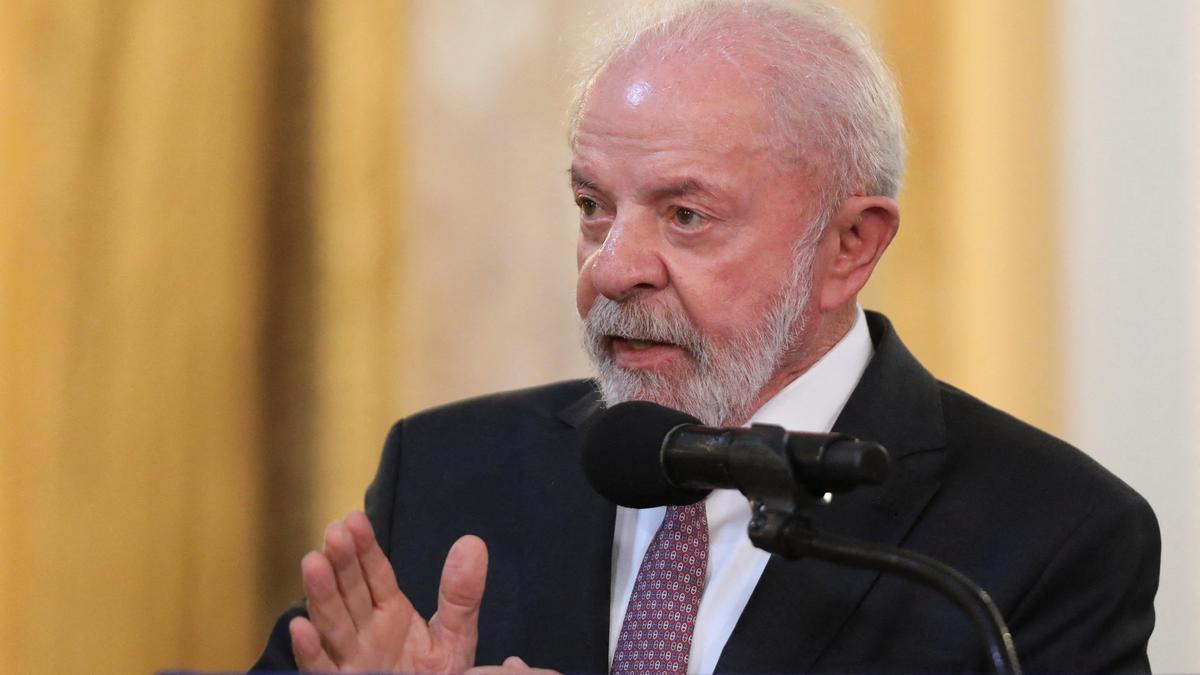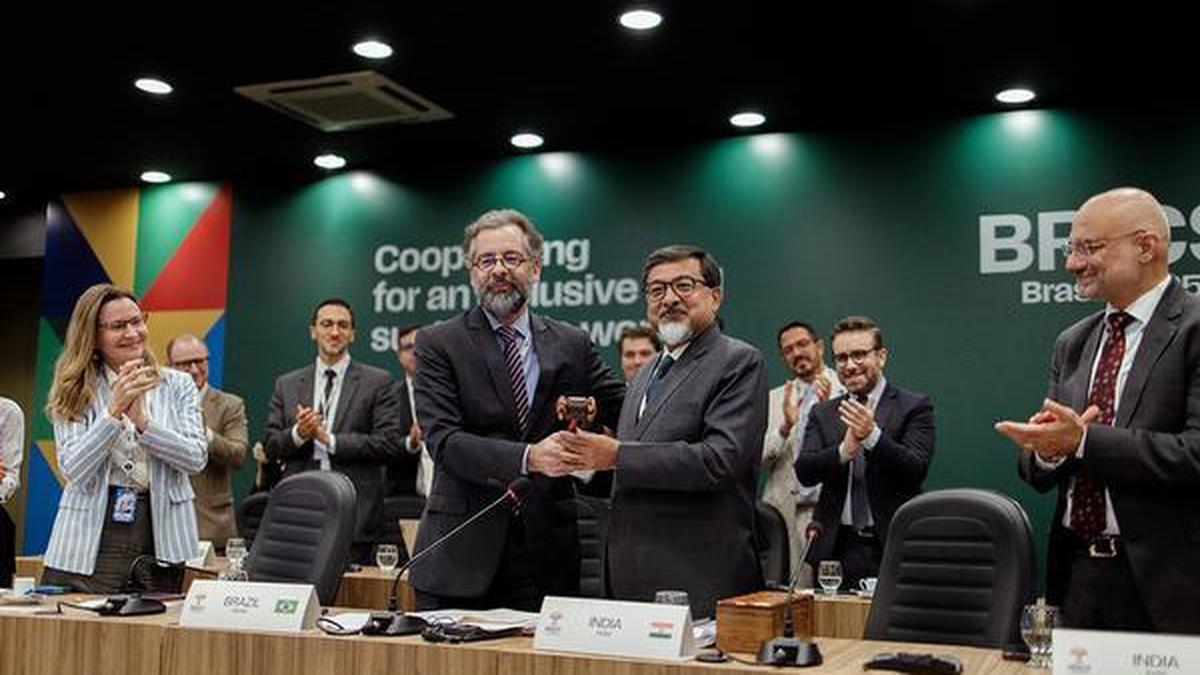
Brazil handed India a gavel. The media calls it a "shift in gears." I call it a relay race where the baton is made of melting ice.
The consensus view—the one you’ll read in every vanilla financial op-ed this week—is that BRICS is finally maturing into a cohesive counterweight to the G7. They point to the expansion, the talk of a "BRICS currency," and the high-minded communiqués about a "multipolar world."
It’s a fantasy.
BRICS isn't a bloc. It’s a group chat where half the members aren't on speaking terms and the other half are trying to sell each other overpriced oil. As India takes the lead, the fundamental rot at the core of this "alliance" isn't just a hurdle; it’s the defining feature. If you’re betting your global strategy on a unified BRICS front, you aren’t just wrong—you’re dangerously late to the realization that the front doesn’t exist.
The Myth of the Unified Alternative
The most persistent lie in geopolitical analysis is that "shared grievances" equal "shared goals."
The BRICS nations share a resentment of the US Dollar’s hegemony. That is a fact. But resentment is not a policy. To build a functional economic bloc, you need synchronized monetary goals, compatible legal frameworks, and, most importantly, trust.
Look at the data. China’s GDP is larger than all other BRICS members combined. This isn't a partnership of equals; it’s a solar system where Beijing is the sun and everyone else is fighting for the warmth of a trade deal. India knows this. New Delhi isn’t stepping into the leadership role to "strengthen" BRICS; it’s stepping in to ensure China doesn’t turn the bloc into a satellite office for the Belt and Road Initiative.
In my years tracking emerging market capital flows, I’ve seen Western investors get spooked by the "de-dollarization" narrative. They see the headlines and panic. What they miss is the plumbing.
De-Dollarization is a Pipe Dream for Amateurs
Let's talk about the "BRICS Currency." It’s the Bigfoot of macroeconomics: everyone talks about it, but no one has a clear photo of it.
The competitor article suggests that India will lead the charge toward a common unit of account. This ignores the most basic reality of Indian fiscal policy. India is fiercely protectionist of the Rupee. You think the Reserve Bank of India is going to outsource its monetary sovereignty to a basket of currencies that includes the Russian Ruble and the Iranian Rial?
If you believe that, I have a bridge in Novosibirsk to sell you.
The technical hurdles are insurmountable. To have a common currency, you need:
- A Banking Union: Impossible when half the members are under heavy Western sanctions.
- Fiscal Integration: Brazil’s deficit spending habits would never fly in Beijing or New Delhi.
- Liquidity: No one wants to hold a currency they can’t spend everywhere.
The "de-dollarization" we’re actually seeing isn't the rise of a new currency. It’s a messy, inefficient shift toward bilateral trade in local currencies. It’s not a "seamless" transition. It’s a logistical nightmare that increases transaction costs and leaves countries like India holding piles of Russian Rubles they can’t easily offload for anything other than more oil.
The India-China Paradox
You cannot have a "robust" geopolitical bloc when your two most powerful members are literally killing each other on a Himalayan border with spiked clubs.
The media loves to gloss over the Galwan Valley clashes because it ruins the "Global South Unity" narrative. But the reality is that India’s primary strategic threat isn't the United States or the G7—it’s China.
India’s strategy within BRICS is "Containment from Within." By taking the chair, India ensures that the expansion of the group doesn’t just become a list of China’s debtors. The addition of Iran, Ethiopia, Egypt, and the UAE wasn't a sign of strength; it was a dilution of purpose.
When you increase the number of voices in a room from five to ten, and those voices range from radical theocracies to hyper-capitalist petrostates, you don't get a louder voice. You get a deafening hum of conflicting interests.
The Expansion is a Dilution, Not an Evolution
The competitor piece argues that expansion "amplifies the voice of the Global South."
In reality, expansion is where movements go to die. Every new member brings a new veto, a new border dispute, and a new set of economic vulnerabilities.
- Egypt and Ethiopia: Currently in a heated dispute over the Grand Ethiopian Renaissance Dam.
- Iran and Saudi Arabia: Engaged in a decades-long regional cold war that a few handshakes in Beijing haven't solved.
- Russia: A pariah state looking for anyone to help it bypass the SWIFT system.
This isn't an "ambitious goal." It’s a chaotic wedding guest list where the bride and groom aren't even sure they want to get married.
When you look at the economic spread, the "BRICS" label loses all meaning. You have the high-tech manufacturing of China, the service-driven growth of India, the commodity-dependent volatility of Brazil and Russia, and the frontier market instability of the new members.
There is no "synergy" here. There is only a shared desire to sit at a table that isn't hosted by the Americans. But once they sit down, they realize they don't like the food and they hate their seatmates.
India’s Real Play: The Multi-Alignment Trap
The "lazy consensus" says India is pivoting away from the West.
Wrong.
India is practicing "Multi-Alignment." It’s the art of being in every room at the same time and committing to nothing. India wants the tech transfers and defense deals from the US (the Quad), the cheap energy from Russia, and the manufacturing investment from the rest of the world.
Taking the BRICS gavel isn't a "shift in gears." It’s a defensive crouch.
If India leaves the chair vacant, China fills it. If India lets BRICS fail, it loses its leverage with the West. The West treats India better because India is the only "sane" democratic power in the BRICS room. New Delhi knows that its value to Washington increases every time it plays the "neutral" arbiter in Moscow or Beijing.
It’s a high-stakes game of geopolitical arbitrage. But don't mistake the theater for a plan.
Stop Asking if BRICS Will Replace the G7
It’s the wrong question.
The G7 is a club of wealthy, aging democracies with aligned security interests. BRICS is a protest movement.
Protest movements don't build global reserve currencies. They don't set international shipping standards. They don't provide the security architecture for global trade.
The "People Also Ask" section of your brain is probably wondering: Will BRICS change the global financial system?
The answer is: Yes, but not in the way they want.
They won't replace the dollar; they will just make the world more expensive. By fragmenting trade into smaller, local-currency silos, they are ending the era of hyper-efficient global supply chains. We are moving toward a "Balkanized" global economy.
Prices will go up. Volatility will increase. Certainty will vanish.
The "Gavel" is a Burden, Not a Prize
India’s term at the helm will be defined by one thing: damage control.
They have to manage a Russia that wants to use the forum for war propaganda, a China that wants to use it for economic dominance, and a host of new members who think they just joined a club that hands out free money.
The "ambitious goals" mentioned by the competition—climate finance, digital infrastructure, poverty law—are just the wrapping paper on an empty box. No one in that room is going to write a check for someone else’s climate transition when their own domestic inflation is hitting double digits.
The reality of the "India-led BRICS" is that it will be a year of performative diplomacy. Expect lots of photos, very few treaties, and zero progress on a common currency.
If you’re a business leader or an investor, ignore the "Global Shift" headlines. Look at the bond yields. Look at the FDI flows. Money isn't flowing into a "BRICS system." It’s flowing into specific, individual winners—mostly India and parts of the Middle East—who are successfully playing both sides against the middle.
BRICS isn't the future of the world. It’s the world’s most expensive therapy group for countries that are tired of the status quo but too divided to build something new.
India isn't "passing the gavel" to a new era. It’s just holding the bag while the ice melts.
Stop looking for a new world order in a press release. It isn't there.