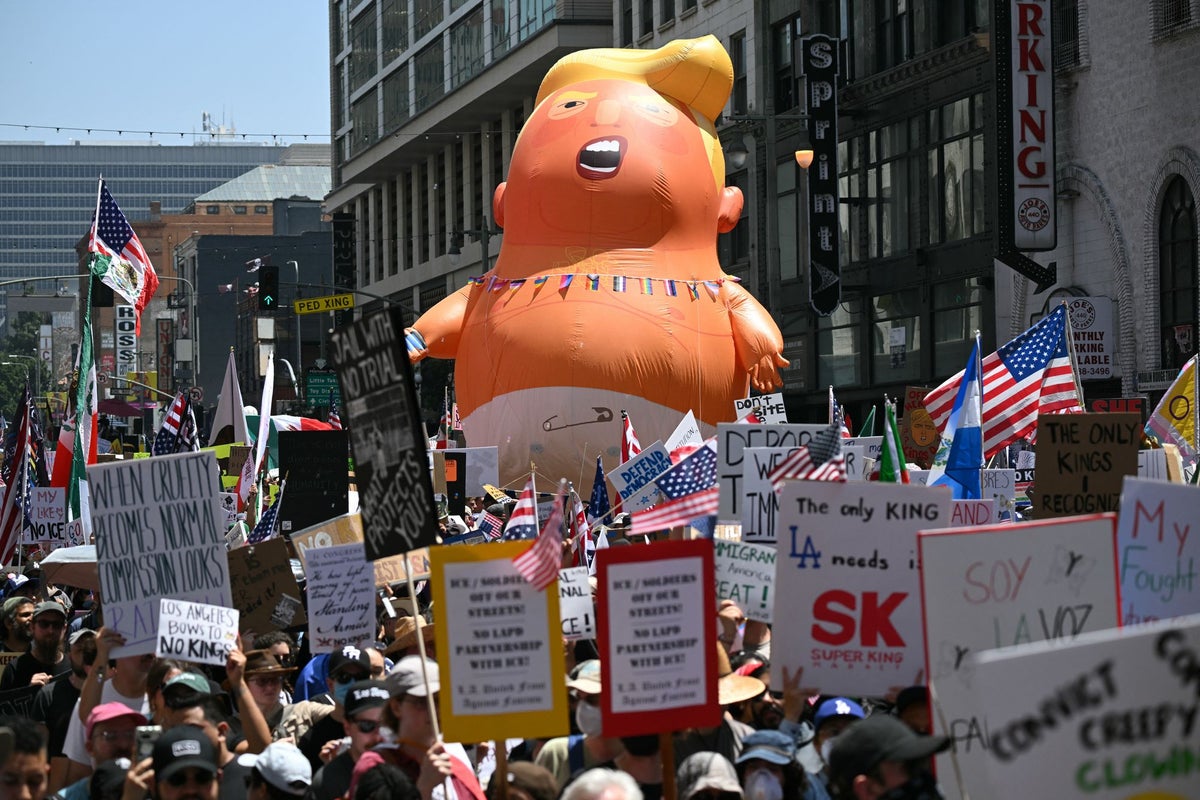
The air in downtown Philadelphia during late March doesn’t just blow; it bites. It’s a damp, historical cold that seeps through wool coats and settles into the marrow. On a nondescript corner near City Hall, a woman named Elena fumbles with a thermos of lukewarm coffee. Her fingers are red, stiff from holding a sign made of repurposed moving boxes. The ink is thick and black, bleeding slightly at the edges where the mist has kissed the cardboard. It reads: NO KINGS.
Elena isn't a career activist. She is a retired librarian who spent thirty years shushing teenagers and organizing local bake sales. But this weekend, she is part of a silent, growing pulse. She is a single cell in a massive, nationwide organism. Across the country, from the rain-slicked streets of Seattle to the humid plazas of Miami, thousands of people like Elena are stepping out of their living rooms and into the wind. They are responding to a call that feels less like a political platform and more like a fundamental survival instinct.
The "No Kings" protests are not merely about a single man or a single election cycle. They are a visceral reaction to a shift in the American bedrock. For nearly two and a half centuries, the country operated on a singular, precarious promise: that the law is a ceiling for the powerful and a floor for the weak. Now, that ceiling is being raised so high it’s disappearing into the clouds.
The Weight of a Golden Fleece
Power is heavy. Usually, we don't feel it until it lands on us.
Consider the concept of immunity. In a courtroom, it sounds like a dry, legalistic term, a shield forged in the fires of constitutional interpretation. But on the street, it feels like a shadow. When a former president argues for a level of legal protection that borders on the monarchical, it creates a vacuum. If the person at the top cannot be held to the same standard as the person at the bottom, the entire social contract begins to fray. It’s like playing a game of cards where one player can change the rules mid-hand simply because they used to own the deck.
The protests planned for this weekend are a direct response to this perceived imbalance. They are triggered by the ongoing legal battles surrounding Donald Trump, specifically the arguments suggesting that a president’s actions while in office should be shielded from criminal prosecution. To the people gathering in the parks and squares, this isn't a complex legal theory to be debated in ivory towers. It is an existential threat to the idea of a neighborly republic.
Elena looks at her sign. She thinks about her father, who worked in a steel mill and believed, with a religious fervor, that even the foreman had to answer to the same traffic cop as the guys on the floor. That was the American magic. It wasn't that everyone was rich; it was that everyone was equally vulnerable to the truth.
The Geography of Discontent
This isn't a localized flare-up. The map of the "No Kings" movement looks like a constellation of anxieties.
In Chicago, organizers are bracing for Lake Michigan’s brutal gusts, setting up stations with hand-warmers and flyers that explain the history of executive overreach. In Austin, the energy is different—louder, younger, fueled by a sense that the future is being bartered away for a return to an era of "strongman" rule.
The organizers aren't just looking for a headcount. They are looking for a shift in the atmosphere. They want the visual of a crowded street to serve as a reminder to the courts and the legislature that the public is watching. Not with the passive eyes of a television audience, but with the active, piercing gaze of the owners of the house.
There is a specific kind of exhaustion that comes with modern political life. It’s a low-grade fever of "what now?" Each news cycle brings a new headline that seems to push the boundaries of what was previously unthinkable. The protests are a way to sweat out that fever. Standing in a crowd of five hundred strangers, all shivering for the same reason, provides a sense of clarity that a social media feed never can. It turns an abstract fear into a physical presence.
The Invisible Stakes
Why does the word "king" trigger such a deep, ancestral shudder in the American psyche?
It’s because a king doesn't need to persuade. A king only needs to command. The American experiment was designed as an explicit rejection of that convenience. It was built to be slow, frustrating, and burdened by the necessity of consensus. When you remove the threat of consequence from the executive branch, you remove the friction that keeps the machine from spinning out of control.
Imagine a small town where the mayor decides that because he is the mayor, he can drive on whatever side of the road he chooses. At first, people swerve to avoid him. They complain at the diner. But eventually, the rules of the road stop meaning anything to anyone. If the person in charge doesn't follow the lines, why should the person in the pickup truck?
This is the "invisible stake" the protesters are fighting for. It’s not about a specific policy on taxes or healthcare. It’s about the integrity of the lines on the road.
The legal arguments being heard in the highest courts of the land are dense. They involve precedents from the 18th century and nuanced interpretations of "official acts." But for the people on the sidewalk, the translation is simple: Can one person be above the law? If the answer is yes, then the law is no longer a law. It’s an option.
The Anatomy of a Movement
The "No Kings" protests are largely decentralized. They are being organized by a coalition of grassroots groups, some with names that sound like revolutionary committees and others that are just "Friends of the Local Park." This lack of a central, polished PR machine is what gives the movement its grit.
- The Educators: People who spend their time handing out copies of the Constitution, highlighting the sections that emphasize accountability.
- The Witnesses: Individuals like Elena, who feel that their physical presence is a form of testimony.
- The Amplifiers: Younger activists using digital tools to ensure that a rally in a small town in Ohio is seen by someone in London or Tokyo.
These roles are fluid. At a rally in Atlanta, you might see a corporate lawyer standing next to a gig-economy delivery driver. They aren't there because they agree on everything. They are there because they agree on the one thing that makes all other disagreements possible: the rules apply to everyone.
The Sound of the Silence
There is a moment in every large protest where the chanting stops. For a few seconds, the only sound is the rustle of jackets and the distant hum of traffic. In that silence, the weight of the moment hits home.
Opponents of these protests often dismiss them as "theatre" or "partisan noise." They argue that the legal process should be left to the lawyers and that the streets are no place for constitutional debate. But history suggests otherwise. The streets have always been the place where the Constitution is given its heartbeat. The document is just parchment and ink until people decide to stand in the cold to defend what’s written on it.
The stakes this weekend are high because the precedent being set is permanent. If the "No Kings" sentiment is ignored, it signals a quiet acceptance of a new American reality—one where power is its own justification. If the protests are large and persistent, they serve as a rumble of thunder before a storm, a warning that the public’s patience with the erosion of accountability has reached its limit.
Beyond the Weekend
As the sun begins to dip behind the skyscrapers in Philadelphia, Elena packs up her sign. Her coffee is long gone, and her feet ache. She knows that tomorrow, the news will report the "estimated turnout" and show a few clips of people shouting. The pundits will analyze what it means for the polls.
But for Elena, and for the thousands of others who will take her place in the coming days, the success of the weekend isn't measured in data points. It’s measured in the feeling of the cardboard in her hands and the sight of her neighbors refusing to look away.
The struggle for the soul of a republic doesn't happen in a single courtroom or on a single ballot. It happens in the spaces between us. it happens when we decide that some things are too precious to be left to chance, and some people are too powerful to be left without a leash.
The wind picks up, swirling old newspapers and grit around the base of the statues. The city feels old, tired, and deeply alive. Elena starts the walk to the train station, her sign tucked under her arm like a shield she isn't quite ready to put down.
The "No Kings" banners will be folded and stored in garages by Monday morning. But the question they raise will remain, hanging in the air like the smell of ozone before a lightning strike. We are a nation that was born from a refusal to bow. The true test of our character isn't whether we can keep our leaders in line, but whether we still remember why we must.
Would you like me to help you draft a local community outreach plan or a set of talking points for organizing a small-scale civic engagement event in your area?