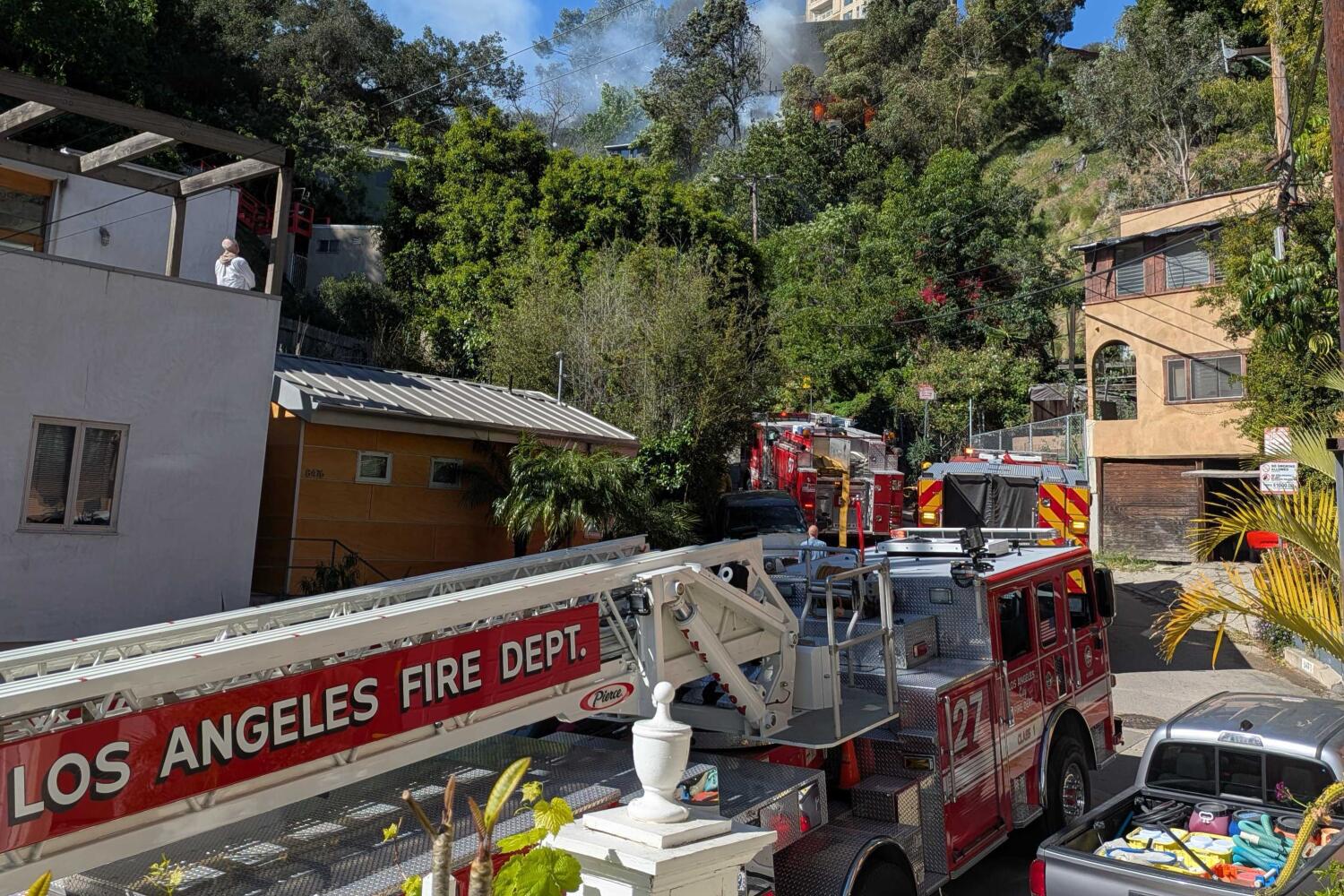
The destruction of residential assets in Laurel Canyon during Santa Ana wind events is not a result of random misfortune but the predictable output of a specific environmental engine. When high-pressure systems over the Great Basin collapse toward the Southern California coast, the resulting pressure gradient forces air through narrow mountain passes, creating a dehydrating, high-velocity thermal effect. In the context of the Wildland-Urban Interface (WUI), this transforms a single ignition point into a systemic failure of the built environment. To understand the recent Laurel Canyon fire is to understand the intersection of fluid dynamics, fuel moisture periodicity, and the structural deficiencies of mid-century canyon architecture.
The Mechanics of the Santa Ana Pressure Gradient
The primary driver of these events is a synoptic-scale meteorological phenomenon. High-pressure air masses trapped over the elevated deserts of Nevada and Utah seek equilibrium by moving toward the lower pressure over the Pacific Ocean. As this air descends from the high desert to sea level, it undergoes adiabatic heating—compressing and warming at a rate of approximately 10°C for every 1,000 meters of descent.
This process simultaneously drives relative humidity toward single digits. By the time these winds reach the Santa Monica Mountains, they are not merely "windy"; they are atmospheric desiccants. They strip moisture from ornamental vegetation and native chaparral, lowering the ignition threshold of the entire landscape.
The Venturi Effect and Topographic Acceleration
Laurel Canyon acts as a physical bottleneck. In fluid dynamics, the Venturi effect dictates that when a fluid (in this case, air) passes through a constricted section of a pipe or a canyon, its velocity increases while its static pressure decreases.
- Canyon Geometry: The steep V-shaped walls of Laurel Canyon compress the airflow, meaning a 40 mph gust at the ridge can translate to 60 or 70 mph gusts within the canyon's interior folds.
- Spotting Distances: These velocities enable "long-range spotting," where embers (or firebrands) are lofted into the laminar flow of the wind and transported up to a mile ahead of the main fire front.
- Micro-Climatic Turbulence: The rugged terrain creates mechanical turbulence, causing the fire to move erratically. This makes traditional flanking maneuvers by fire crews physically dangerous and often tactically impossible.
The Three Pillars of WUI Structural Failure
A home in Laurel Canyon does not usually burn because it is "overrun" by a wall of flames. It burns because of a sequence of mechanical vulnerabilities that allow the fire to bypass the exterior envelope.
1. The Ember Intrusion Pathway
Statistically, the majority of homes lost in these wind-driven events are ignited by embers, not radiant heat. Standard attic vents, designed for airflow, act as intake valves for wind-driven firebrands. Once an ember enters the attic space, it encounters dry framing timber and insulation, initiating a "top-down" burn that is invisible to residents and difficult for first responders to access.
2. The Fuel-Loading Paradox
In affluent canyon neighborhoods, "defensible space" is often compromised by the desire for privacy. Dense, non-native privacy hedges (such as Italian Cypress or Eucalyptus) act as vertical fuel bridges. These species contain high volatile oil content, which increases the heat release rate (HRR) once ignited. This heat then shatters double-pane windows, allowing the fire to transition from the exterior landscape to the interior furniture.
3. Topographic Pre-Heating
Fire travels significantly faster uphill. Because Laurel Canyon homes are often perched on steep slopes or stilts, the rising heat from burning vegetation below the structure pre-dries the underside of the house. By the time the flames reach the structure, the wood's chemical bonds are already beginning to break down through pyrolysis.
The Cost Function of Infrastructure Aging
The systemic risk in Laurel Canyon is exacerbated by the age of the electrical and water infrastructure.
- Grid Fragility: High-wind events create mechanical stress on overhead power lines. A single conductor slap or a tree limb contact creates a high-energy arc. If the surrounding "fine fuels" (grasses and small twigs) have been desiccated by the Santa Anas, the time from ignition to a "major incident" is measured in seconds, not minutes.
- Hydraulic Limitations: In older canyon developments, water mains are often sized for domestic consumption rather than high-volume fire suppression. When multiple hydrants are opened simultaneously, the static pressure in the system drops. In a wind-driven event, the "fire flow" requirement often exceeds the local grid's capacity, forcing a reliance on aerial assets which are frequently grounded due to high-wind turbulence.
Quantitative Analysis of Rate of Spread
In a standard fuel model (Chaparral/Shrub), the rate of spread ($R$) can be modeled as a function of wind speed ($U$) and fuel moisture ($M_f$):
$$R \propto \frac{U^2}{M_f}$$
As wind speed doubles, the rate of spread does not merely double; it increases quadratically. When fuel moisture drops below the critical 5% threshold during a Santa Ana event, the denominator approaches a point where the fire's forward velocity becomes extreme. This explains why the Laurel Canyon incident transitioned from a small brush fire to a structural threat in a window that outpaced the mobilization time of local "strike teams."
Hardening the Envelope: A Logical Framework for Mitigation
To move beyond the reactive cycle of "burn and rebuild," a shift toward passive survivability is required. This involves treating the home as a sealed vessel rather than a ventilated structure.
- Non-Combustible Zone 0: The first five feet around the structure must be entirely void of organic material. No mulch, no bushes, no wooden fences. This breaks the continuity of the fuel bed.
- WUI-Compliant Venting: Replacing standard mesh screens with flame-rated, intumescent vents. These vents contain material that expands when exposed to heat, physically sealing the attic or crawlspace before embers can enter.
- Structural Underside Protection: For homes on stilts or hillsides, the "under-floor" area must be enclosed with fire-rated materials like fiber-cement board. This prevents the "chimney effect" where heat is trapped under the house.
The strategic imperative for Laurel Canyon property owners and municipal planners is the decoupling of the "landscape fire" from the "structural fire." The wind and the terrain are constants that cannot be altered. Therefore, the only variable within human control is the ignition resistance of the built environment. Failure to harden these structures according to modern biophysical standards ensures that the next high-pressure system over the Great Basin will produce an identical economic and social loss.
Immediate tactical priority must be shifted from reactive suppression to the mandatory retrofitting of "Zone 0" and the installation of ember-resistant venting across all pre-1990 canyon assets. Without this granular hardening, the density of the canyon's fuels will continue to outweigh the suppression capabilities of the most advanced fire departments in the world.
Would you like me to analyze the specific insurance actuarial shifts occurring in the Hollywood Hills as a result of these localized climate-driven loss models?