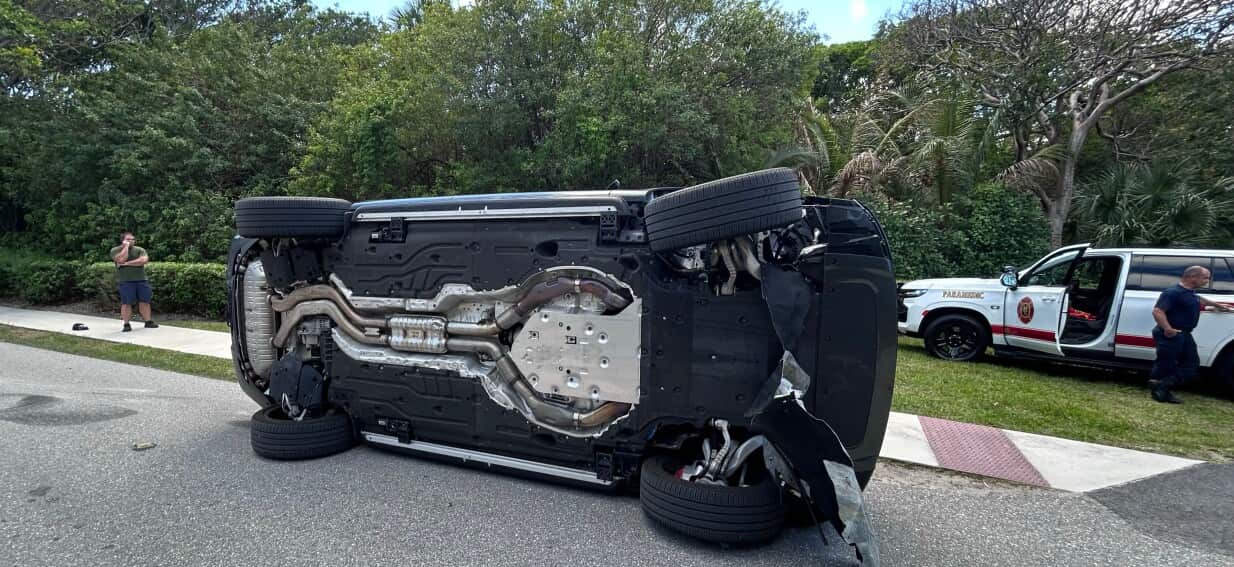
The failure of a high-performance kinetic system—in this case, a luxury SUV operated by an elite athlete—is never a localized event; it is the intersection of mechanical limits, human physiological states, and the rigorous application of forensic law. When Tiger Woods’ vehicle departed the roadway, the subsequent investigation moved beyond simple traffic enforcement into a complex reconstruction of deceleration forces and toxicology. Understanding this incident requires deconstructing the three primary variables: the mechanics of the collision, the physiological assessment of the operator, and the procedural standards of a DUI investigation.
The Kinematics of the Departure Phase
A vehicle at speed possesses linear momentum $p = mv$. When that vehicle exits a planned trajectory, the dissipation of that energy determines the severity of the outcome. In the Woods incident, the lack of skid marks prior to the point of impact suggests a total absence of braking input, indicating a "passive" rather than "active" collision entry. This points toward three possible causal mechanisms:
- Neurological Lag: A delay in stimulus-response time where the operator is aware of the hazard but unable to execute a motor command.
- Loss of Consciousness: A complete cessation of operator input due to medical or chemical factors.
- Mechanical System Failure: A catastrophic loss of steering or braking authority, though modern forensic telemetry usually rules this out via the Event Data Recorder (EDR).
The EDR, or "black box," provides the ground truth for these hypotheses. It records throttle position, steering angle, and brake activation in the five seconds preceding an airbag deployment. In cases where the throttle remains depressed during an impact, the data suggests "pedal misapplication" or a state of reduced consciousness.
The Toxicology Threshold and Field Assessment
Law enforcement utilizes a standardized hierarchy of evidence to determine impairment. The transition from a "welfare check" at a crash site to a "DUI investigation" is governed by the observation of specific clinical indicators. When an operator is trapped in a vehicle or seriously injured, the standard Horizontal Gaze Nystagmus (HGN) test—the most reliable field sobriety metric—becomes difficult to administer accurately due to potential head trauma.
Impairment is not a binary state but a spectrum of central nervous system (CNS) depression. The presence of analgesics or sedative-hypnotics, often used in post-surgical recovery (relevant to Woods' history of spinal procedures), creates a cumulative effect on motor coordination. Even if individual substances are within a therapeutic range, their interaction can result in "combined effect" impairment. This complicates the legal pursuit of a DUI charge, as the prosecution must prove that the substance—not the trauma of the accident—was the proximate cause of the erratic driving.
The Structural Integrity of the Safety Cell
The survival of the operator in a high-speed rollover is a testament to the engineering of the vehicle's safety cage. Modern luxury SUVs utilize high-strength steel reinforcements in the A, B, and C pillars to prevent roof crush.
- Energy Absorption Zones: The front-end crumple zones are designed to deform elastically and then plastically, extending the duration of the impact ($\Delta t$). According to the impulse-momentum theorem ($F\Delta t = \Delta p$), increasing the time of the collision reduces the average force ($F$) exerted on the cabin.
- Restraint System Sequencing: The timing between the pretensioning of seatbelts and the deployment of multi-stage airbags is measured in milliseconds. If the operator is out of position (e.g., leaning or unbelted), these systems can cause secondary injuries.
- Lower Extremity Vulnerability: While the safety cell protects the torso and head, the floor pan often deforms upward during a frontal offset crash. This explains the prevalence of "pilon" fractures and comminuted open fractures in the lower legs, as the engine block is pushed toward the firewall.
Legal Procedural Barriers in Post-Crash Investigations
The primary bottleneck in a DUI arrest following a major accident is the Fourth Amendment protection against unreasonable search and seizure. Without a voluntary blood draw, officers must obtain a search warrant based on probable cause.
Probable cause in a single-vehicle accident is not automatic. The mere fact of a crash does not prove impairment. Investigators look for "clues of impairment" at the scene:
- The odor of alcoholic beverages.
- Slurred speech patterns inconsistent with shock.
- The presence of open containers or prescription pill bottles.
- Statements made by the operator regarding their timeline of activities.
If an operator is transported to a trauma center, the medical blood draw taken for clinical purposes is often shielded by HIPAA (Health Insurance Portability and Accountability Act) and doctor-patient privilege. To bridge this gap, law enforcement must demonstrate a clear nexus between the observed driving behavior and a suspected intoxicating agent. In the Woods case, the lack of immediate "objective symptoms" of intoxication reported by the first responders created a strategic vacuum that prevented an immediate blood sample seizure.
The Economic and Brand Implications of Performance Failure
For a high-net-worth individual and global brand, a DUI arrest at a crash scene represents a catastrophic risk to "Morals Clauses" within endorsement contracts. These clauses allow sponsors to terminate agreements if the athlete engages in conduct that brings them into public disrepute.
The strategy for brand preservation in these scenarios relies on "narrative displacement." By focusing the public discourse on the severity of the injuries and the "miraculous" survival, the legal and behavioral failures are moved to the periphery. This creates a conflict between the public relations objective (transparency and recovery) and the legal objective (silence and protection of the record).
Strategic Reconstruction of the Incident Timeline
To move from speculation to analysis, one must map the known trajectory against the expected performance of a sober, alert driver. The "Black Jack" curve where the accident occurred is a known high-risk zone. A driver maintaining a standard line would utilize a late-apex steering input. A vehicle that continues straight through a curve indicates a total failure of the human-machine interface.
The absence of braking, combined with the high velocity of the vehicle at the point of first impact, suggests that the operator was not "trying and failing" to control the vehicle, but was instead "non-participatory" in the driving task for several seconds prior to the departure. This distinction is critical for insurance adjusters and legal teams: it shifts the liability from "negligence" (making a mistake) to "gross negligence" or "reckless endangerment" (operating in a state where control is impossible).
The final determination of such an event rests on the synchronization of the EDR data with the personal toxicology report. If the EDR shows an increase in speed leading up to the crash, it supports a hypothesis of pedal misapplication—hitting the gas instead of the brake—a common occurrence in states of acute impairment or extreme age.
The tactical move for any investigative body or legal defense in this context is the isolation of the "pre-crash" period. If it can be proven that a medical emergency (such as a vasovagal response or a reaction to a recent surgical intervention) occurred before the vehicle left the road, the criminal element of a DUI is effectively neutralized. The burden of proof remains on the state to demonstrate that the impairment was a result of voluntary ingestion rather than an involuntary physiological failure. Moving forward, the focus shifts from the wreckage to the digital and biological logs that preceded the first impact.