The moon isn't just a rock in the sky anymore. It’s a strategic high ground. When Artemis II launches, it won’t just be about four people circling the moon. It’s a loud statement to the rest of the world. We’re currently in a sprint against China to see who can claim the lunar south pole first. If you think this is just a repeat of the 1960s, you’re missing the bigger picture. This time, we’re going back to stay, and the stakes for American leadership have never been higher.
Artemis II is the first crewed mission of NASA’s broader program to return humans to the lunar surface. It follows the successful uncrewed Artemis I flight in late 2022. This mission will send four astronauts—Reid Wiseman, Victor Glover, Christina Koch, and Jeremy Hansen—around the moon and back. It tests the life support systems of the Orion spacecraft with humans on board for the first time. They’ll travel further into deep space than any human in history.
The Reality of the New Space Race
We aren't alone out there. China is moving fast. They’ve already landed rovers on the far side of the moon, something no one else has done. Their CNSA (China National Space Administration) plans to put taikonauts on the lunar surface by 2030. They’re building a permanent base called the International Lunar Research Station (ILRS) in partnership with Russia.
This isn't just about bragging rights. The moon’s south pole contains water ice. That ice is gold. You can drink it, sure, but you can also break it down into oxygen and hydrogen. That’s rocket fuel. Whoever controls those icy craters controls the gas station for the entire solar system. If China gets there first and sets up "exclusion zones" under the guise of safety, American commercial and scientific interests could be locked out of the most valuable real estate in space.
What Artemis II Proves to the World
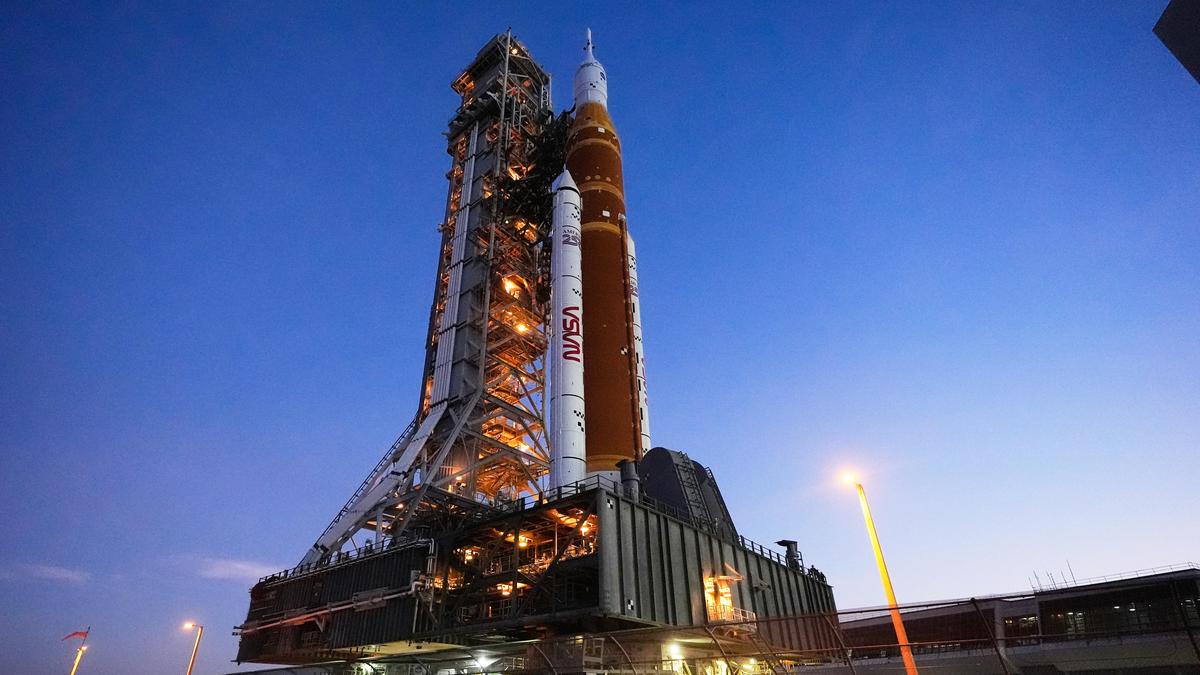
Artemis II is the bridge. Without it, we don't get to Artemis III, which is the actual landing. This mission validates the Space Launch System (SLS) rocket and the Orion capsule. Orion is a beast. It’s designed to keep humans alive for weeks in a high-radiation environment outside the Earth’s protective magnetic field.
The crew choice matters too. Victor Glover will be the first person of color to leave low Earth orbit. Christina Koch will be the first woman. Jeremy Hansen represents Canada, our closest partner in this. This diversity isn’t just for show. It’s about building a global coalition. The U.S. is leading through the Artemis Accords, a set of principles for peaceful space exploration that over 40 nations have signed. China, meanwhile, is building its own rival bloc. We're seeing the world split into two different visions for how space should be governed.
The Economic Risk of Standing Still
Space is a trillion-dollar economy in the making. If the U.S. slows down, we lose our edge in aerospace manufacturing and satellite technology. Think about GPS, weather forecasting, and global communications. All of that relies on space dominance.
Thousands of jobs across all 50 states depend on the SLS and Orion programs. Companies like Boeing, Lockheed Martin, and Northrop Grumman are the backbone, but there are hundreds of small suppliers too. If Artemis II fails or gets delayed indefinitely, that industrial base withers. We can't just flip a switch and get that expertise back. Once you lose the ability to build world-class rockets, you're at the mercy of whoever still can.
Technical Hurdles That Keep Engineers Up
Space is hard. It’s actually harder now than it was in 1969 because our safety standards are much higher. During Artemis I, the heat shield on the Orion capsule wore away in a way engineers didn't expect. It "charred" and lost material differently than the computer models predicted. NASA spent much of 2024 and 2025 analyzing this.
You don't put humans on a rocket until you're sure they won't burn up on reentry at 25,000 miles per hour. There's also the issue of the mobile launcher. The massive structure that holds the rocket at Kennedy Space Center took a beating during the Artemis I launch. Repairs and upgrades are slow. We're playing a high-stakes game of Tetris with hardware, funding, and physics.
Why This Matters to Your Everyday Life
You might wonder why we’re spending billions on the moon when there are problems on Earth. It’s a fair question. But the tech we develop for the moon usually ends up in your pocket or your hospital.
Water purification systems developed for the ISS are used in remote villages today. Better batteries, lightweight materials, and advanced medical imaging all have roots in space tech. Artemis II forces us to solve the problem of living in a harsh, resource-scarce environment. Those solutions—like high-efficiency solar or closed-loop recycling—are exactly what we need to solve climate and resource issues here at home.
The Geopolitical Fallout of Failure
If the U.S. retreats from the moon, we cede the narrative of progress. In the 20th century, the Apollo missions proved the superiority of democratic systems and American engineering. In the 21st century, the Artemis program serves the same role.
A successful Artemis II tells the world that the U.S. is still the leader in high-tech exploration. It signals to allies that we're a reliable partner and to adversaries that we haven't lost our will to do big things. If we stumble, it validates the argument that the West is in decline. It’s about soft power as much as it is about rocket engines.
Steps to Follow the Mission
Don't just wait for the 30-second clip on the evening news. This is history in the making and you can actually track it.
- Watch the pre-flight testing at Kennedy Space Center. NASA streams most of the major milestones.
- Read the Artemis Accords. It’s a short document that explains exactly how we plan to keep space peaceful.
- Check out the NASA "Artemis" app. It gives real-time updates on the hardware builds.
- Support STEM initiatives in your local schools. We need the next generation of engineers to actually build the lunar bases Artemis II is paving the way for.
The window for Artemis II is narrow. Every delay gives the competition more time to close the gap. We're at a crossroads where space exploration stops being a dream and starts being a core part of our national infrastructure. If we don't lead, someone else will, and they likely won't share our values regarding transparency and open science. Pay attention to the pad at 39B. Everything is on the line.