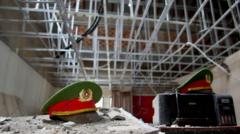
The seizure of sprawling scam compounds across Southeast Asia has revealed a chillingly sophisticated mimicry of international law enforcement. These are not mere boiler rooms hidden in basements. They are fortified mini-cities, often spanning several city blocks, designed to project an aura of state-sanctioned authority to both victims and the captive workforce within. When investigators breached the gates of recent sites in the Mekong region, they didn't just find rows of computers; they found meticulously constructed film sets. Replicas of Australian, Chinese, and Brazilian police stations stood ready for high-definition video calls, complete with authentic uniforms, official-looking badges, and the cold, bureaucratic lighting of a precinct office. This is the industrialization of the "authority scam," a multi-billion-dollar shadow economy that has moved past simple phishing and into the realm of total psychological immersion.
The primary objective of these compounds is to bypass the victim's skepticism by weaponizing their respect for the law. By appearing as a uniformed officer from the victim's home country, the scammer instantly shifts the dynamic from a suspicious solicitation to a terrifying legal crisis. The infrastructure found in these seized locations proves that criminal syndicates are no longer content with scripts. They are investing millions in physical assets to ensure the "hook" is inescapable.
The Engineering of Coercion
To understand why these compounds exist, one must look at the logistical nightmare of modern fraud. Operating a global scam network requires hundreds, sometimes thousands, of disciplined workers. The compound model solves the problem of "talent management" through human trafficking and physical imprisonment. These locations are designed as self-contained ecosystems. They feature dormitories, cafeterias, gyms, and, most importantly, high-security perimeters that keep the "employees" in as much as they keep the public out.
The interior design of the scam floors is a masterclass in deception. In the "Australian wing" of a recently dismantled operation, the attention to detail was surgical. The wall paint matched the specific shade of blue used in New South Wales police stations. Behind the scammer’s desk hung a framed portrait of a government official and a legitimate-looking organizational chart. When a victim in Sydney receives a video call, they see a background that reinforces every cultural marker of a government office. They aren't looking at a grainy image from a basement; they are looking at a high-fidelity recreation of their own state’s power.
This setup facilitates the "Social Engineering" cycle. A worker, often a victim of human trafficking themselves, initiates contact via a text or voice call claiming a package has been seized or a bank account is under investigation for money laundering. When the victim becomes defensive or skeptical, the call is "escalated" to a superior. This is where the physical set comes into play. The victim is told to switch to a video platform for "official verification." The moment the camera turns on and they see a uniformed officer sitting in what looks like a genuine police station, the psychological battle is largely won.
Why Law Enforcement is Always Two Steps Behind
The existence of these compounds highlights a massive failure in international jurisdictional cooperation. Most of these sites are located in "Special Economic Zones" or border regions where local oversight is either non-existent or heavily compromised by corruption. By the time an international agency like Interpol coordinates with local police to raid a compound, the leadership has often been tipped off. They vanish, leaving behind only the low-level "slaves" of the operation and the physical shells of their fake precincts.
Furthermore, the technology used to mask these operations is evolving faster than the legislation meant to track it. Scammers utilize sophisticated "SIM boxes"—hardware that can hold hundreds of SIM cards and route calls through local numbers—to make a call from a compound in Myanmar appear as if it is coming from a local precinct in Melbourne or São Paulo. Combined with deepfake technology, which is increasingly being used to map the faces of real officers onto the scammers in the compounds, the line between reality and fraud has blurred to the point of invisibility.
The Economics of the Fake Precinct
From a business perspective, the "fake police station" is a high-cost, high-reward investment. Constructing a compound and outfitting it with the necessary technology and sets requires significant upfront capital. However, the return on investment is staggering. A single successful "long-con" targeting a wealthy individual can net the syndicate upwards of $500,000. With hundreds of calls being made daily, the compound pays for itself within months.
The syndicates operate with the efficiency of a Fortune 500 company. They have HR departments, IT support, and even "quality control" teams that review call recordings to refine scripts and improve the believability of the fake officers. They study the legal systems of the countries they target. If a scammer is posing as a Chinese Public Security Bureau officer, they know the specific terminology of a "procuratorate" and the exact sequence of a criminal investigation. This isn't guesswork; it is a dedicated study of state mechanisms used to destroy individuals.
The Human Cost Inside the Walls
While the world focuses on the financial loss of the victims, the reality inside the compounds is a human rights catastrophe. The workforce is largely comprised of young people from across Asia and Africa who were lured by the promise of high-paying tech jobs. Upon arrival, their passports are confiscated. They are told they owe a "debt" for their travel and housing, which can only be paid off by hitting aggressive scamming quotas.
Those who fail to meet their targets or attempt to escape are subjected to physical abuse, solitary confinement, and starvation. The "fake police station" is thus a double-edged sword of deception. For the victim on the phone, it is a symbol of terrifying authority. For the worker sitting in the chair, it is a theater of survival where they must perform their role perfectly or face the very real violence of their captors.
The seized compounds have provided a wealth of data, but they also serve as a warning. As soon as one site is shuttered, another opens in a different jurisdiction, often with better equipment and more convincing sets. The criminal organizations are decentralized, fluid, and incredibly wealthy. They don't need a single headquarters; they need a series of disposable stages.
Tactical Realities of the New Fraud Era
Combatting this requires a shift in how the public perceives digital communication. The old advice of "checking the number" is obsolete. Spoofing technology makes the number on the screen meaningless. The presence of a uniform on a video call is no longer proof of identity. We have entered an era where visual evidence can be manufactured at scale in an industrial setting.
The only effective defense is a complete refusal to engage with unsolicited "official" contact via digital channels. Real police departments do not conduct entire criminal investigations or demand "security deposits" to clear a name via WhatsApp or Telegram. They do not ask for cryptocurrency or wire transfers to "holding accounts" during a video call.
The existence of these compounds proves that the perpetrators are no longer interested in the "low-effort" scam. They are building a shadow world where the visual language of the state is used to strip citizens of their life savings. Until international pressure can force the closure of the lawless zones where these compounds thrive, the fake Australian, Chinese, and Brazilian police stations will continue to multiply. They are the brick-and-mortar manifestations of a digital plague that has found a way to bridge the gap between the virtual and the physical.
The next time you see a badge on a screen, remember the blue paint in the Mekong. The most dangerous lies are the ones that look exactly like the truth. The burden of skepticism now rests entirely on the individual, as the traditional markers of authority have been successfully hijacked, commoditized, and housed behind barbed wire.
Verify through independent, offline channels every single time. There is no alternative.