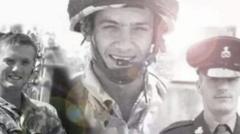
The unveiling of a memorial to three soldiers is not merely a local event; it is a deliberate act of socio-political engineering designed to convert transient human experience into a permanent cultural asset. Commemorative structures serve as physical anchors for collective memory, ensuring that specific historical narratives survive the decay of living testimony. To understand the significance of this unveiling, one must analyze the mechanics of institutional memory, the logistical requirements of public tributes, and the psychological impact of spatial sanctification.
The Tripartite Model of Public Remembrance
A memorial functions through three distinct operational pillars. When these pillars align, the monument transitions from a static object into a functional piece of social infrastructure.
- The Symbolic Anchor: The physical representation—whether bronze, stone, or steel—serves as the medium. Its durability is a direct response to the fragility of biological memory. By utilizing materials with high resistance to environmental degradation, the state or community asserts that the sacrifice of the three soldiers is immune to the passage of time.
- The Ritualistic Interface: The unveiling ceremony itself acts as a formal activation of the site. It establishes the protocols for how the public will interact with the space in the future. The presence of dignitaries, families, and military personnel creates a hierarchy of grief and respect that dictates subsequent public behavior at the location.
- The Pedagogical Function: Memorials are teaching tools. They condense complex geopolitical conflicts into a singular, digestible narrative of service and loss. For the observer, the memorial simplifies the "why" of military engagement into the "who" of personal sacrifice.
The Logic of Spatial Selection
The placement of a memorial is never accidental. It follows a strict logic of visibility and historical resonance. Proximity to civic centers or the specific locations of a soldier’s origin creates a geographical bond between the individual and the community. This spatial choice transforms a neutral public area into a "sacred" zone.
The cost of such an installation involves more than the raw materials of the monument. It includes the permanent dedication of land—a resource with fluctuating economic value—into a non-productive, high-sentiment asset. This conversion signifies a community's willingness to prioritize historical continuity over immediate commercial or residential utility.
Mechanism of Collective Identity Formation
Public monuments solve a specific social problem: the fragmentation of identity. By honoring three specific soldiers, the community creates a focal point for shared values. This process operates via several psychological mechanisms.
Validation of Service
For the families and surviving peers, the memorial provides an external validation of internal trauma. The state’s recognition through physical infrastructure acts as a formal "receipt" for service rendered. This reduces the friction of reintegration for veterans and provides a framework for the mourning process.
Narrative Standardization
Without a central physical point of reference, the story of these three soldiers would inevitably drift. Individual accounts would diverge, and details would blur. The memorial freezes the narrative in a specific pose or inscription. It provides the "official" version of events, which becomes the benchmark for all future discourse regarding their service.
The Logistics of Enduring Tributes
The transition from a concept to an unveiled monument requires a rigorous procurement and maintenance strategy. Failure in these logistical phases results in a "dead" memorial—one that is neglected and loses its communicative power.
- Material Selection: The choice between granite and bronze is dictated by the local climate and the desired aesthetic of permanence. Granite offers high compressive strength and resistance to acid rain, while bronze allows for greater detail in figurative sculpture but requires periodic patination to prevent unappealing oxidation.
- Fundraising and Governance: The financial backing of a memorial often involves a mix of private donations and public grants. This creates a stakeholder map that includes local government, veterans’ organizations, and civilian contributors. Each group has a vested interest in how the history is portrayed.
- Maintenance Cycles: A memorial requires a perpetual care fund. Neglected monuments convey a message of forgotten relevance. Therefore, the unveiling is actually the start of an ongoing operational expense.
Identifying the Bottlenecks in Modern Commemoration
While the unveiling of a memorial is a moment of high emotional and social impact, several factors can limit its long-term efficacy.
The first limitation is Contextual Drift. As generations pass, the specific conflict or circumstances that led to the soldiers' sacrifice may become obscure to the general public. If the memorial lacks sufficient explanatory text or digital integration (such as QR codes linking to historical archives), it risks becoming an "invisible" landmark—a shape in the park that no longer communicates its original intent.
The second limitation is Aesthetic Alienation. Trends in commemorative art shift from literal, figurative representations to abstract symbolism. A memorial that feels "dated" can lose its resonance with younger demographics. The challenge for designers is to create a visual language that remains legible across decades.
Structural Comparison: Individual vs. Collective Memorials
The decision to honor three specific soldiers as a unit, rather than as part of a larger mass memorial, shifts the psychological focus from "The Many" to "The Few." This creates a more intimate connection for the viewer.
In a mass memorial, such as a wall of names, the individual is a data point. In a tripartite memorial, the individuals are protagonists. This distinction is vital for small communities where the social fabric is tightly woven. The loss of three individuals represents a significant percentage of the local demographic's "human capital" and social history, necessitating a more focused architectural response.
Strategic Integration of Historical Assets
To maximize the impact of the newly unveiled memorial, the community must move beyond the initial ceremony and integrate the site into its ongoing cultural and educational programming. This involves several tactical steps.
Local schools should incorporate the site into history curricula, using the soldiers’ biographies as case studies for broader historical themes. This transforms the monument from a static object into an active educational resource. Furthermore, the site should be utilized for annual re-dedications. These recurring events function as "software updates" for the community’s memory, reinforcing the values established at the original unveiling.
The ultimate success of a memorial is measured by its ability to remain a site of active engagement rather than becoming a background element of the urban landscape. The focus must remain on the tension between the silence of the stone and the ongoing dialogue of the community it serves.
The most effective commemorative strategy involves the digital archival of the unveiling proceedings and the personal histories of the three soldiers. This ensures that even if the physical monument suffers catastrophic damage or the site becomes inaccessible, the data—the "memory" itself—remains retrievable and protected. Physical infrastructure is the frontline of remembrance, but digital redundancy is its insurance policy.