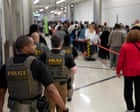
Sarah is staring at a plastic bin of graying shoes.
Behind her, a businessman is vibrating with a frantic, caffeinated energy, his briefcase bumping against her calf every time the line inches forward. To her left, a toddler is hitting a pitch of screaming that feels less like a tantrum and more like a siren warning of an impending structural failure. Sarah isn’t afraid of the plane. She isn’t worried about turbulence or the statistical improbability of an engine flameout.
She is vibrating because she has been standing in this hall for seventy-two minutes, and she still hasn't reached the metal detector.
We have long misdiagnosed air travel anxiety. For decades, the industry treated it as a phobia of heights or a fear of mechanical failure. We focused on the "air" part of the equation. But for the modern traveler, the plane is often the only place where the panic finally subsides. The true trauma of 21st-century transit lives in the liminal spaces—the tile-floored purgatories, the serpentine queues, and the shifting goalposts of the "on-time" departure.
This is the hidden tax on the human nervous system.
The Illusion of Control
Humans are wired to handle stress when that stress has a clear trajectory. If you are running from a predator, your body knows what to do. But if you are standing in a TSA line that hasn't moved in twenty minutes while an overhead monitor flashes "Gate Closing," your biology short-circuits. This is "learned helplessness," a psychological state where an individual forced to endure aversive stimuli becomes unable or unwilling to avoid subsequent encounters with those stimuli, even if they are "escapable."
In an airport, you have no agency. You cannot walk faster to make the line move. You cannot negotiate with the biometric scanner that refuses to recognize your face. You are a data point being processed through a bottleneck.
Psychologically, the airport is designed to strip away the "self." You are told when to take off your belt. You are told where to stand. You are barked at by overhead recordings to keep your bags with you at all times, a constant, low-level reminder of potential catastrophe. By the time Sarah actually reaches her seat, her cortisol levels aren't just elevated; they have rewritten her mood for the next forty-eight hours.
The Biology of the Bottleneck
Consider the sensory environment. Airports are masterpieces of overstimulation. The lighting is almost universally a sterile, flickering fluorescent or a harsh LED. The acoustics are a chaotic wash of rolling suitcase wheels, distant announcements, and the hum of industrial HVAC systems.
When we are exposed to this much "white noise" and visual clutter, our prefrontal cortex—the part of the brain responsible for logical reasoning and emotional regulation—begins to fatigue. This is why otherwise rational adults find themselves weeping over a cold $14 turkey sandwich or snapping at a gate agent who has no control over the weather in Chicago.
It isn't about the sandwich. It is about the cumulative erosion of the ego.
Statistically, the "disruptions" we face are increasing. It isn't just your imagination. A combination of staffing shortages, aging air traffic control technology, and a razor-thin margin for error in flight scheduling means that a single thunderstorm in Atlanta can ripple across the entire hemisphere. We are flying in a system that is perpetually running at 99% capacity. There is no slack in the rope. When the rope snaps, the passengers are the ones who feel the whiplash.
The Invisible Stakes
Imagine a hypothetical traveler named Elias. Elias is traveling for a funeral. He has exactly four hours of "buffer" time. To a logistics computer, four hours is a robust margin. To a human heart, those four hours are a fragile shield against grief.
When the "Delay" notification pings on his phone, Elias doesn't just see a later arrival time. He sees the window of his final goodbye closing. The anxiety he feels isn't "travel anxiety" in the traditional sense. It is the terror of being trapped in a system that does not recognize his humanity. To the airline, he is seat 22B. To himself, he is a son trying to get home.
This disconnect is the core of the modern travel crisis. We have optimized for efficiency, but we have failed to optimize for the human spirit. We have built cathedrals of glass and steel that are marvels of engineering but deserts of empathy.
The Ritual of Departure
Historically, travel was a ritual. It had a beginning, a middle, and an end. There was a sense of "crossing over." Today, the "middle" has expanded to swallow the journey. We spend more time in the infrastructure of travel than we do in the act of traveling.
The result is a collective, low-grade trauma. We approach the airport with our shoulders hunched, our teeth clenched, and our "fight or flight" response pinned to the red. We expect the worst. We expect the line to be long, the staff to be tired, and the seat to be cramped.
And expectations have a funny way of becoming reality. When we enter a space expecting conflict, we project it. We become less patient with our fellow travelers. We see the family struggling with three strollers not as people in need of a hand, but as obstacles to our own survival. The airport becomes a literalized version of Thomas Hobbes’ "war of all against all."
Reclaiming the Breath
So, how do we survive a system designed to ignore us?
It starts with an honest naming of the problem. We must stop telling ourselves that we are "afraid of flying" when we are actually "afraid of being trapped." By identifying the source of the tension—the loss of agency, the sensory overload, the stakes of the destination—we can begin to build a mental bulkhead against the chaos.
Some travelers have turned to radical acceptance. They arrive four hours early, not because they need to, but because they refuse to let the "Time Demon" sit on their chest. They bring noise-canceling headphones as a literal shield for their nervous system. They treat the airport as a test of stoicism rather than a race to be won.
But the burden shouldn't only be on the passenger. There is a growing movement in "trauma-informed design" for public spaces. Architects are beginning to experiment with "green zones"—areas of airports with natural light, living plants, and a total absence of loudspeakers. They are realizing that a calm passenger is a more profitable passenger. A human who feels like a human is less likely to cause a "disruption" that grounds a flight.
The Final Gate
Back at the security line, Sarah finally reaches the front. She pushes her bin onto the rollers. She walks through the scanner. On the other side, she pauses.
She watches the man with the briefcase, still vibrating, still rushing. She watches the child, now exhausted and slumped in a stroller. She takes a breath. It is a shallow breath, flavored with the scent of jet fuel and floor wax, but it is hers.
The plane is waiting. It is a silver tube that will hurtle her through the stratosphere at five hundred miles per hour. That part is easy. The hard part is already over. She has survived the hall of mirrors. She has navigated the maze. She is still herself, even if the system tried its best to turn her into a barcode.
The gate is open. The jet bridge is a dark tunnel leading to the sky. She walks down it, not toward a destination, but away from the noise, seeking the only place left where the world finally goes quiet: thirty thousand feet above the breaking point.