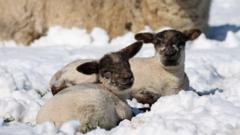
The child stands by the window, nose pressed against the glass, eyes searching the graying horizon for a miracle. In his mind, Easter isn't just about chocolate eggs hidden in the damp grass of the garden. It is about a transformation. He wants the world to turn white, to see the rabbit tracks etched into a fresh powder that shouldn't, by all laws of the calendar, be there. He is waiting for a "White Easter."
But the odds are stacked against him. Heavily.
The dream of a snowy Easter is a peculiar kind of psychological haunting. We are conditioned by Christmas—a holiday fixed firmly in the dead of winter—to associate divinity and celebration with a blanket of frost. When Easter arrives, often trailing the first tentative scents of wild garlic and damp earth, we secretly crave one last visit from the North. We want the seasons to collide. Yet, if you look at the cold, hard data provided by decades of meteorological records, you begin to realize that the White Easter is less of a seasonal staple and more of a statistical ghost.
The Mathematical Cruelty of the Calendar
To understand why your boots are more likely to be covered in mud than snow this Sunday, you have to look at the erratic behavior of the holiday itself. Unlike Christmas, which sits comfortably on December 25th, Easter is a wanderer. It follows the Paschal Full Moon, drifting anywhere between March 22nd and April 25th.
This five-week window makes all the difference in the world.
In the Northern Hemisphere, late March is a transitional battlefield. The atmosphere is a chaotic mess of retreating arctic masses and the first bold surges of subtropical warmth. If Easter falls in March, the probability of snow rises significantly. In places like the United Kingdom or the Northern United States, the statistical likelihood of seeing snow on the ground on a March Easter can hover around 10% to 15%.
Move that date to mid-April, however, and the odds plummet. By then, the sun’s angle has shifted. The ground has begun to absorb heat. Even if the clouds manage to squeeze out a few flakes, they rarely survive the contact with a warming earth. They vanish. Melted. Forgotten before the morning service begins.
A Tale of Two Easters
Consider a hypothetical family in Chicago. Let’s call them the Millers. In 1970, they woke up to a world transformed. Easter fell on March 29th that year, and a rogue storm dumped significant accumulation across the Midwest. The "invisible stakes" for the Millers weren't just about aesthetics; it was about the disruption of tradition. The outdoor egg hunt was cancelled. The pastel dresses were buried under heavy wool coats. The snow was a beautiful intruder that redefined their memory of the day.
Compare them to the Millers of 2023. Easter fell on April 9th. The sun was out, the temperature was a mild 55 degrees, and the snow was a distant myth. The data tells us that for every one "Miller 1970" experience, there are nearly ten "Miller 2023" experiences. We remember the anomalies because they break the script. We forget the mild days because they follow it.
Statistically, snow is actually more common at Easter than it is at Christmas in certain parts of the world, such as the UK. This sounds like a contradiction, but it's a matter of timing. The British Isles often see their coldest "winter" weather in January and February, but the volatile nature of March means that "spring" snow showers are a recurring character in the climate narrative. But there is a catch.
Snow that falls is not the same as snow that stays.
The Physics of the Disappearing Flake
Metaphorically, snow at Easter is like a guest who arrives at a party where they aren't wanted. The atmosphere might be cold enough to create the flake—this requires the "thickness" of the air to be below a certain threshold, usually around 528 decameters—but the surface of the planet has already moved on.
When a snowflake falls in December, it lands on soil that has been cooling for months. It finds a home. When it falls in April, it hits a surface that has been drinking in the strengthening spring sun. The heat capacity of the soil acts as a thermal shield. This is why "White Easters" are often recorded by meteorologists as "snow falling" rather than "snow lying." To the record books, it counts. To the child at the window, it’s a disappointment. It doesn't stick.
The Ghost in the Machine of Climate Change
We cannot discuss the likelihood of a white Easter without acknowledging the warming shadow of the 21st century. The baseline is shifting. Historical data from the mid-20th century suggested a certain rhythm of spring cold snaps. Today, that rhythm is stuttering.
As global mean temperatures rise, the "cold snaps" required for Easter snow are becoming shallower and shorter. We are seeing a compression of winter. The window for snow is narrowing, retreating back into January and February, leaving March and April to the rain and the wind. While extreme weather events can still produce late-season blizzards—often fueled by an unstable Jet Stream—the everyday reality is a steady march toward greener, wetter springs.
The "invisible stakes" here are cultural. We are losing the visual vocabulary of the seasons. If the white Easter becomes a once-in-a-century event rather than a once-in-a-decade surprise, something subtle breaks in our connection to the turning year. We lose the "shiver" of spring.
The Odds in Your Backyard
If you are looking for a hard number, a "probability" to bet on, you have to look at your latitude.
If you live in the Highlands of Scotland or the peaks of the Rockies, a white Easter isn't just likely; it’s a frequent reality. In these high-altitude realms, winter doesn't surrender until May. But for the vast majority of the population living in temperate lowlands, the odds are roughly 1 in 30 for any given year.
It is a gamble. A long shot.
The child at the window doesn't care about 1-in-30 odds. He doesn't care about decameters of atmospheric thickness or the thermal capacity of the topsoil. He is looking for the magic that happens when the atmosphere defies the calendar. He is looking for the moment the world stops being predictable.
But for the rest of us, the adults checking the weather app while we brine the lamb and hide the plastic eggs, the truth is simpler. The white Easter is a beautiful, rare glitch in the system. It is a reminder that nature doesn't adhere to our holiday schedules or our desire for a perfect photo op.
Rain is coming. The wind will likely be sharp. The ground will be cold and the sky will be a bruised shade of violet. You should probably bring a jacket. The snow is staying in the clouds this year, hovering just out of reach, waiting for a March long ago or an April far in the future.
The rabbit will leave his tracks in the mud, and the eggs will be found among the damp, greening shoots of the tulips, and the world will continue its slow, inevitable thaw.