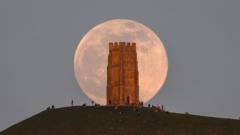
On the night of April 13, 2026, the lunar cycle reaches its peak. This is the moment the Pink Moon takes center stage. To see it at its most imposing, you must look to the eastern horizon at dusk, precisely as the sun dips below the opposite edge of the world. For observers in North America, the moon reaches its technical peak illumination at approximately 11:15 PM Eastern Time, but the astronomical "exact" moment matters less than the atmospheric conditions at moonrise.
The name is a bit of a marketing lie. You will not see a neon-magenta orb hanging in the sky. The "Pink Moon" moniker stems from the Phlox subulata, a moss pink wildflower that blankets the ground in eastern North America during early spring. Native American tribes, specifically the Algonquin, used these celestial markers as a survival calendar rather than a cosmic light show. While the moon itself remains its usual dusty gray, the timing of this specific full moon often aligns with the perigee—the point in the moon's orbit where it is closest to Earth.
The Physics of the Lunar Illusion
The most striking version of the Pink Moon happens within the first twenty minutes of its appearance. When the moon sits low on the horizon, it appears massive. This is not because it is actually closer to you, but because of a cognitive trick called the Ponzo illusion. Your brain compares the moon to terrestrial objects like trees, buildings, or mountains. Without these reference points, when the moon is high in the zenith, it looks smaller, even though its physical size on your retina has not changed.
Atmospheric scattering plays a secondary role in the "Pink" narrative. As the moon rises, its light must travel through a thicker layer of Earth's atmosphere than when it is overhead. This density filters out shorter blue wavelengths, leaving behind the longer red and orange wavelengths. If there is high humidity or local particulate matter—dust or smoke—the moon may actually take on a bruised, copper, or pale rose hue. It is a fleeting trick of light, gone the moment the orb climbs high enough to shed the weight of the horizon's air.
Orbital Mechanics and the Perigee Factor
To understand why some April moons feel more significant than others, we have to look at the elliptical nature of the lunar orbit. The moon does not circle us in a perfect ring. Instead, it follows a wobbling path.
In 2026, the April full moon occurs within a window that brings it remarkably close to Earth. While astronomers often debate the strict definition of a "Supermoon," the visual impact remains consistent. When the moon is at perigee, it can appear up to 14% larger and 30% brighter than at its furthest point, known as apogee.
Why Timing Matters for Photography
If you are trying to capture the event, the "peak" time listed in most almanacs is actually your worst enemy. A full moon at midnight is a blown-out white circle against a pitch-black void. There is no contrast. There is no story.
The professional window is the "Blue Hour." This occurs about 20 to 30 minutes after sunset. At this stage, there is still enough residual light in the atmosphere to illuminate the foreground, but the sky has darkened enough for the moon to glow. This balance allows a camera sensor to capture the textures of the lunar craters (the Maria) alongside the silhouettes of the landscape.
The Ecological and Cultural Ripple Effect
The Pink Moon is more than a social media trend; it is a biological trigger. In coastal regions, the increased gravitational pull during a full moon—combined with the perigee—results in "King Tides." these are exceptionally high spring tides that can cause localized flooding even without a storm.
For the agricultural sector, the Pink Moon traditionally signaled the end of the killing frosts. In the Old Farmer’s Almanac tradition, this was the "Sprouting Grass Moon" or the "Egg Moon." It marked a shift in labor, moving from the maintenance of tools to the breaking of soil. While modern industrial farming relies on satellite data and soil sensors, the lunar cycle still dictates the behavior of nocturnal pollinators and the migration patterns of certain bird species that use the moon’s light to navigate.
Countering the Supermoon Hype
It is worth noting that the term "Supermoon" was actually coined by an astrologer, Richard Nolle, in 1979, not by NASA. Scientific communities were slow to adopt the phrasing because the physical difference is often indistinguishable to the naked eye without a side-by-side comparison. We have entered an era of "lunar inflation" where every full moon is given a dramatic title to drive engagement.
However, the April Pink Moon holds a unique position because it often determines the date of Easter. In Western Christianity, Easter is observed on the first Sunday following the Paschal Full Moon—the first full moon occurring on or after the spring equinox. In 2026, the April moon serves as this pivotal marker, anchoring the liturgical calendar to the sky.
Viewing Logistics and Equipment
You do not need a telescope to appreciate the Pink Moon. In fact, a telescope often narrows the field of view too much to appreciate the "horizon effect."
- Location: Find a spot with a clear, unobstructed view of the East-Southeast horizon.
- Optics: A simple pair of 7x50 or 10x50 binoculars will reveal the Tycho crater and the dark basaltic plains.
- Light Pollution: While the moon is bright enough to cut through city smog, the subtle color shifts of the rising moon are best seen away from the amber glare of streetlights.
The moon will remain technically "full" to the casual observer for about three days, centered on the night of the 13th. If clouds ruin your view on Monday, the Tuesday moonrise will offer nearly the same visual density, rising about 50 minutes later each night.
The Reality of Cosmic Cycles
We tend to view these events as isolated spectacles, but they are part of a long-term orbital resonance. The moon is slowly drifting away from Earth at a rate of about 3.8 centimeters per year. Millions of years from now, the "Supermoon" will be a physical impossibility, as the moon will be too far away to ever cover the sun in an eclipse or dominate the horizon with its current intensity.
Every time you watch a Pink Moon rise, you are witnessing a specific, decaying window of Earth’s history. It is a reminder that the stability of our night sky is an illusion of our short lifespans. The moon isn't just a rock; it is a giant, gravitational clock.
Check your local weather forecast for cloud cover percentages around 8:00 PM local time on April 13. If the sky is clear, find a high vantage point and wait for the horizon to do the heavy lifting for you. Don't look for pink paint; look for the heavy, golden distortion of a world shifting its tides.
Grab a compass and identify your East-Southeast bearing now so you aren't searching for the moon after it has already climbed out of its most dramatic phase.