You're standing there looking at a thermostat or a weather app. It says 84 degrees Fahrenheit. If you grew up with the metric system, that number might as well be written in ancient hieroglyphics. You need to know: Is it "light jacket" weather or "I’m going to melt into the sidewalk" weather?
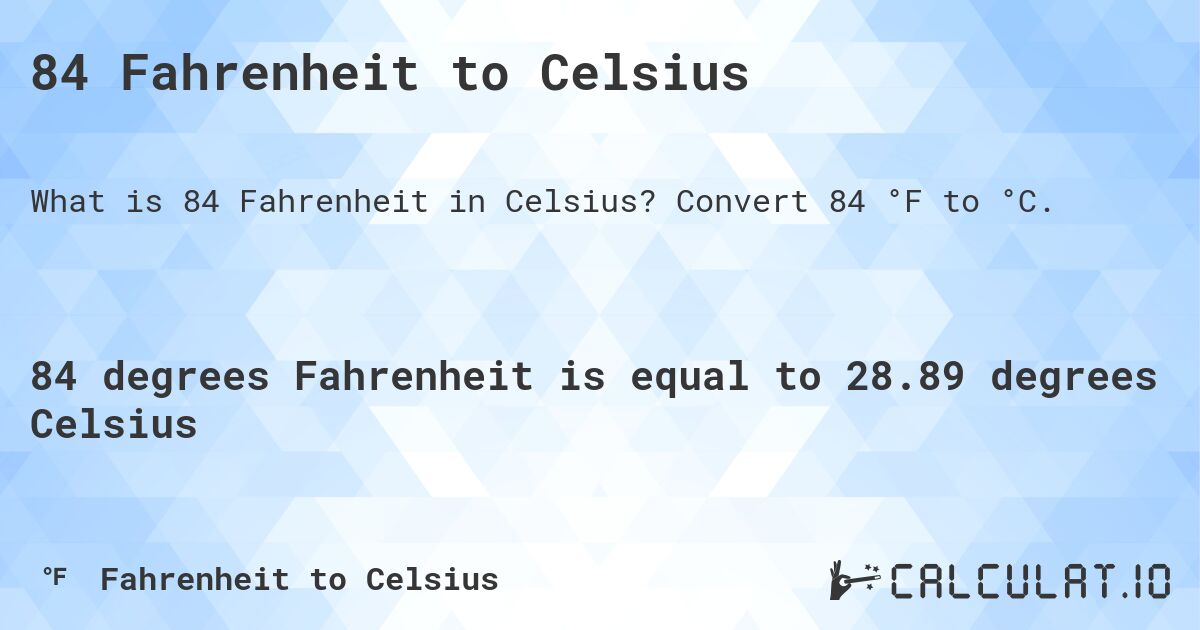
To give it to you straight, 84 F to Celsius is exactly 28.89°C.
Most people just round it up to 29°C. It’s warm. Actually, it’s arguably the most controversial temperature in the world of indoor comfort. Some people think 29°C is the perfect summer vibe, while others are already reaching for the air conditioning remote with a sense of desperation.
The Math Behind 84 F to Celsius (Without the Headache)
I know, nobody likes doing algebra on the fly. But if you're stuck without a calculator, there’s a quick mental shortcut. Subtract 30 from the Fahrenheit number, then divide by two.
84 minus 30 is 54. Half of 54 is 27.
It’s not perfect—the real answer is 28.89—but it gets you in the ballpark. If you want the precise scientific version because you're working in a lab or just like being right, the formula is:
$$C = (F - 32) \times \frac{5}{9}$$
When you plug 84 into that equation, you get:
$$28.8888...$$
Which we round to 28.89. It’s funny how a few decimal points can change how a room feels. In a high-humidity environment like Singapore or Florida, 28.89°C feels like a steam room. In a dry heat like Arizona, it’s a pleasant afternoon on a patio.
Why 28.89°C Matters for Your Health and Sleep
Believe it or not, there is a whole field of study dedicated to how our bodies react to specific thermal environments. Researchers at organizations like the American Society of Heating, Refrigerating and Air-Conditioning Engineers (ASHRAE) spend millions of dollars figuring out where humans are happiest.
Usually, the "comfort zone" ends around 78°F (25.5°C).
Once you hit 84°F, your body starts working harder. Your heart rate might tick up just a tiny bit as your system tries to dump heat through your skin. If you’re trying to sleep in 28.89°C weather, good luck. Most sleep experts, including those at the National Sleep Foundation, suggest that the optimal sleep temperature is way lower—down around 65°F (18.3°C).
Attempting to sleep at 84°F often leads to fragmented REM cycles. You toss. You turn. You wake up feeling like you went ten rounds in a boxing ring. If your room is sitting at this temperature, you're likely experiencing "thermal discomfort," a polite way of saying you're sweaty and annoyed.
The Global Perspective: Is 84°F Actually Hot?
Context is everything. Honestly, if you ask someone in London about 29°C, they’ll tell you it’s a heatwave. They’ll be out in the parks, sunbathing, and the news will be running segments on how to stay hydrated. In London, many homes aren't built with AC, so 84°F indoors is a legitimate health concern for the elderly.
Now, ask someone in Phoenix, Arizona or Dubai.
To them, 84°F is "light sweater weather" in the morning. It’s all about what your body is acclimated to. This biological adaptation is called thermal homeostasis. Your sweat glands actually become more efficient over time if you live in a hotter climate.
Plants and Pets at 29°C
It isn't just about us. Your dog or cat experiences 84°F differently. Dogs don't sweat like we do; they pant. If the indoor temperature is hovering at 28.89°C, make sure they have plenty of water.
For the gardeners out there, 84°F is a magic number for many vegetables. Tomatoes, for instance, love this range. However, once you start creeping much higher than 30°C (86°F), some plants actually stop producing fruit because the heat stresses the pollen. 28.89°C is basically the "Goldilocks" zone for a backyard garden—warm enough to grow, but not so hot that things start to wither.
Practical Applications: Cooking and Tech
Why would you need to know 84 F to Celsius in a kitchen? You probably wouldn't for an oven—that would be a very cold oven. But for fermentation, it’s a big deal.
If you are a sourdough baker or you make your own kombucha, the ambient temperature of your kitchen matters immensely. Most yeast strains are incredibly active around 28-29°C. If your kitchen is 84°F, your bread dough is going to rise significantly faster than the recipe suggests. You have to watch it like a hawk to prevent over-proofing.
In the world of technology, 84°F is a bit of a warning sign for server rooms and high-end gaming PCs. Electronics hate heat. While 28.89°C isn't "melt your processor" hot, it reduces the efficiency of the cooling fans. Your computer has to work harder to stay cool, which can lead to "thermal throttling"—where your device purposefully slows down so it doesn't cook itself.
How to Handle an 84°F Day
If you're stuck in a place that's 84°F and you don't have air conditioning, don't panic. Humans have survived much worse for thousands of years.
- The Cross-Breeze Trick: Don't just open one window. Open two on opposite sides of the house.
- Humidity Management: If it's 29°C and 80% humidity, a fan won't do much because your sweat can't evaporate. Use a dehumidifier if you have one.
- Hydration: Drink water before you feel thirsty. By the time you’re thirsty, you’re already slightly dehydrated.
- Pulse Points: If you're really overheating at this temperature, run cold water over your wrists or put a damp cloth on the back of your neck. It cools the blood circulating near the surface of your skin.
What Most People Get Wrong About Temperature Conversion
The biggest mistake? Thinking the scale is linear in a way that’s easy to guess. It’s not.
Because the Celsius scale is based on the freezing and boiling points of water (0 and 100) and Fahrenheit uses 32 and 212, the gaps between the degrees are different sizes. One degree Celsius is "larger" than one degree Fahrenheit. Specifically, 1°C is equal to 1.8°F.
This is why 84°F feels very different from 80°F, even though it's only a 4-degree jump. In Celsius, that's the difference between 26.7°C and 28.9°C—a jump of over two full units.
Actionable Insights for 84°F / 28.89°C
- Check your thermostat: If you're trying to save money on electricity, setting your AC to 78°F (25.5°C) is the standard recommendation, but if you can tolerate 84°F with a ceiling fan, you'll slash your power bill by nearly 15-20% in the summer months.
- Dough Fermentation: If your kitchen is 84°F, reduce your bulk fermentation time by about 30% to avoid sour, collapsed bread.
- Wine Storage: 84°F is too hot for long-term wine storage. If you have expensive bottles sitting out at 28.89°C, they will age prematurely and develop "cooked" flavors. Move them to a cooler closet or a specialized fridge.
- Clothing Choices: At 29°C, synthetic fabrics like polyester become your enemy. Switch to linen or light cotton to allow for maximum airflow.
Understanding 84 F to Celsius isn't just about math; it's about knowing how to navigate your environment. Whether you're traveling to a metric-using country or trying to figure out why your sourdough is rising so fast, 28.89°C is a benchmark for "warm but manageable." Keep your water bottle full, your fans spinning, and remember that for a tomato, this is the best day of its life.