You're standing in the kitchen, apron on, oven preheating. The recipe calls for a specific weight, but all you've got is a plastic measuring cup and a bag of semi-sweets that’s already been opened. It happens to everyone. You need to know how many 6 ounces of chocolate chips in cups actually looks like before you ruin a batch of cookies.
Most people assume it’s a simple one-to-one ratio. It isn't. Recently making news lately: Your School Breakfast Club is Serving Mediocrity on a Plate.
If you dump 6 ounces of lead into a cup, it’s tiny. If you dump 6 ounces of feathers, you’ll need a literal bucket. Chocolate chips sit somewhere in the middle, but because they have air gaps between them—what bakers call "interstitial space"—the volume doesn't match the weight. Honestly, this is where most Pinterest-fail photos start.
Why Volume is a Dirty Word in Baking
Standard liquid measuring cups and dry measuring cups aren't the same. But even if you use the right dry cup, the brand of chocolate matters. A 6-ounce pile of Nestlé Toll House semi-sweet morsels takes up a different amount of space than 6 ounces of Ghirardelli 60% Cacao Bittersweet Chips. Why? Because the Ghirardelli chips are often wider and flatter. They don't settle into the cup as tightly. Further insights on this are explored by ELLE.
Basically, if you’re looking for a quick answer: 6 ounces of standard chocolate chips is approximately 1 cup.
But wait. There is a catch.
Standard chips—the kind you find in the yellow or maroon bags at the grocery store—usually weigh about 6 ounces per cup. However, if you are using mini chips, they pack much tighter. You’ll actually get more weight into that same cup. Conversely, if you’re using those jumbo chips or hand-chopped chocolate chunks, 1 cup might only weigh 5 ounces because there’s so much empty air between the irregular pieces.
Kitchen scales are cheap. You should buy one. Really.
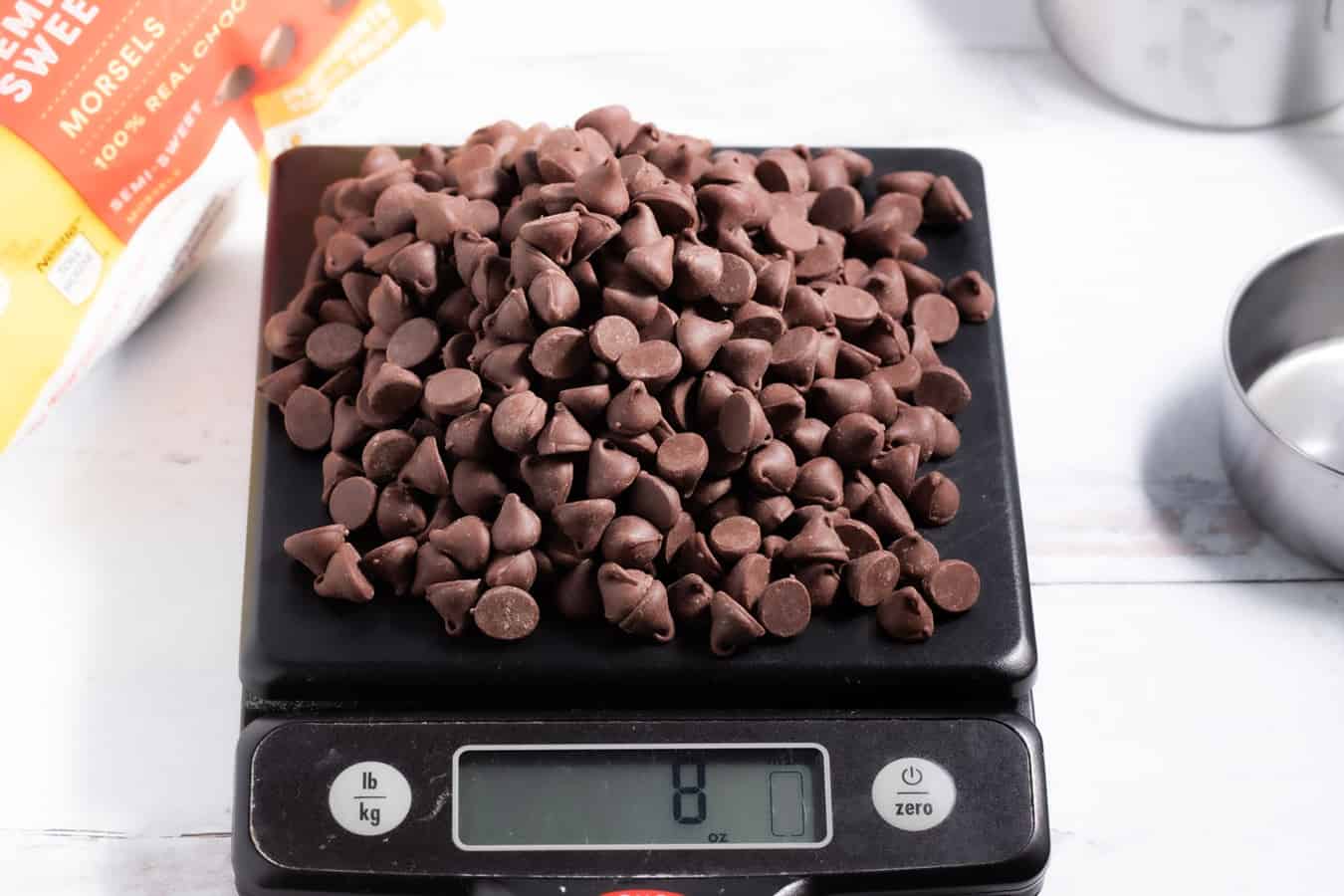
Using a scale eliminates the "did I pack this cup too tightly?" anxiety. If the recipe calls for 6 ounces, you put the bowl on the scale, hit tare, and pour until it says 6.0. No guessing. No flat cookies.
The 6 Ounces of Chocolate Chips in Cups Breakdown
Let’s look at the actual physics here. The US fluid ounce is a measure of volume (29.57 ml), while the ounce we use for chocolate is a measure of mass. This is the "ounce vs. fluid ounce" trap that confuses almost every beginner.
For standard-sized morsels, 1 cup equals 6 ounces. This is convenient because a standard 12-ounce bag is exactly 2 cups. It’s a clean, easy split. If your recipe asks for 6 ounces of chocolate chips in cups, you fill that 1-cup measure to the brim, level it off with your finger, and you’re good to go.
What about other types?
- Miniature Chips: Because they are so small, they fill in the gaps. A cup of mini chips often weighs closer to 6.5 or 7 ounces. If you use a full cup of these when the recipe specifically asked for 6 ounces by weight, you’re adding about 15% more chocolate. Usually, more chocolate isn't a "problem," but it can affect how the cookie spreads in the oven.
- Chocolate Chunks: These are the rebels. Because they are jagged and oversized, they create massive air pockets. You might need 1 and 1/4 cups of chunks to actually hit that 6-ounce mark.
- Chopped Bar Chocolate: This is the gold standard for melting or for "puddles" of chocolate in cookies. Since you're chopping it by hand, the density is all over the place. You absolutely cannot rely on a cup measure for chopped bars. Use a scale or look at the wrapper—most baking bars are 4 ounces, so you’d need one and a half bars.
Temperature and Settling: The Invisible Variables
Have you ever noticed how a box of cereal is half empty when you open it? "Settling may occur." Chocolate chips do the same thing. If you scoop your measuring cup directly into a deep bag of chips, you’re packing them down. You might end up with 6.3 ounces. If you gently sprinkle them into the cup with a spoon, you might only have 5.8 ounces.
It sounds like nitpicking. It’s not.
In a recipe for Ganache, the ratio of chocolate to heavy cream is everything. If you have too much chocolate, your ganache turns into a brick. Too little, and it stays a runny mess that won't set on your cake. For something like a classic Toll House cookie, the margin of error is wider, but precision still matters for texture.
King Arthur Baking, arguably the most respected authority on home baking in the US, generally lists a cup of chocolate chips as 170 grams. Since 1 ounce is roughly 28.35 grams, 6 ounces comes out to about 170.1 grams. So, the "1 cup = 6 ounces" rule is actually backed by the pros, provided you are using standard chips.
Converting 6 Ounces of Chocolate Chips in Cups for International Recipes
If you're looking at a recipe from the UK or Australia, they rarely use "cups" for solids. They use grams. This is infinitely better. If you see a recipe asking for 170g of chocolate, and you want to know how many ounces that is, just divide by 28.35.
170 / 28.35 = 6.00 ounces.
It’s a perfect circle. But again, if you don't have a scale and you're trying to figure out 6 ounces of chocolate chips in cups, stick to the 1-cup rule for semi-sweet morsels and maybe add a "heaping" tablespoon if you’re using large bittersweet discs or chunks.
Why Quality Changes the Volume
Cheap chocolate often contains more paraffin wax or stabilizers to keep the "kiss" or "chip" shape under high heat. High-end chocolate, like Valrhona or Guittard, has a higher cocoa butter content. Cocoa butter is a fat. It behaves differently under pressure.
While the weight remains 6 ounces, the way those chips stack can vary based on the manufacturing mold. For instance, Guittard "Super Cookie Chips" are large, flat discs. If you try to measure 6 ounces of those in a cup, you’ll find you have huge gaps. You’ll likely need nearly 1.5 cups to reach the 6-ounce weight requirement.
Common Mistakes to Avoid
Don't use a liquid measuring cup. You know the ones—the glass Pyrex jugs with the spout? It’s hard to level off solids in those. You’ll end up looking at the line from the side, which is notoriously inaccurate for dry goods. Use the nesting metal or plastic cups that allow you to sweep a knife across the top.
Also, don't melt the chocolate first and then measure. 6 ounces of solid chips will not result in 6 fluid ounces of melted chocolate. Volume changes when solids turn to liquids. Always measure your 6 ounces of chocolate chips in cups while they are in their solid, room-temperature state unless the recipe explicitly tells you otherwise.
Practical Steps for Perfect Results
If you want to be certain about your 6 ounces of chocolate chips in cups, follow this workflow:
Check the bag size first. Most standard bags are 12 ounces. If you need 6 ounces, simply use exactly half the bag. This is much more accurate than using a measuring cup. You can even use a ruler to mark the halfway point on the outside of the bag before pouring.
Use the "Spoon and Level" method if you must use a cup. Don't pack the chips down. Shake the cup gently once to let the chips settle, then add more until it’s level with the rim.
Account for chip size. If using mini chips, use a slightly "scant" cup (a little less than full). If using large chunks, use a "heaping" cup (a little more than full).
Invest in a digital kitchen scale. It’s the single most important tool for any baker. It allows you to switch between grams and ounces instantly, making sure your 6 ounces is exactly 6 ounces every single time, regardless of the brand or shape of the chocolate.
Switching to weight-based baking removes the guesswork. You’ll stop searching for conversions and start producing consistent, professional-quality results. If your recipe calls for 6 ounces, set your scale to ounces and pour until you hit 6. It’s that simple.