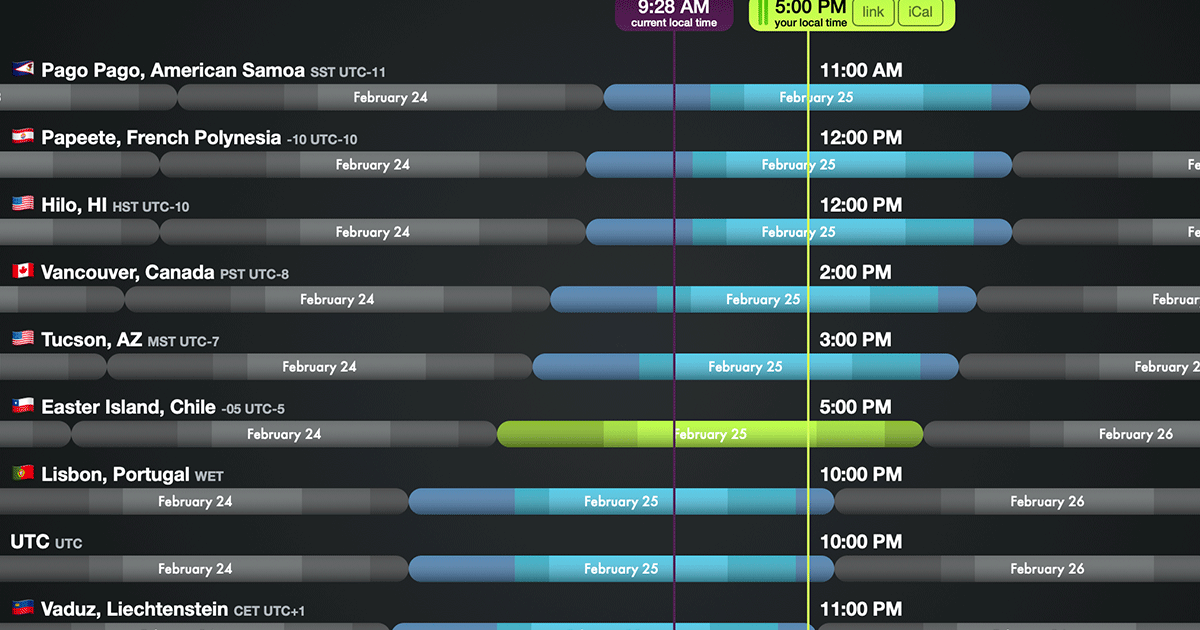
Time zones are weird. Honestly, they’re a relic of the railroad era that we’ve just collectively decided to keep suffering through because the alternative—everyone using the same clock—is somehow even more confusing. If you’re trying to figure out 5pm Pacific Time to Central, you’re likely staring at a calendar invite or a dinner reservation and wondering if you're about to be horribly late or embarrassingly early.
It’s 7:00 PM. Meanwhile, you can explore other developments here: The Ghost in the Ledger and the Art of Spending Your Own Life.
That’s the short answer. When the sun starts dipping low over the Pacific Coast Highway in Los Angeles at 5:00 PM, folks in Chicago, Dallas, and New Orleans are already two hours deep into their evening. It sounds simple. It is simple, yet we Google it every single day because our brains aren't naturally wired to juggle multiple invisible timelines while multitasking.
The Math Behind the 5pm Pacific Time to Central Jump
The United States is sliced into these vertical strips of time. Pacific Standard Time (PST) is UTC-8, while Central Standard Time (CST) is UTC-6. When we shift to Daylight Saving Time—which, let's be real, most of us wish would just go away—PST becomes PDT (UTC-7) and CST becomes CDT (UTC-5). To explore the complete picture, check out the detailed analysis by Vogue.
The gap stays the same. Two hours. Always.
If you’re on the West Coast finishing up your 5:00 PM "end of day" emails, your colleagues in the Central time zone have likely already closed their laptops. They are probably halfway through a bowl of pasta or stuck in traffic on I-94. This two-hour offset is the "dead zone" of American business. It's that awkward window where the West Coast is peaking in productivity while the Midwest is firmly in "do not disturb" mode.
Think about the geography. You've got the Mountain Time Zone sitting right there in the middle like a buffer. When it's 5:00 PM in Seattle, it's 6:00 PM in Denver, and finally 7:00 PM in Houston. People often forget Mountain Time exists, which is why they accidentally miscalculate the jump from coast to coast.
Why This Specific Time Slot Matters for Everything
Why 5:00 PM? It’s the "Golden Hour" of logistics.
In the world of live broadcasting and sports, this shift is brutal. Take a Monday Night Football game that kicks off at 5:15 PM Pacific. For a fan in Nashville or Austin, that’s a 7:15 PM start. It’s perfect. It’s prime time. But if that same game is a late-night West Coast special starting at 7:00 PM Pacific, the Central time zone viewer is looking at a 9:00 PM kickoff. By the time the fourth quarter rolls around, it’s past midnight in the South.
The 5pm Pacific Time to Central conversion is also the bane of the "National Webinar."
Marketing teams love 5:00 PM Pacific for West Coast engagement. It catches people just as they’re winding down. But for the Central audience, 7:00 PM is "family time." You’re competing with dinner, kids' homework, and Netflix. If you’re a business owner, scheduling a hard deadline for 5:00 PM PT means your Central Time clients are effectively working until 7:00 PM if they want to hit that same-day window.
Real-World Chaos: The Travel and Tech Factor
Ever flown from SFO to O’Hare? You leave at 5:00 PM. The flight is about four hours. You look at your watch when you land, expecting it to be 9:00 PM. Nope. It’s 11:00 PM. You’ve lost a chunk of your night to the "time thief."
Then there’s the tech side of things.
Most servers and automated systems run on UTC (Coordinated Universal Time). However, many consumer-facing apps default to the user's local time or a specific "Home" time zone. If a video game drops a "Midnight Release" based on Eastern Time, the Central players get it at 11:00 PM, and the Pacific players get it at 9:00 PM.
But if the release is pegged to 5:00 PM Pacific?
The Central folks are refreshing their screens at 7:00 PM. This mismatch causes "spoiler culture" to explode on social media. People in Chicago see the spoilers from the California crowd who got off work and immediately started playing, all while the Central crowd was still finishing dinner.
The Arizona Exception and Other Headache-Inducing Nuances
We can't talk about 5pm Pacific Time to Central without acknowledging the chaos that is Arizona.
Arizona does not observe Daylight Saving Time. Most of the year, Arizona is effectively on Pacific Time. But when the rest of the country "springs forward," Arizona stays put. Suddenly, they align with Mountain Time.
If you are a remote worker in Chicago (Central) trying to call a client in Phoenix during the summer, the gap is two hours. But in the winter? It's still two hours? No. Wait.
Actually, the gap between Central and Arizona changes because Central moves and Arizona doesn't. From March to November, 5:00 PM in Phoenix is 7:00 PM in Chicago. In the winter, 5:00 PM in Phoenix (which is now basically Mountain Time) is 6:00 PM in Chicago.
It is enough to make you want to throw your clock out the window.
How to Manage the Gap Without Losing Your Mind
If you’re managing a team or a life across these zones, stop trying to do the math in your head every time. You’ll eventually slip up. I’ve seen people miss flights because they did the "plus two" instead of the "minus two" in a moment of sleep-deprived panic.
- Set a Secondary Clock: If you use a Mac or Windows, you can add a secondary clock to your taskbar. Set one to PT and one to CT. Don't think. Just look.
- The "Rule of Seven": A weird trick some people use is remembering that 5:00 PM PT always ends in a 7:00 PM for Central. 5 becomes 7. 6 becomes 8. Just add two.
- Google Calendar is Your God: When you invite someone to a meeting, let the software handle the conversion. If you type "5pm PT," it will automatically show up as "7pm CT" for the person in Dallas. Never, ever send a plain text invite that just says "Let's meet at 5." Which 5? My 5 or your 5?
The Psychological Impact of the Two-Hour Difference
There is a real psychological weight to being "behind" or "ahead."
People in the Central time zone often feel like they’re in the middle of a tug-of-war. They are constantly looking East to New York and West to Silicon Valley. When it’s 5:00 PM on the West Coast, the day is still vibrant and active. There’s a "hustle" energy.
In the Central zone, 7:00 PM feels like the day is over.
This leads to "Time Zone Guilt." Remote workers in the Midwest often feel pressured to stay online until 7:00 PM to match their California bosses’ 5:00 PM finish time. Conversely, California workers might feel like they are "late" to the party because the rest of the country has been awake and emailing for hours by the time they have their first coffee.
Making the 5pm Shift Work for You
Instead of fighting it, use it.
If you live in a Central time zone city like St. Louis, and you have a deadline of 5:00 PM Pacific, you’ve just gained two hours of "bonus" time. You can work until 6:30 PM local time and still be "early" for a West Coast deadline.
If you're on the West Coast, 5:00 PM is your hard cut-off if you want to reach anyone in the middle of the country before they go to bed.
Actionable Steps for Time Zone Success
- Sync Your Smartphone: Go to Settings > Date & Time. Ensure "Set Automatically" is on, but also manually add a "World Clock" widget to your home screen for the "other" zone.
- Audit Your Calendar: Check your recurring meetings. If you have a "5pm PT" sync, realize you are asking your Central Time teammates to work until 7:00 PM. Move it to 3:00 PM PT (5:00 PM CT) to be a hero.
- Use Military Time for Logistics: If you're dealing with international or cross-country shipping, 17:00 (5pm) PT is 19:00 CT. Using the 24-hour clock reduces "AM/PM" errors significantly.
- Confirm the Date: Remember that near midnight, a time zone jump can actually change the day. While 5:00 PM PT to Central is always the same day, a 10:00 PM PT event happens on a "different" day for those on the East Coast. Always verify the date for late-night events.
The 5:00 PM Pacific to Central jump is more than just a number on a screen. It’s the boundary between the workday and the evening, between the West Coast’s sun and the Midwest’s stars. Keep that two-hour gap in your pocket, and you'll never be the person awkwardy joining a Zoom call while everyone else is signing off.