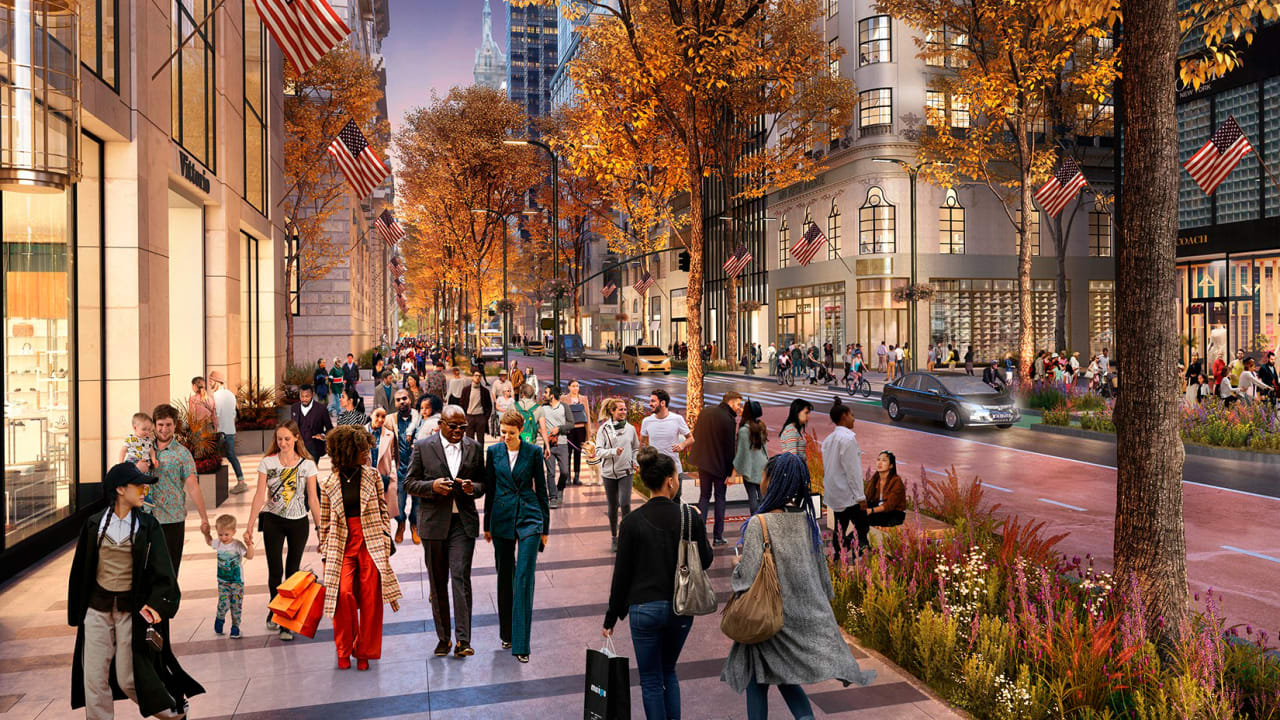
Midtown Manhattan is basically a forest of steel and glass where every building screams for your attention. Some do it with pointy spires, others with flashy LED screens. But then there's 565 Fifth Avenue New York. If you’re walking down 46th Street, you might almost miss it, which is kind of the point. It doesn’t try too hard. Honestly, it’s one of those rare spots in the Diamond District vicinity that manages to feel corporate and sophisticated without being soul-crushing.
Built back in 1993, this place isn’t a historical relic like the Chrysler Building, nor is it a super-tall toothpick for billionaires. It’s a 30-story office tower designed by Kohn Pedersen Fox (KPF), a firm that basically shaped the modern skylines of London, Tokyo, and NYC. People usually search for it because they have a meeting there or they're looking for high-end retail, but the architecture actually tells a much more interesting story about how New York changed in the nineties.
The Architecture of 565 Fifth Avenue New York
KPF didn't just throw up a square box. They used this cool mix of green granite and soft-tinted glass. It has these subtle setbacks. New York zoning laws are a nightmare, usually forcing architects to create "wedding cake" tiers so light reaches the street. At 565 Fifth, they handled those requirements with a sleekness that feels very post-modern but stays timeless.
The lobby is where things get surprisingly fancy. Think red marble and polished wood. It feels like a place where serious deals happen, the kind involving lawyers in $4,000 suits and private equity guys who haven't slept in three days. The floor plates are about 15,000 square feet on the lower levels and get smaller as you go up. This is actually a big deal for boutique firms. If you're a small hedge fund, you don't want to be tucked in a corner of a massive 50,000-square-foot floor at the World Trade Center. You want your own floor. You want to feel like the king of your own little mountain. 565 Fifth gives them that.
Location Realities: The 46th and Fifth Vibe
Let’s be real about the neighborhood. You’re right on the edge of the Diamond District. Walk half a block west and you’ll see guys carrying suitcases of emeralds and security guards with very intense stares. It’s chaotic. It’s loud. But the moment you step into the revolving doors of 565 Fifth Avenue New York, the noise just... stops.
The building is owned by the Sapir Organization. They’ve poured a lot of money into keeping it competitive because, let’s face it, Midtown is facing a massive challenge from Hudson Yards and the new One Vanderbilt. To stay relevant in 2026, an old-school Fifth Avenue tower has to offer more than just a desk. It needs air filtration, high-speed elevators, and that "prestige" factor that keeps tenants from fleeing to the Far West Side.
- Proximity to Grand Central: It’s a five-minute walk. If you’re commuting from Westchester or Connecticut, this is the holy grail.
- Retail Presence: The base of the building has hosted names like Adidas in the past. It’s high-traffic. Millions of tourists shuffle past these windows every year.
- The Views: Once you get above the 15th floor, you start to see the "real" New York. You aren't staring into someone else's cubicle across the street; you're looking at the peaks of the surrounding landmarks.
Why Tenants Still Pay the Premium
You might wonder why anyone would rent here when they could get a "cool" loft in SoHo or a glass palace in Long Island City. It comes down to the address. "565 Fifth" carries weight on a business card. It signals stability.
The building attracts a specific mix. We’re talking about wealth management, international law firms, and tech startups that have outgrown their "we work in a garage" phase and need to impress investors. The Sapir Organization has focused heavily on the "tenant experience"—a buzzword that basically means they make sure the coffee is good and the lobby doesn't look like a scene from 1982.
Efficiency is another factor. The building has a side-core design. In nerd-speak, that means the elevators and stairs are pushed to the side rather than being in the middle of the floor. This creates an open, flexible workspace. You can have an open-plan layout or a maze of private offices without a giant concrete pillar blocking your view of the hallway.
Comparing 565 Fifth to the Competition
If you look at 565 Fifth Avenue New York alongside something like 608 Fifth or the massive towers near Rockefeller Center, it occupies a "middle-luxury" niche. It's not as prohibitively expensive as the GM Building, but it's leagues above the aging "Class B" stock on the side streets.
| Feature | 565 Fifth Avenue | Typical Midtown Older Build |
|---|---|---|
| Windows | Floor-to-ceiling glass (mostly) | Small, punch-hole windows |
| Technology | Modern HVAC and fiber | Retrofitted, sometimes spotty |
| Lobby | Attended 24/7, high-end stone | Small, often cramped |
The real advantage here is the light. Because it’s a corner lot, the building catches the sun from multiple angles. In a city where "seasonal affective disorder" is a legitimate office productivity killer, having a workspace that isn't a dark cave is a massive selling point.
The Future of Midtown Office Space
Is the office dead? People have been asking that since 2020. But walk into 565 Fifth on a Tuesday morning and you’ll see the answer is a hard "no." People are back. However, they are more demanding. They want touchless entry. They want LEED certification (which this building has worked toward). They want to feel like the commute was worth it.
Recent renovations have focused on these "invisible" upgrades. Better air quality sensors. Faster internet. More communal spaces. The building has survived market crashes, a global pandemic, and the rise of remote work because it sits on one of the most valuable pieces of dirt on the planet. Fifth Avenue isn't just a street; it's a brand.
Actionable Insights for Visitors and Prospective Tenants
If you're heading to 565 Fifth Avenue New York, here is the ground-level reality of what to expect:
- Security is tight. Don't think you can just wander up to a high floor to take a photo of the view. You need a QR code or an invite. Have your ID ready at the desk.
- The "Secret" Commute: Don't use the main Fifth Avenue entrance if you're coming from the subway during rush hour. Use the 46th street side to avoid the heaviest tourist clumps.
- Leasing Strategy: If you're a business owner looking at this space, ask about the "pre-built" suites. The Sapir Organization often has spaces already designed and furnished, which saves you six months of arguing with contractors.
- Lunch Spots: Forget the tourist traps on Fifth. Head one block over to 47th or 48th for the "hidden" Japanese delis and basement eateries that the local office workers actually use.
565 Fifth Avenue New York remains a pillar of the Midtown business district. It doesn't need to be the tallest or the newest to be effective. It works because it balances the prestige of a Fifth Avenue address with the functional needs of a modern business. Whether you’re an investor looking at the REITs that hold these properties or a professional heading in for an interview, understanding the layout and the "vibe" of this building gives you a leg up in the fast-paced world of New York real estate.
The building stands as a testament to the KPF design philosophy: that a skyscraper should "speak" to its neighbors while maintaining its own distinct voice. In the sea of Midtown architecture, 565 Fifth speaks clearly, professionally, and with just enough luxury to remind you exactly where you are.


