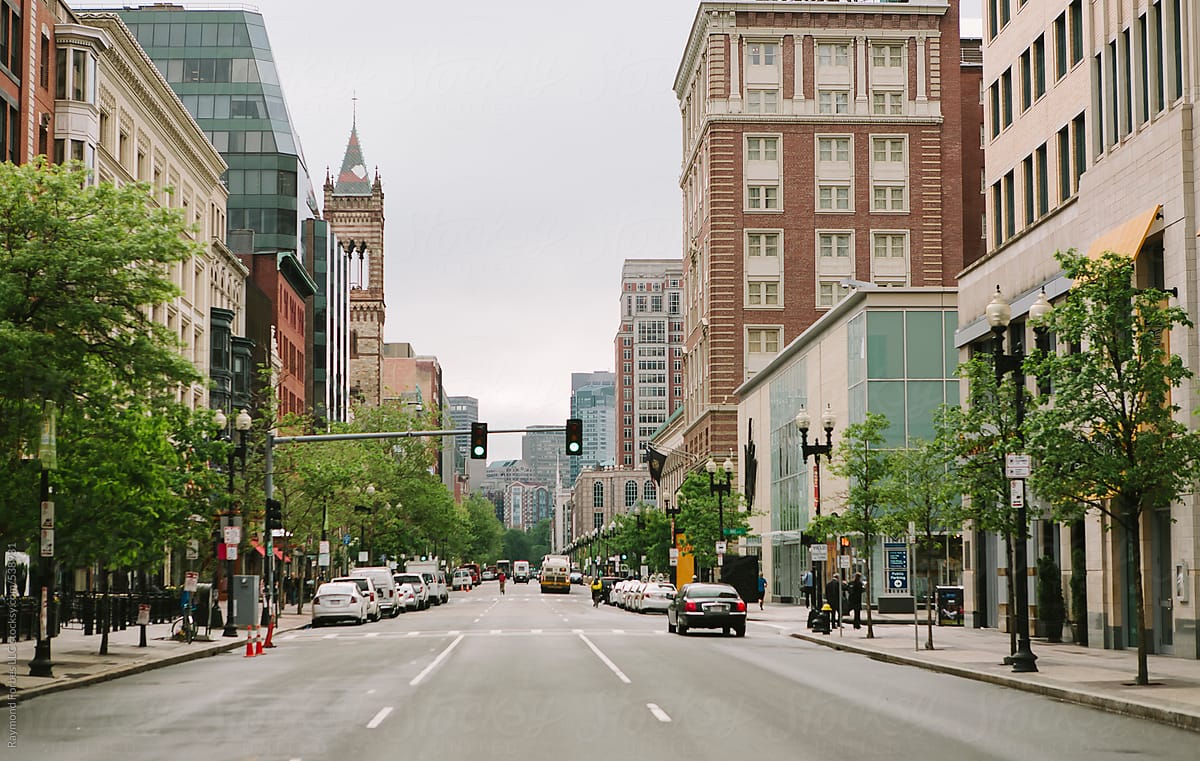
Walk down Boylston Street toward Copley Square and you can’t miss it. It’s that massive, rose-colored granite curve that looks like it belongs in a Batman movie—but, you know, a classy one. 500 Boylston Street Boston is one of those buildings that people either love or love to complain about. If you’ve ever lived in the city, you’ve probably used it as a landmark while trying to find the nearest Tatte or the Apple Store. It’s weirdly permanent. It’s imposing. Honestly, it’s a bit of a flex.
Completed back in 1989, this 25-story behemoth didn't just happen. It was a statement. Philip Johnson and John Burgee, the architects behind it, were basically the rock stars of the Postmodern movement. They wanted to move away from the "boring glass box" era of the 60s and 70s and bring back some drama. They succeeded. Depending on who you ask, they either saved the skyline or cluttered it up with too much stone.
The Architecture That Divided a City
Philip Johnson was already a legend when he designed 500 Boylston Street Boston. He had already done the AT&T Building in New York with its famous "Chippendale" top. For Boston, he went with a giant palladian window motif and that distinctively curved front. It creates this sort of formal plaza that feels very European, which was a huge departure from the cramped, colonial feel of the nearby streets.
Some people think it’s a masterpiece. Others, like former Boston Globe critic Robert Campbell, weren't always so kind. The building was part of a two-phase project, but the pushback was so intense that the second phase—the neighboring 222 Berkeley Street—had to be scaled back and redesigned by Robert A.M. Stern to feel more "Bostonian."
The granite itself is "Stony Creek" rose granite. It’s the same stuff used for the pedestal of the Statue of Liberty. If you stand at the base and look up, the scale is dizzying. The building doesn't just sit there; it looms. But it looms with style. You've got these massive bronze-framed windows and a lobby that looks like it should be hosting a gala for 1920s oil tycoons every single night.
Why the Office Space Actually Matters
You might think, "Okay, it's a pretty building, so what?" Well, it's home to some of the most influential firms in the world. We're talking MFS Investment Management. These guys basically invented the mutual fund in the 1920s. Having their headquarters here isn't an accident. In the world of high finance, your address is your business card.
The building offers about 715,000 square feet of office space. That's a lot of desks. But it’s the "Class A" designation that draws the big fish. In real estate speak, Class A means top-tier. It means the elevators work fast, the HVAC doesn't make weird clanking noises, and there’s a concierge who probably knows more about the city than most tour guides.
The Pop Culture Connection
If the building looks familiar and you’ve never been to Boston, you might be a TV nerd. 500 Boylston Street was the fictional home of the law firm Crane, Poole & Schmidt in the show Boston Legal.
James Spader and William Shatner spent years on a balcony that supposedly looked out from this building. The funny thing? The balcony doesn't exist. Not like that, anyway. Most of those exterior shots were filmed right there on the corner of Boylston and Berkeley, but the actual law office scenes were on a soundstage in California. Still, for a generation of viewers, this building is where Alan Shore gave his closing arguments. It gave the show a sense of "Old Boston" power that a modern glass tower just couldn't provide.
The Neighborhood Vibe
Being at 500 Boylston means you're at the epicenter of the Back Bay. You are steps away from Trinity Church and the Boston Public Library. This is the heart of the city’s 19th-century planned expansion.
Back in the 1800s, this whole area was literally a stagnant swamp—a "back bay." They filled it in with gravel from Needham, and it became the most prestigious neighborhood in New England. 500 Boylston is the modern anchor of that history. It’s surrounded by high-end retail like Marshalls (for the deals) and various boutiques (for the splurges).
You’ve also got some of the best food in the city nearby. Stephanie's on Newbury is a short walk away. Santouka Ramen is right there if you need a salt fix. The building itself has retail on the ground floor, keeping the sidewalk active. It's not a dead zone after 5:00 PM like some financial districts. People actually live, breathe, and shop around here.
Renovations and the Future of the Workspace
Ownership has changed hands a few times. Currently, Oxford Properties Group owns it. They’ve poured millions into keeping it relevant because, let's be real, a 1980s building can get "tired" pretty fast. They recently renovated the lobby and common areas to make them feel more "Boutique Hotel" and less "Corporate Fortress."
They added a rooftop terrace. That's the holy grail of Boston real estate. Space is tight in the Back Bay, so having a private outdoor area where you can look at the Charles River while answering emails is a massive selling point for tech and finance companies trying to lure workers back to the office.
The building also holds a LEED Gold certification. It’s sort of impressive when you think about it. You take this massive stone structure from forty years ago and retro-fit it to be environmentally conscious. It shows that the bones of the building are good enough to last another century.
Getting There (The Practical Stuff)
If you're visiting or have an interview at 500 Boylston Street Boston, don't bother driving. Boston traffic is a special kind of hell. The Green Line is your best friend. Get off at Copley Station. Walk half a block. You're there.
If you absolutely must drive, there is an underground garage, but be prepared to pay "Boston Prices." You might spend more on parking than you do on your lunch at the Prudential Center food court. Pro tip: if you’re just looking to see the architecture, grab a coffee at the nearby Pavement Coffeehouse and sit on one of the benches in Copley Square. You get the best view of the building's curve from across the street.
Is It Worth the Hype?
Look, 500 Boylston isn't the tallest building in the city—the Prudential and the Hancock (now 200 Clarendon) take those titles. But it has more "personality" than almost any other commercial tower in the area. It represents a specific moment in time when architects were allowed to be a little weird and developers were willing to spend money on pink granite.
It's a anchor. It’s a piece of television history. It’s a workplace for thousands of people who keep the city’s economy moving. Most of all, it’s a reminder that Boston isn't just about red brick and colonial steeples. It's a city that’s constantly layering the new on top of the old, even if it causes a few arguments along the way.
Practical Next Steps for Navigating 500 Boylston Street:
- For Architectural Enthusiasts: Visit the lobby during business hours to see the incredible barrel-vaulted ceiling and the transition between the outdoor plaza and the interior. It’s a masterclass in Postmodern scale.
- For Commuters: Utilize the Copley or Arlington MBTA stations (Green Line). The building is centrally located between both, making it accessible even during heavy snow days.
- For Business Visitors: Check in at the security desk in the main lobby; the building uses a modern badge-access system for all elevator banks, so ensure you have a digital or physical invite from the firm you are visiting.
- For Tourists: Use the courtyard as a shortcut between Boylston and St. James Avenue to get a feel for the "urban canyon" effect created by the building's massive wings.