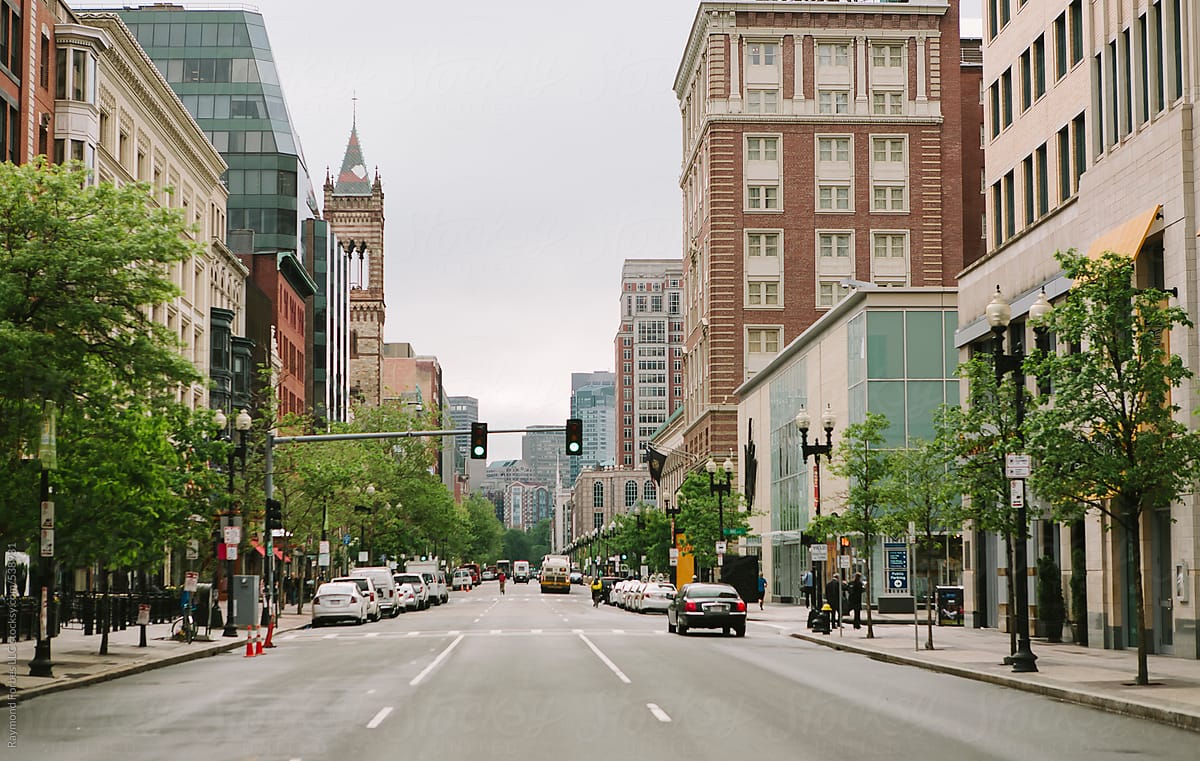
Walk down Boylston Street on a windy October afternoon and you can't miss it. The massive, rose-colored granite curves. Those giant columns that look like they belong in a Roman forum rather than a 1980s office block. Honestly, 500 Boylston St Boston MA is one of those buildings that people either absolutely love or secretly think is a bit "too much." But whether you’re a fan of the architecture or not, there is no denying that this site is the undisputed gravity center of the Back Bay’s business district.
It’s weird to think about now, but back in the early 80s, this spot was just a gap in the skyline. When Philip Johnson and John Burgee—the rockstars of the architecture world at the time—unveiled the plans, it sparked a massive debate. People were worried it would ruin the historic vibe of the neighborhood. Instead, it became the face of corporate Boston. You’ve probably seen it on TV without even realizing it; it was the "star" of the legal drama Boston Legal. If those walls could talk, they’d tell stories of billion-dollar hedge fund deals, high-stakes legal battles, and the slow evolution of how Bostonians actually work.
The Architecture That Divided a City
Philip Johnson wasn't interested in making a boring glass box. He wanted drama. 500 Boylston St Boston MA is the poster child for Postmodernism, a style that basically says, "Let's take old-school classical shapes and make them huge and slightly weird."
The building features a massive, six-story vaulted entry that feels more like a cathedral than a lobby. It uses Spanish Pink granite, which gives it that distinct warm glow when the sun sets over the Charles River. Some critics at the time called it "pompous." Others thought it was a brilliant bridge between the old Trinity Church nearby and the modern skyscrapers of the Financial District.
What’s really interesting is how the building handles the wind. If you've ever walked past the 25-story tower on a gusty day, you know that the "canyon effect" is real. The curved facade wasn't just an aesthetic choice; it was designed to help manage the airflow around the site, though anyone trying to hold onto an umbrella might disagree.
A Neighborhood Anchor
It isn't just an office building. It's a massive mixed-use ecosystem. You have roughly 1.3 million square feet of space when you combine it with its sister building at 222 Berkeley Street.
- Retail presence: The ground floor has hosted everything from high-end apparel to essential tech hubs.
- The Courtyard: That central plaza is one of the few places in the Back Bay where you can actually find a moment of semi-quiet away from the traffic.
- The "Boston Legal" Connection: Fans of the show still stop by to take photos of the exterior, imagining James Spader and William Shatner having a cigar on the balcony (which, fun fact, the real office tenants don't actually use for cigars as often as you'd think).
Who Actually Works There?
For a long time, 500 Boylston was the "it" address for financial services. It’s where the big money lived. Even as the Seaport district started pulling tech companies away from the traditional center, 500 Boylston St Boston MA held its ground. It’s managed by Oxford Properties, and they’ve spent a fortune keeping the interiors from feeling like a 1989 time capsule.
Today, you’ll find a mix of private equity firms, heavy-hitting law offices, and wealth management groups. The tenant roster has included names like MFS Investment Management and various high-profile lobbyists.
But it's not all starched collars. The building has had to adapt. In the post-pandemic era, the "amenity war" in Boston real estate is brutal. To keep companies from moving to shiny new glass towers in the West End or Seaport, 500 Boylston has leaned into its location. You are steps away from the Public Garden, the Pru, and some of the best steakhouse power-lunch spots in the country. That's a hard value proposition to beat.
The Real Estate Reality
Let's talk numbers, but not the boring kind. The valuation of 500 Boylston St Boston MA has fluctuated wildly with the interest rates of the mid-2020s. However, because it sits on top of a massive underground parking garage—a rare commodity in the Back Bay—the "dirt" it’s built on is worth a staggering amount.
Most people don't realize that the building is actually two distinct parts. There's the tower that everyone sees, and then there's the shorter, more ornate section that wraps around the corner. This was actually a compromise with city planners who didn't want a massive monolith overshadowing the smaller brownstones nearby.
The Controversy You Probably Forgot
Back in the late 80s, the development was so controversial that it actually changed Boston's zoning laws. There was supposed to be a "Phase II" that looked exactly like the first tower. But the public outcry against "Twin Towers" in the Back Bay was so loud that the developers had to pivot. That’s why 222 Berkeley Street looks so different from 500 Boylston, even though they are internally connected and managed as one complex.
It was a pivot that saved the skyline. Having two of these massive pink granite giants would have been suffocating. Instead, we got a bit of architectural variety that makes the block feel more like a city and less like a corporate campus.
Navigating the Area Like a Local
If you’re heading to 500 Boylston St Boston MA for a meeting or just to gawk at the columns, don't try to park on the street. Just don't. The meters are a myth and the tow trucks are fast.
- Use the T: The Green Line is your best friend. Get off at Arlington or Copley. It’s a five-minute walk from either.
- The Food Scene: If you’re trying to impress someone, you’ve got Grill 23 & Bar right nearby. If you just want a quick salad, there are plenty of spots in the Pru.
- The View: If you can get access to the upper floors, the view of the Charles River and the finish line of the Boston Marathon is unparalleled.
Why It Still Matters in 2026
The office market is weird right now. We all know that. But "Trophy" buildings—the ones with the best addresses and the most history—are the only ones staying full. 500 Boylston is the definition of a trophy building. It’s a status symbol. Telling a client "Our office is at 500 Boylston" still carries a certain weight that a suburban office park just can't match.
It’s about the "stickiness" of the location. You can work from home, sure. But can you walk out your front door and be at the Boston Public Library in three minutes? Can you have a three-martini lunch at a historic bar and then walk back to a desk with a view of the State House? That’s why firms keep renewing their leases here.
Practical Steps for Visiting or Leasing
If you're looking at 500 Boylston St Boston MA for your business or just visiting for a meeting, keep these things in mind:
- Security is tight. Don't expect to just wander into the elevator banks. You'll need a government-issued ID and a confirmed host to get past the lobby desks.
- Check the vents. If you're looking at office space, ask about the recent HVAC upgrades. The building has undergone significant "green" retrofitting to meet Boston's increasingly strict BERDO (Building Emissions Reduction and Disclosure Ordinance) requirements.
- The Marathon Factor. Remember that every April, this building is basically at Ground Zero for the Boston Marathon. Access is limited, the energy is insane, and it’s one of the best days of the year to be in the office—if you can get there.
The building isn't just a collection of offices; it's a piece of Boston’s identity. It represents a specific moment in time when the city was moving away from its gritty past and trying to become a global financial powerhouse. Every time you see that pink granite against a blue New England sky, you're looking at the ambition of the 80s refined for the modern world.
If you are planning a visit, check the local MBTA schedules for the Green Line or utilize the ride-share drop-off points specifically designated on the Berkeley Street side to avoid the Boylston Street bus lane chaos. For those scouting office space, prioritize the north-facing suites; the light quality coming off the river is significantly better for long workdays than the southern exposure which can get quite hot in the summer months.