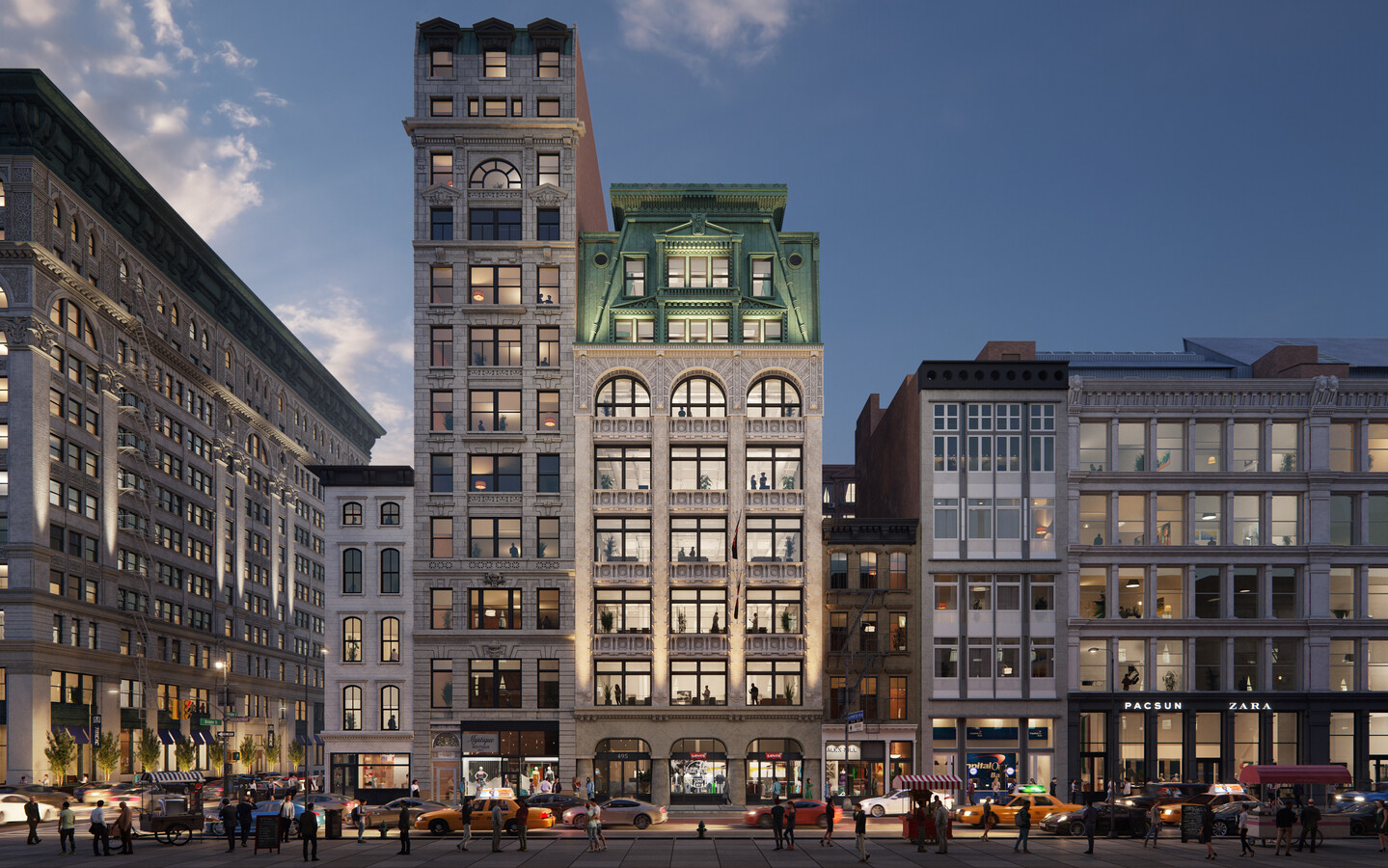
You’ve probably walked right past it. If you’ve ever spent a Saturday dodging tourists and shopping bags between Spring and Broome Streets, you’ve definitely been in its shadow. Most people just see the massive Levi’s storefront on the ground floor and keep moving. Honestly, that’s a mistake.
The building at 495 Broadway is a survivor. Known formally as the New Era Building, it stands out because it looks like it was plucked straight out of a Parisian boulevard and dropped into the middle of Manhattan’s cast-iron district. While everyone else in the 1890s was obsessed with heavy, blocky Beaux-Arts styles, the architect here decided to do something completely different. Also making waves recently: The Night the Nursery Walls Dissolved.
The Weird History of the New Era Building
Back in 1893, SoHo wasn't the high-end retail maze we know today. It was a gritty, industrial hub. 495 Broadway was designed by Alfred Zucker, a name that doesn't always get the same shine as Stanford White, but Zucker had a vibe. He built this for Augustus D. Juilliard—yes, that Juilliard family—and the original plan was for it to be a printing house.
It never actually became a printing plant. Further insights into this topic are covered by Lonely Planet.
Instead, it became the headquarters for the Butler Brothers. Think of them as the Amazon of the late 19th century. They were a massive mail-order company that basically pioneered the "five and dime" store concept. By the time they moved in, they had over 100,000 customers. You can almost picture the horse-drawn carriages clattering over the cobblestones on Mercer Street to pick up crates of goods from the building's rear entrance.
That Time it Almost Fell Down
New York history is usually written in fire. On December 29, 1927, a massive blaze broke out in the basement shipping room. It wasn't just a small fire; it did over a million dollars in damage—in 1927 money.
The heat was so intense that the hollow cast-iron columns in the back of the building actually buckled. Imagine eight floors of heavy industrial equipment and mail-order inventory just... dropping. A massive section of the building toward the Mercer Street side collapsed entirely. If you look at the structure today, it’s a miracle it was ever rebuilt to its former glory.
Architecture That Doesn't Fit (In a Good Way)
What makes 495 Broadway weirdly beautiful is the Art Nouveau influence. In a neighborhood dominated by cast-iron, this building uses brick, masonry, and a whole lot of copper.
- The Columns: At the base, you’ve got these four squat, rounded Doric columns. They look like they’re straining under the weight of the building, which is a classic Zucker move.
- The Arches: By the time your eyes get to the sixth floor, the masonry opens up into three huge, sweeping arches.
- The Roof: This is the "look up" moment. It has a two-story copper-fronted mansard roof. Over the decades, the copper has oxidized into that beautiful, ghostly verdigris green. It’s the kind of roof that makes you feel like you’re in 19th-century France rather than 21st-century New York.
The facade has been restored to a bright, crisp white terra cotta. Up close, the detailing around those upper arches looks almost like it was carved out of ivory. It’s a "gem" in the literal sense—a polished, bright spot in a sea of darker industrial lofts.
Who’s Hiding Inside 495 Broadway Today?
It’s not just jeans and tourists. Above the retail level, the building is a 90,000-square-foot ecosystem of creative and tech companies. It’s currently owned and managed by WB Property Group, and they’ve kept it surprisingly high-end.
For nearly twenty years, the Swiss Institute of Contemporary Art called the third floor home before moving to Wooster Street. Today, the tenant list is a "who’s who" of fashion and lifestyle brands. You’ve got the high-end custom shirtmaker Proper Cloth, the luxury fashion label Proenza Schouler, and even a fitness club called Drive 495.
Honestly, the rent isn't cheap, but it's "SoHo affordable" compared to the glass towers further uptown. Asking prices for office space here usually hover around the $78 to $90 per square foot range. For a building with 24/7 access, a lobby attendant, and those massive loft windows, that’s actually a decent deal for a TAMI (Technology, Advertising, Media, and Information) company.
Why You Should Care
We spend a lot of time looking at our phones while walking through SoHo. 495 Broadway is a reminder to look up. It’s one of the few remaining examples of early Art Nouveau in the city. It survived a catastrophic collapse, outlasted the death of the mail-order industry, and transitioned from a warehouse to a fashion hub without losing its soul.
Next time you’re in the area, stop across the street. Don't look at the mannequins in the window. Look at the verdigris roof against the sky. Look at the terra cotta arches. It’s a piece of 1893 that still feels incredibly modern.
Practical Tips for Visiting
- Best View: Stand on the west side of Broadway, near the corner of Broome Street, to get the full scale of the copper roof.
- The "Secret" Side: Walk around to 66-68 Mercer Street. This is the back of the building where the 1927 collapse happened. The contrast between the Broadway facade and the Mercer Street side tells the real story of the building's industrial past.
- Getting There: It's a five-minute walk from the Prince Street (N, R, W) or Spring Street (6, C, E) subway stations.
If you’re a fan of New York architecture, 495 Broadway is a mandatory stop. It’s not a museum, but it’s a living, breathing part of the city’s history that you can actually walk into. Just try not to get distracted by the denim on your way in.
Actionable Insight: If you're interested in New York's architectural history, download the NYC Landmarks Preservation Commission's map of the SoHo-Cast Iron Historic District. 495 Broadway is listed as a primary contributing structure, and the report provides a deep dive into the specific masonry techniques used to save the building after the 1927 fire. For those looking to lease, reaching out to WB Property Group directly is the move; they've been the long-term stewards of the property and often have off-market loft spaces available for creative firms.