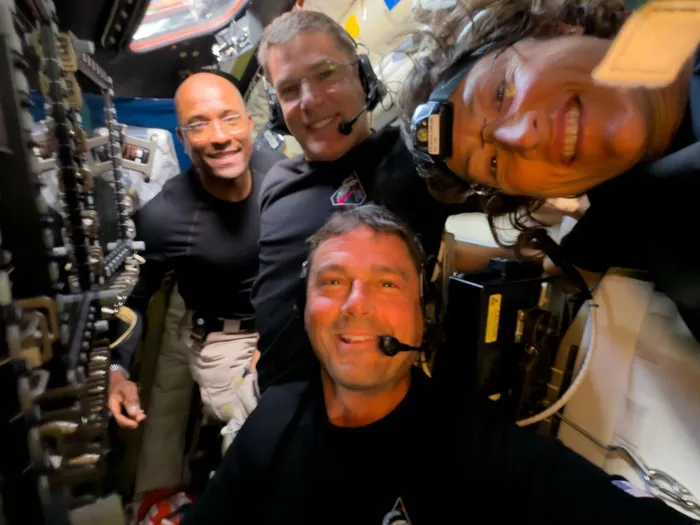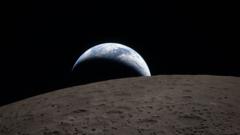
NASA just dropped a new batch of high-resolution images from its latest lunar fly-by. You’ve seen the headlines. "Awe-inspiring." "Breathtaking." "A historic view of Earthset." The internet is currently tripping over itself to hit the share button on a photo of a blue marble hanging in a void.
It is a beautiful distraction. It is also an expensive piece of PR theater designed to mask a fundamental lack of original thinking in modern space exploration.
The media treats these images like a technological breakthrough. They aren't. We have been taking pictures of the Earth from the Moon since the Lunar Orbiter 1 in 1966. We have been staring at "Earthrise" for over half a century. If your standard for "progress" in a multi-billion dollar space program is a higher-megapixel sensor on a familiar flight path, you aren't looking at a mission; you're looking at a screensaver.
The Resolution Trap
The general public has been conditioned to equate image quality with scientific value. It’s the "CGI Effect." Because the latest fly-by images are crisp, 4K, and color-corrected, we feel like we are getting closer to the stars.
We aren't. We are getting closer to a marketing department's vision of the stars.
The optics used in these missions are undeniably impressive, but the raw data—the stuff that actually matters for geological mapping, thermal analysis, and radiation shielding—rarely makes the front page. Instead, we get "Earthset." We get the emotional hit.
Why? Because NASA is a federal agency that needs to justify its budget to a taxpayer base with a three-second attention span. High-def photos are the easiest way to buy another year of funding without having to explain why we still haven't solved the long-term biological effects of cosmic rays on human tissue.
The Physics of Failure
Let’s talk about the real numbers. The energy required to move mass out of Earth’s gravity well is dictated by the Tsiolkovsky rocket equation:
$$\Delta v = v_e \ln \frac{m_0}{m_f}$$
In this equation, $v_e$ is the effective exhaust velocity, $m_0$ is the initial total mass (including propellant), and $m_f$ is the final total mass. The math is brutal and unforgiving. Every gram of high-end camera equipment, every specialized lens, and every bit of shielding for those sensors is mass that isn't being used for life support, fuel, or actual scientific instrumentation.
I have sat in rooms where engineers argued over milligram tolerances. I have seen projects delayed by months because of weight distribution. When a mission spends its precious mass allowance on "public outreach" sensors instead of experimental propulsion or autonomous mining rigs, it is a conscious choice to prioritize optics over advancement.
We are trading $m_f$ for Instagram likes.
The Illusion of the "New Space Race"
The competitor articles love to frame these fly-bys as the dawn of a new era. They use words like "pioneering" to describe a mission profile we mastered during the Nixon administration.
The "New Space Race" is currently a branding exercise. While SpaceX and Blue Origin argue over launch pad leases, the actual technology of moving through space hasn't fundamentally shifted. We are still burning chemical propellants. We are still riding explosions into orbit.
The fly-by images serve a specific purpose: they make it look like we are doing something new while we are actually just perfecting the old. If we were serious about being a multi-planetary species, the headlines wouldn't be about a photo of an eclipse; they would be about the first successful test of a nuclear thermal rocket (NTR) in vacuum.
Dismantling the "Awe" Argument
"But it inspires the next generation!"
This is the standard defense. It’s also a lie. True inspiration comes from capability, not imagery. The generation that watched the Apollo landings didn't go into STEM because the photos were pretty—they went because the feat was impossible. They went because we were doing something that hadn't been done.
Showing a ten-year-old a 4K version of a photo their grandfather saw in 1968 isn't inspiration. It’s a reboot. It’s the Hollywood-ization of science. We are giving them the "Force Awakens" of space exploration—familiar beats, better special effects, but no new story.
The Data We Aren't Seeing
While you’re staring at the "breathtaking" curve of the lunar horizon, here is what isn't being discussed:
- Micro-Meteoroid Impact Stats: The real danger of the lunar environment is the constant rain of high-velocity dust.
- Regolith Toxicity: Lunar dust isn't just dirt; it's jagged, electrostatic glass that destroys lungs and seals.
- The Logistics of Sustenance: We still haven't figured out how to keep a human alive on the Moon for 365 days without a constant, prohibitively expensive umbilical cord to Earth.
If NASA released a 500-page report on the failure rates of lunar habitat seals, nobody would read it. So they release a photo of an eclipse.
The Opportunity Cost of the Aesthetic
Every dollar spent on high-fidelity visual telemetry for public consumption is a dollar not spent on the "boring" stuff that actually wins wars and builds civilizations.
We need better batteries. We need closed-loop life support that doesn't fail after six months. We need to solve the bone density loss issue caused by low gravity ($1.62 \text{ m/s}^2$ on the Moon vs $9.8 \text{ m/s}^2$ on Earth).
If we keep prioritizing the "visual" mission, we will end up with the most beautifully documented failure in history. We will have 8K footage of the first Mars colony as it runs out of oxygen because we spent the last twenty years focusing on the camera instead of the scrubber.
Stop Looking Up
The "Earthset" photo is designed to make you feel small. It's designed to make you feel that "we are all in this together" on a "pale blue dot."
That sentiment is the enemy of exploration. Exploration is about being big. It’s about leaving the dot. It’s about recognizing that the Earth is a cradle, and you don’t stay in the cradle forever just because it looks nice from the hallway.
NASA's latest images aren't a milestone. They are a mirror. They show us exactly where we were sixty years ago, just with fewer scan lines.
If you want to be impressed, stop looking at the pictures. Start looking at the propulsion specs. Start looking at the mass-to-orbit costs. Start looking at the things that don't make for a good desktop background.
The Moon isn't a photo op. It's a stepping stone. And you don't look at a stepping stone—you step on it and move the hell on.